
Key Takeaways:
- EU China trade tensions were marked by Ursula von der Leyen as an unsustainable €1 billion daily trade deficit.
- Brussels set an October deadline for concrete progress on trade and market access.
- The EU is creating a mechanism to reduce its heavy reliance on Chinese minerals.
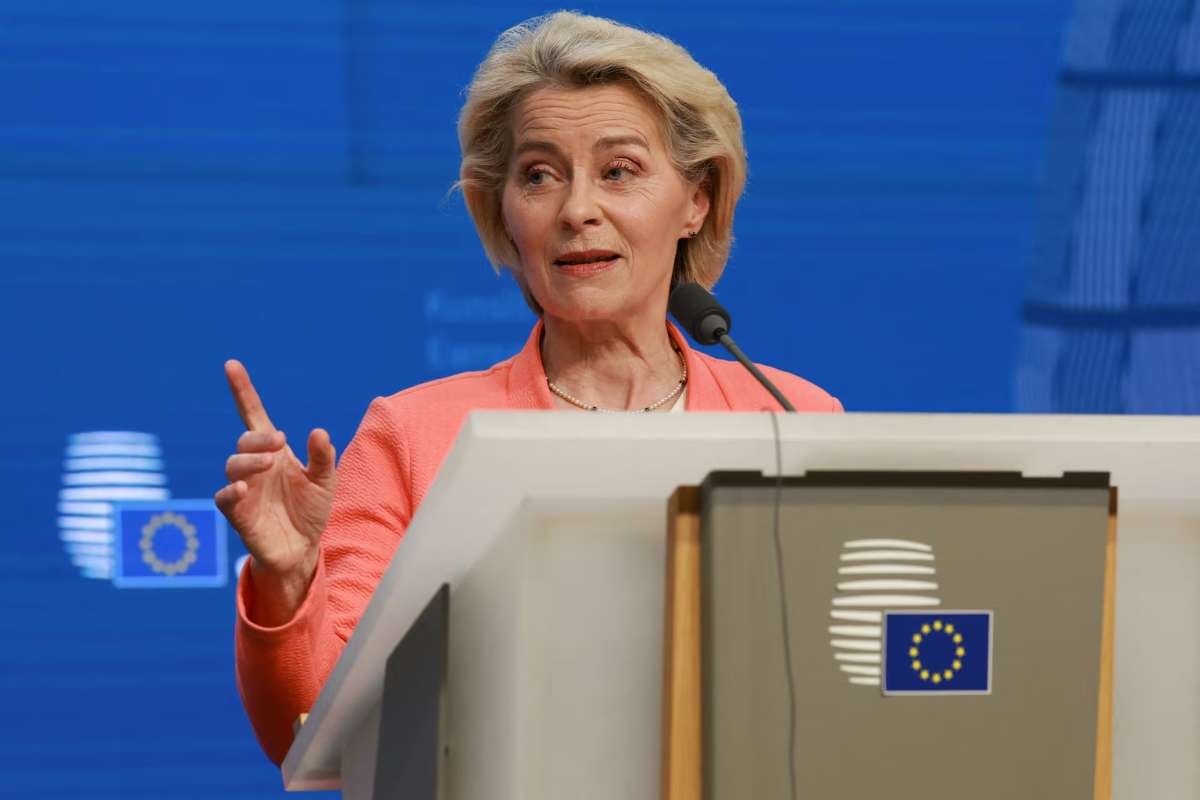
European Commission President Ursula von der Leyen said Sept. 16 that the European Union will use all available tools to address EU China trade tensions, citing a €1 billion daily goods deficit and growing reliance on Chinese raw materials.
EU China trade tensions reach a tipping point
Von der Leyen made the remarks during her annual State of the Union address to the European Parliament in Strasbourg, France. She said the trade imbalance had reached a tipping point and warned that a new wave of Chinese industrial exports was already putting pressure on European manufacturing.
“Our trade deficit with China is now €1 billion a day. It has reached a tipping point,” von der Leyen said. She described the situation as a “second China shock” and said it was contributing to deindustrialization in European industrial regions.
The European Commission president said Brussels remains engaged in talks with Beijing but expects those discussions to produce measurable results. “Words are good. But deeds are better,” she said, while warning that the bloc would use its available trade tools to address the imbalance.
EU Trade Commissioner Maroš Šefčovič has set October as a target for tangible progress in negotiations with China. The October deadline comes as EU China trade tensions intensify over market access, industrial exports and trade imbalances. The talks cover trade and investment, export controls, intellectual property rights and World Trade Organization reform.
EU moves to reduce critical raw material dependence
Von der Leyen also highlighted the bloc’s dependence on China for critical raw materials. She said the EU relies on China for more than 80% of many critical raw materials and about 90% of some rare earths.
The Commission plans to establish a European cooperation mechanism for critical raw materials to help secure supplies and build reserves. The materials are important for electric vehicles, chips, batteries, clean technology and defense industries, according to the European Commission.
The move comes as European officials seek to reduce supply risks while keeping trade talks with Beijing open. In June, Šefčovič said the EU and China had agreed to create a joint mechanism to monitor trade flows and identify sudden increases in imports.
China urges EU to avoid protectionism
China has continued to call for dialogue and has warned against measures it considers protectionist. Foreign Minister Wang Yi said China and the EU should maintain openness and resolve trade disputes through constructive dialogue.
“Protectionism cannot enhance Europe’s competitiveness,” Wang said, according to remarks reported after a Sept. 16 call with French Foreign Minister Jean-Noël Barrot. He said China’s market should be viewed as an opportunity for Europe rather than a challenge.
Chinese Foreign Ministry spokesperson Guo Jiakun also said on Sept. 16 that discriminatory restrictions would hurt European companies and weaken confidence among foreign investors. Beijing has repeatedly urged the EU to avoid protectionist policies as trade tensions increase.
The EU-China discussions now face an October checkpoint as EU China trade tensions continue to shape the bloc’s trade relationship with Beijing.