
There comes a point where the business you built starts standing on its own. The late nights, the constant decision-making, and the constant need to prove yourself begin to settle into something stable. In that space, a new question starts to form. After everything you have created, what do you want for yourself next?
For women entrepreneurs, that shift is not just about timing or valuation; it is about ownership of the journey ahead. Female founder exit strategies bring clarity to that moment, helping you decide how to step away while protecting what you built.
Exit strategies are planned ways for founders to transition out of their business, whether through selling, transferring leadership, or gradually stepping back while securing their financial and personal goals.
Why exit planning is different for female founders
Most exit playbooks assume easy access to capital, strong networks, and steady deal flow. Reality often looks different. Growth may happen with tighter budgets and fewer early opportunities. This does not reduce business quality, but it changes how buyers judge value. Clear traction, solid margins, and a sharp story carry more weight in these cases. This is why female founder exit strategies often require a more deliberate approach.
Deals rarely begin in formal rooms. They grow through trust, repeat interactions, and consistent visibility over time. When fewer buyers enter the process, pricing power can weaken. A wider network can improve both deal interest and final terms. Building these connections early gives more control during negotiations.
Early equity decisions start to show their impact here. Holding a higher stake can protect control, while early dilution can support faster growth. Each path brings tradeoffs during an exit. At the same time, team stability and brand value often influence decisions, even when they are not fully reflected in price.
Exit planning works best when it runs alongside growth. It should stay active at every stage. A clear plan helps maintain control, improve leverage, and secure stronger outcomes.
The 6 different types of female founder exit strategies
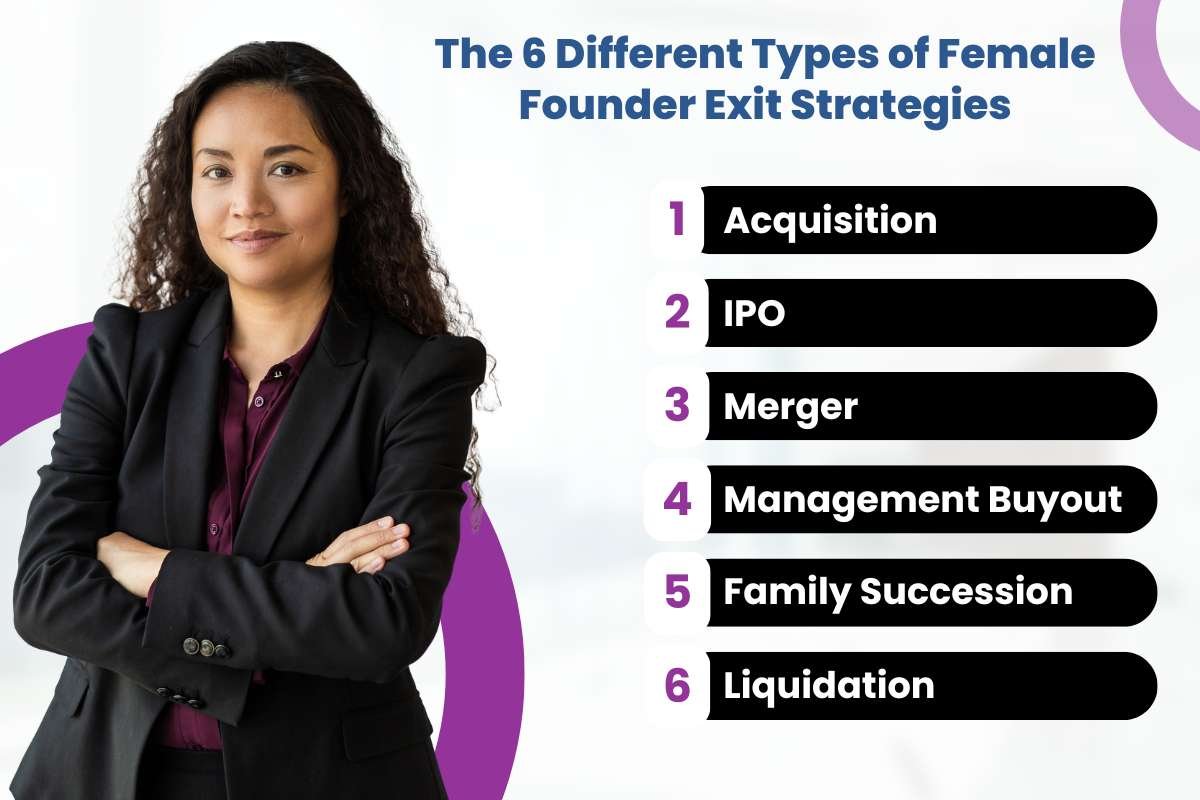
Each of these exit paths offers a different balance of control, risk, and return. There is no single best option. The right choice depends on how the business has grown, what the market looks like, and what the founder wants from the exit.
Understanding these differences is only the first step. The real value comes from knowing which path fits your situation and when to act.
1. Acquisition
An acquisition is one of the most direct exit paths. A founder sells the company to another firm or investor group for cash, stock, or both. The outcome depends on the type of buyer and the intent behind the deal. Strategic buyers are companies in the same space. They want synergy, such as product fit, market access, or talent. This makes it one of the most common female founder exit strategies.
Pros
- Potential for high valuation with the right buyer
- Faster exit compared to other routes
- Access to larger resources and distribution
Cons
- Loss of control after the sale
- Cultural or vision misalignment with the buyer
- Earnouts or conditions may delay full payout
2. IPO
An IPO allows a company to go public and raise capital from public investors. It works best when the business shows strong growth, stable revenue, and clear demand in the market. This path can unlock large funding and visibility, but it also brings strict compliance, constant reporting, and pressure from market expectations.
Pros
- Access to large capital pools
- Strong brand credibility and visibility
- Liquidity for founders and early investors
Cons
- High compliance and regulatory costs
- Market swings can impact valuation
- Ongoing public and investor pressure
3. Merger
A merger brings two companies together into a single entity. These deals are often driven by synergy, where both sides gain from shared products, markets, or operations. While the combined business may grow stronger, control gets shared, and leadership structure often changes.
Pros
- Improved market position and scale
- Shared resources and cost efficiency
- Opportunity for a higher combined value
Cons
- Reduced control and decision power
- Integration and culture challenges
- Possible conflict in leadership vision
4. Management buyout
A management buyout allows the internal team to purchase the company and take control. This is one of the smoothest female founder exit strategies, as the buyers already understand the business. It offers stability and continuity, but valuations may be lower compared to external deals.
Pros
- Smooth transition with minimal disruption
- Strong cultural and operational continuity
- Faster alignment during the deal process
Cons
- Lower valuation compared to external buyers
- Limited access to large capital
- Heavy financial burden on the internal team
5. Family succession
Family succession passes the business to the next generation. This path focuses on legacy, control, and continuity of vision. It keeps ownership within the family, but execution can be complex due to skill gaps and internal dynamics.
Pros
- Preserves legacy and long-standing vision
- Maintains control within the family
- Strong emotional and cultural continuity
Cons
- Risk of unprepared successors
- Family conflicts can impact decisions
- May limit growth or external opportunities
6. Liquidation
Liquidation involves closing the business and selling its assets. It is usually considered when growth stalls, losses increase, or no viable buyer is found. This path provides a clean exit, but often results in lower financial returns.
Pros
- Simple and clear exit process
- Immediate closure of liabilities
- No dependency on buyers
Cons
- Lower financial returns
- Loss of brand and business value
- Impact on employees and stakeholders
How to choose the right exit strategy?
- Match Business Stage with Exit Type
- Study Industry Exit Trends
- Align Financial Goals with Deal Structure
- Weigh Control Against Capital
- Time, the Market, and the Business
Choosing the right path within female founder exit strategies starts with clarity on where the business stands. Early-stage companies often attract acquisitions, while growth-stage firms may fit mergers or financial buyers. Mature businesses with stable revenue can explore a public listing. Industry patterns add another layer, as some sectors see more acquisitions while others lean toward mergers or internal transitions. Looking at recent deals helps set clear expectations.
Financial goals guide the structure of the exit. Some founders aim for a full cash payout, while others accept phased exits with future upside. At the same time, every deal involves a tradeoff between control and capital. Higher payouts often come with reduced control, while partial exits allow continued involvement but may limit immediate gains.
Timing ties everything together. Strong markets can improve deal value and attract more buyers, while weak cycles can slow the process. Internal readiness matters just as much, including clean financials and steady growth. When both align, the chances of a strong exit increase.
How to maximize exit value?
A strong exit does not happen at the end. It builds over time through clear performance and steady growth. Buyers look for clean financial records, predictable revenue, and margins that hold up under pressure. When the numbers are easy to trust, the process moves faster, and the valuation stays firm.
Brand strength adds another layer of value. A business with clear positioning and loyal customers stands out in a crowded market. It feels harder to replace, which can push buyers to pay more. At the same time, operations should run without heavy founder involvement. Simple systems and a reliable team make the business easier to transfer and scale.
Partnerships and leadership also influence the final outcome. Strong ties with partners can show stability and open new growth paths. A capable leadership team reduces risk while implementing female founder exit strategies. When the business runs smoothly without the founder, buyers step in with more confidence and better terms.
Whitney Wolfe Herd and bumble IPO exit case study

One of the best cases of female founder exit strategies is that of Whitney Wolfe Herd.
Whitney Wolfe Herd built Bumble into a global platform with a strong brand and clear user growth. In 2021, the company went public on the NASDAQ under the ticker BMBL, marking one of the most visible exits led by a female founder. The company filed its official registration with the U.S. Securities and Exchange Commission, detailing its financials, growth, and business model.
The structure of this exit shows strong preparation. The filing highlights revenue growth, paying users, and a clear product position built around women’s first interactions. This gave investors confidence and supported a strong market entry. Going public allowed liquidity for early stakeholders while still keeping leadership involved.
What this shows
This case shows how disciplined growth, strong brand identity, and clear financial reporting drive exit value. The timing aligned with high investor interest in tech platforms, which helped secure a strong valuation. It highlights how preparation and positioning can turn a public listing into a powerful exit path.
Conclusion
At some point, the focus shifts from building something valuable to deciding how that value fits into your life. The business may continue to grow, but your role in it does not have to stay the same. That choice, when made intentionally, can feel just as powerful as the decision to start.
For many women entrepreneurs, stepping back is about stepping forward into something new. Well-planned female founder exit strategies give you the freedom to shape that transition on your terms, protect what you have created, and carry your momentum into the next chapter with clarity and confidence.
People Also Ask
1. What is the most common exit strategy?
The most common option is selling the business, often through acquisition. It allows founders to unlock value while transferring ownership.
2. What challenges do female founders face while planning an exit strategy?
They may face limited access to networks, valuation bias, and fewer mentorship opportunities. Balancing personal goals with business decisions can also add complexity.
3. What are the risks of female founder exit strategies?
Risks include undervaluation, loss of control, and poor transition planning. Without preparation, the exit may not align with long-term financial or personal goals.
Source:
https://www.sec.gov/Archives/edgar/data/1830043/000119312521009745/d20761ds1.htm