
Social entrepreneurship funding strategies focus on how impact-driven ventures secure capital while balancing mission, control, and long-term sustainability. This article explores seven key funding options and also provides a step-by-step approach to choosing the right funding path.
Not every idea is built purely for profit. Some are driven by a need to solve real problems, create impact, and still find a way to sustain themselves along the way. That balance is where things start to get complicated.
You might have a strong mission, a clear purpose, even early traction, but when it comes to funding, the usual paths do not always fit. Traditional investors look for scale and returns. Grants come with limits. Donations can be unpredictable. It is rarely a straight line.
Social entrepreneurship funding strategies sit right in the middle of this tension. They influence how impact-driven ventures secure resources without losing sight of why they started in the first place, turning funding into something that supports both purpose and progress.
In this article, we will take a look at some of these strategies and how to pick one that is best for you.
The 7 social entrepreneurship funding strategies that support social impact

Before you choose a funding path, you need to understand how each option works in practice. Every strategy comes with its own level of risk, control, and effort. Some give quick access to capital, while others take time but offer long-term stability.
The following Social Entrepreneurship Funding Strategies break down these options so you can match them with your mission, stage, and growth goals.
1. Grants
Grants give you capital that you do not repay. Governments, foundations, and global programs offer them to support social impact work. You apply with a proposal that explains your mission, target group, and expected results.
This funding helps you reduce risk in the early stage. You can test ideas, run pilot programs, and build your model without worrying about repayment or ownership loss. It gives you time to refine your approach before scaling.
Grants come with strict rules. You must track progress, submit reports, and use funds as approved. Funding is often short-term, so you need a plan for what comes next.
Best for: Early-stage ventures and pilot projects
2. Impact investing
Impact investing funds businesses that create profit and measurable social change. Investors expect returns, but they also track real outcomes using data. You must show how your model earns and creates impact at the same time.
This works best when your business has traction. Investors look for growth potential, clear metrics, and a path to scale. You need proof that your idea works in real conditions.
Investors often support you beyond money. They guide strategy and open networks, but they expect performance in return.
Best for: Growth-stage enterprises with scalable impact
3. Crowdfunding
Crowdfunding raises money from a large group of people through online platforms. You present your idea, share your story, and collect small contributions from supporters.
It is one of the social entrepreneurship funding strategies that helps you validate your idea. If people fund your campaign, it shows demand and builds early trust. You also create a community around your mission.
But it requires strong promotion. You must market your campaign, stay active, and keep supporters engaged to reach your goal.
Best for: Idea validation and community-driven projects
4. Revenue-based funding
Revenue-based funding gives you capital in exchange for a share of future revenue. You repay based on how much your business earns, so payments adjust with your income.
You keep full ownership, which gives you control over decisions. This makes it attractive for founders who want growth without giving equity.
You need stable revenue to qualify. Investors check your cash flow before funding, so this option suits businesses that already earn.
Best for: Revenue-generating businesses seeking flexible repayment
5. Debt financing (loans)
Debt financing gives you capital that you repay with interest over time. Banks and financial institutions offer these loans based on your credit and revenue history.
You keep full ownership, which allows you to make decisions without investor pressure. This can help you maintain focus on your mission.
Repayment is fixed, which creates risk during low revenue periods. Lenders also require strong financial records, which can limit access for early-stage ventures.
Best for: Stable businesses with predictable income
6. Equity funding
Equity funding gives you capital in exchange for ownership in your business. You sell a share to investors and use the funds to grow faster.
Investors often bring more than money. They guide your strategy and connect you with networks that support expansion. You give up part of your control. Investors may push for faster returns, so your mission must align with their expectations.
This can help you scale faster in competitive markets, which is why this is one of the best social entrepreneurship funding strategies.
Best for: High-growth social enterprises aiming to scale
7. Corporate partnerships
Corporate partnerships connect you with large companies that support social impact projects. They may provide funding, resources, or access to wider markets.
These partnerships boost your credibility and help you scale faster. You gain reach and operational support that would take years to build alone. These partnerships also help you scale faster without increasing your fixed costs.
You must align goals clearly. Both sides need shared values and defined roles to avoid conflict. Over time, strong partnerships can turn into long-term funding and growth channels.
Best for: Scaling operations and expanding reach
Ok, now you know all the different ways to fund your social enterprise. But how do you know which of these strategies suits you best? Fear not, we have you covered.
Read More:
- Biggest Mistakes Social Enterprises Make That Stop Real Growth
- How 10 Women-Led Social Enterprises Match Profit with Purpose
How to choose the right funding strategy: a step-by-step guide
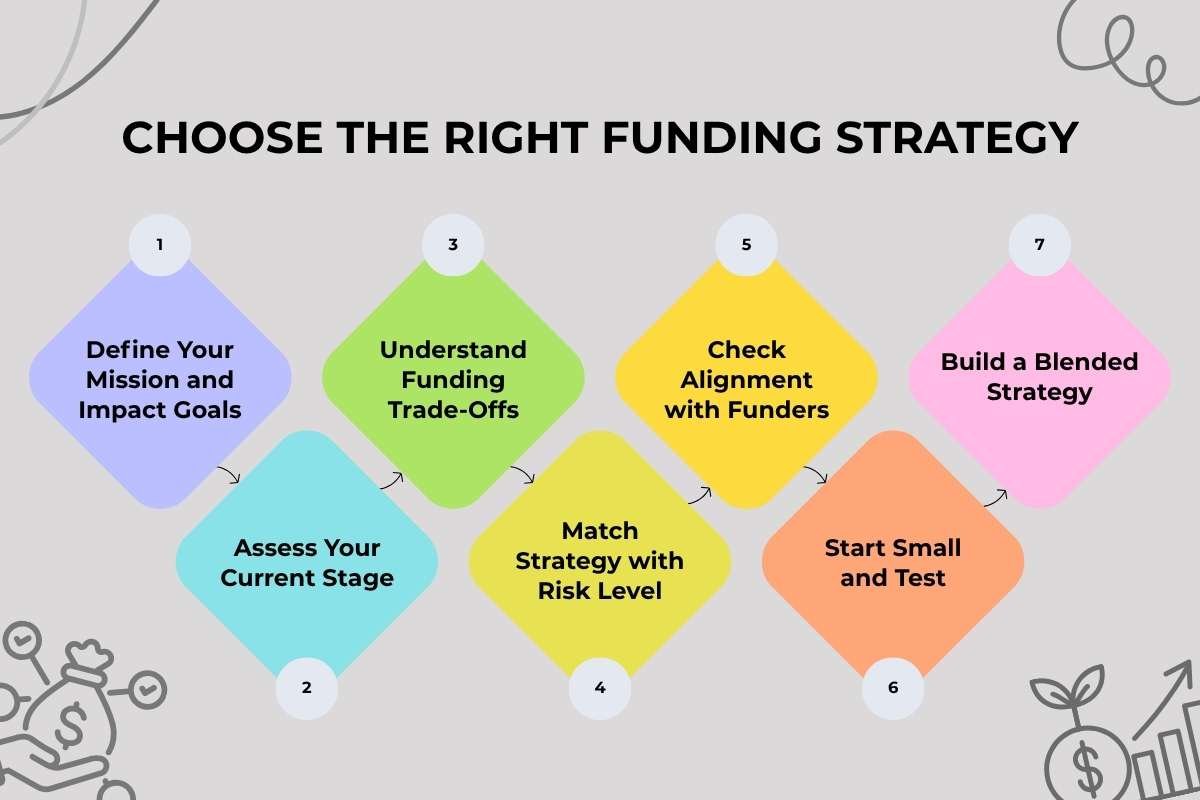
Choosing the right funding path can shape how your social venture grows. Each option comes with trade-offs. Some give you control, while others bring scale and speed. You need to match your funding choice with your mission, stage, and risk level. Here is how you choose the social entrepreneurship funding strategies that are suitable for your business:
Step 1: Define your mission and impact goals
Start with clarity. What problem are you solving, and who benefits from it? Write down your core impact goals in simple terms. This will help you avoid funding sources that push you away from your purpose.
Clear goals also help you communicate better with funders. They want to see focus and direction. If your mission feels vague, you may attract the wrong type of funding.
Step 2: Assess your current stage
Your funding needs depend on where you stand today. Early-stage ventures often rely on grants, crowdfunding, or personal savings. Growth-stage ventures can explore impact investors or partnerships.
Be honest about your numbers. Look at your revenue, costs, and growth rate. This helps you avoid raising more money than you can manage.
Step 3: Understand funding trade-offs
Every funding source comes with conditions. Equity funding means sharing ownership. Loans require steady repayments. Grants may limit how you use funds.
List what you are willing to give up. Control, profit share, or flexibility. This step helps you avoid regret later.
Step 4: Match strategy with risk level
Some social entrepreneurship funding strategies carry more risk than others. Loans can create pressure if your income is unstable. Equity funding may reduce your power to make decisions.
Choose a strategy that fits your comfort. But it should also be moderately risky. If your revenue is not stable, avoid heavy debt. If control matters, limit equity deals.
Step 5: Check alignment with funders
Not all money is good money. Some investors may push for profit over impact. Others may support your mission fully.
Study your funders before you pitch. Look at their past investments and values. Strong alignment leads to long-term support.
Step 6: Start small and test
You do not need to go all in at once. Start with one funding method and test how it works. For example, try crowdfunding before seeking large investors.
This gives you real feedback. It also builds proof that your idea works in the market. Small experiments also help you spot risks early before they grow into bigger problems. They give you data you can use to improve your pitch and funding strategy.
Step 7: Build a blended strategy
Depending on one funding source can create risk. If that source fails, your entire operation can slow down. A single stream also limits flexibility in decision-making.
Most successful social ventures use more than one funding source. They mix grants, revenue, and investments. This reduces risk and improves stability. A blended approach gives you flexibility.
Social entrepreneurship funding trends in 2026

Funding for social entrepreneurship is now driven by a large financing gap. According to the World Economic Forum, social enterprises are seeking about $1.1 trillion in external funding beyond personal savings. This highlights the scale of unmet demand and the need for better funding access.
Social entrepreneurship funding strategies are shifting to close this gap. Blended finance is growing, where grants reduce risk and attract private investors. At the same time, sector-focused funds are increasing. This helps founders find aligned capital but also raises competition within each sector.
Early-stage funding is improving, but expectations are higher. Accelerators and impact funds now demand clear proof of outcomes. Investors want simple metrics and long-term viability. Social entrepreneurs must show both impact and financial discipline to secure funding.
Conclusion:
Funding leaves fingerprints on everything. The pace of growth, the kind of decisions that get made, and even the way impact is measured over time. It is rarely neutral.
For ventures built around purpose, that influence runs deeper. The wrong fit can quietly pull things in a direction that was never intended, while the right mix can create room to grow without constant friction.
Looking at social entrepreneurship funding strategies through that lens shifts the focus. It becomes a question of alignment, timing, and control, where each choice shapes how the mission holds up as the venture evolves.
People also ask
1. Why do funding choices matter so much for social enterprises?
Because each source comes with expectations that can influence direction, priorities, and decision-making.
2. Are grants better than investors for social ventures?
It depends on the stage and goals. Grants offer flexibility, while investors may bring scale along with expectations.
3. Can multiple social entrepreneurship funding strategies work together?
Yes, combining strategies can provide stability and reduce dependence on a single stream.
Thank You For Reading!
See More
Social Enterprise vs NGO: Which Impact Engine Should Female Founders Build in 2026?