
Securing an overseas job offer is only one part of working abroad. Women professionals must also qualify for the relevant immigration route, meet salary and sponsorship requirements, and understand the conditions attached to their visas.
Countries such as Germany and other EU member states, the US, the UK, and Australia offer employment-based routes, including the EU Blue Card, H-1B, Skilled Worker, and Skills in Demand visas. These work visa options for women professionals differ in eligibility, visa duration, dependent-family rights, and restrictions on changing employers.
Applicants should also examine healthcare access, maternity benefits, and whether dependents can work or study. Comparing these conditions can help women assess the practical and long-term implications of accepting an overseas position.
Work Visa Options for Women Professionals and What They Need to Know
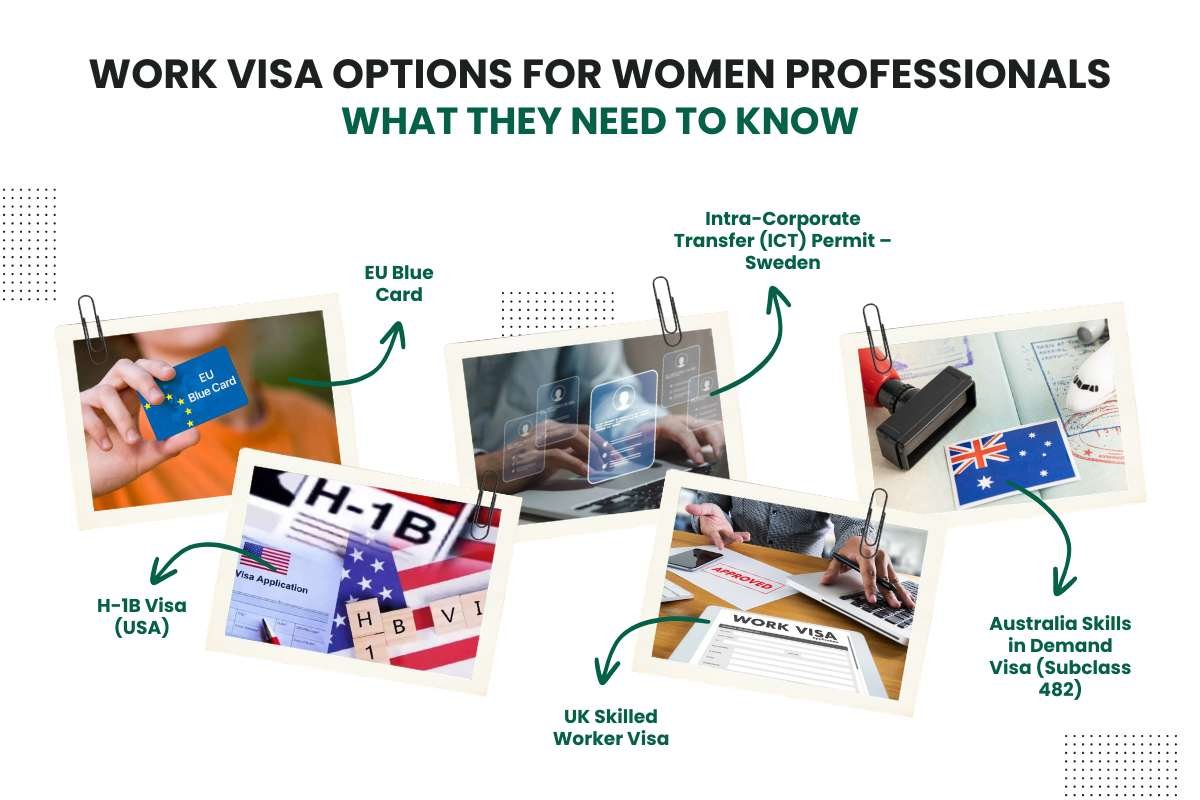
Different countries have immigration routes for skilled employees, specialised professionals, and workers transferring within multinational organisations. The following options are particularly relevant to women considering international employment.
1. EU Blue Card
The EU Blue Card allows qualified professionals from outside the European Union to work in participating EU countries.
Key eligibility requirements:
- A recognised higher education qualification or qualifying professional experience.
- An employment contract or binding job offer for at least six months.
- A salary meeting the destination country’s prescribed threshold.
The EU Blue Card applies in 25 EU Member States, excluding Denmark and Ireland. Salary thresholds and application procedures vary by country. Eligible holders may also benefit from family reunification provisions and mobility opportunities within participating countries.
For country-specific eligibility criteria and application procedures, applicants can use the European Commission’s EU Blue Card destination-country selector.
Why it matters for women:
Women working in technology, engineering, healthcare, research, and other skilled sectors can consider this route for European employment. Eligible Blue Card holders may also bring qualifying family members, subject to dependent eligibility requirements and the national procedures of the destination country.
2. H-1B Visa (USA)
The H-1B visa allows US employers to hire international professionals for specialty occupations requiring specialised knowledge and at least a bachelor’s degree or equivalent in a directly related field. The US Department of Labor outlines the employer’s wage and working-condition obligations under the programme.
Key eligibility requirements:
- A qualifying job offer from a US employer.
- An eligible specialty occupation.
- Relevant educational qualifications or equivalent credentials.
The annual statutory cap generally includes 65,000 regular places and 20,000 additional places for eligible applicants with US advanced degrees. Certain employers are exempt from the cap.
Why it matters for women:
The H-1B route offers opportunities in technology, finance, healthcare, and research. However, women should understand the implications of changing employers, losing their jobs, and the visa conditions governing dependent family members before relocating.
3. Intra-Corporate Transfer (ICT) Permit – Sweden
The Intra-Corporate Transfer (ICT) Permit allows eligible employees of multinational companies to transfer to a Swedish branch or subsidiary for a temporary work assignment.
Key eligibility requirements:
- Existing employment with a company established outside the EU.
- A transfer to a Swedish branch or company within the same organisation.
- A managerial, specialist, or trainee position.
Why it matters for women:
Internal transfers can provide women with access to international assignments without requiring them to leave their existing organisations. They can also build regional leadership experience, cross-border networks, and exposure to international business operations.
Women should check the assignment duration, opportunities for career progression, and arrangements for returning to their previous role or transitioning to another position after the assignment.
4. UK Skilled Worker Visa
The UK Skilled Worker Visa allows international professionals to work in eligible skilled occupations with employers approved by the Home Office. Applicants must have a confirmed job offer, a Certificate of Sponsorship from their employer, and meet the applicable salary and English-language requirements.
Key eligibility requirements:
- A confirmed job offer from an approved sponsor.
- An eligible occupation.
- Required English-language proficiency.
The standard salary requirement for most new applicants is usually £41,700 or the occupation’s going rate, whichever is higher. Exceptions apply to certain occupations and applicant categories.
Why it matters for women:
This route offers opportunities in healthcare, education, technology, and professional services. Applicants should also assess maternity benefits, flexible-work policies, and career progression opportunities.
5. Australia Skills in Demand Visa (Subclass 482)
Australia’s Skills in Demand Visa allows approved employers to sponsor suitably skilled overseas professionals.
Key eligibility requirements:
- Nomination by an approved employer.
- Relevant qualifications and work experience.
- Applicable English-language requirements.
The visa has three streams: Core Skills, Specialist Skills, and Labour Agreement. Depending on the stream and circumstances, eligible applicants can stay for up to four years.
Why it matters for women:
Women in healthcare, technology, and other eligible occupations can consider this route. Dependent visa conditions, healthcare coverage, and potential permanent residency pathways should be checked before accepting employment.
What Women Should Check Before Applying for a Work Visa
Before applying, women professionals should compare the eligibility criteria and documentation requirements of their chosen visa and destination country. Requirements can vary depending on the immigration route, occupation, and employer.
| Requirement | What applicants should verify |
| Educational qualifications | Whether their degree or professional credentials are recognised in the destination country |
| Work experience | Required years of experience and acceptable employment records |
| Employment offer | Whether a confirmed job offer and approved employer sponsorship are necessary |
| Salary requirements | The applicable minimum salary threshold and occupation-specific rates |
| Language proficiency | Whether an approved language test or minimum proficiency level is required |
| Professional licensing | Whether registration or local certification is necessary for regulated professions |
| Identity documents | Passport validity, supporting documents, and any required translations |
Women with career gaps due to maternity leave or caregiving should also maintain accurate employment records, experience letters, and evidence of relevant skills. They should check how the employer and applicable visa route assess previous work experience rather than assuming that a career break automatically affects eligibility.
Challenges Women May Face During International Relocation

Although immigration rules generally assess applicants against occupation, qualifications, and sponsorship requirements, women may encounter additional challenges when pursuing overseas employment.
- Unequal access to international assignments: Women may receive fewer opportunities when employers make assumptions about their willingness to relocate or family responsibilities.
- Career interruptions: Maternity leave and caregiving responsibilities can lead to career breaks. Applicants may need to demonstrate how their previous experience, updated skills, and professional qualifications align with the requirements of the overseas role.
- Family relocation: Childcare, dependent visas, schooling, and a partner’s employment opportunities can affect the financial and practical feasibility of moving abroad.
- Workplace safety: Women relocating to unfamiliar countries should understand local labour laws, anti-harassment policies, healthcare access, and reporting procedures.
- Employer dependency: Employer-sponsored immigration routes can create uncertainty if employment ends or the employee wants to change organisations.
These challenges make it important to assess the employer’s policies alongside the available work visa options for women professionals.
What the Data Says About Women in International Employment
Women’s participation in international employment has increased, but their representation in corporate mobility programmes remains limited. Women and global mobility remain important considerations for organisations seeking to build diverse international talent pipelines and improve women’s representation in overseas assignments.
According to the International Labour Organization’s Global Estimates on International Migrant Workers 2024, women accounted for 38.7% of international migrants in the labour force in 2022, representing approximately 64.9 million women. This was an increase from 53.2 million in 2013.
How Employers Can Support Women Moving Abroad
Organisations play an important role in making international career opportunities accessible to women. Offering visa sponsorship alone is not enough. Employers must also address the professional and personal challenges associated with relocation. Providing equal access to global assignment opportunities for women can help organisations develop diverse leadership pipelines, strengthen international teams, and retain experienced female professionals.
Some important measures include:
| Equal assignment opportunities | Select employees based on qualifications, experience, and leadership potential rather than assumptions about family responsibilities. |
| Relocation assistance | Provide support with accommodation, dependent visas, schooling, and settling-in arrangements. |
| Career continuity | Establish clear promotion opportunities and performance evaluation processes for employees working overseas. |
| Healthcare and maternity support | Explain medical coverage, parental leave, workplace safety, and local employment protections. |
| Professional networking | Connect women relocating abroad with mentors, senior leaders, and professional associations. |
These measures can help organisations retain experienced women professionals while developing a more inclusive international workforce.
Practical Steps Before Applying for an International Work Visa

Planning international career moves for women requires careful consideration of visa eligibility, employment opportunities, relocation costs, and long-term career prospects.
- Identify the destination country: Compare countries based on industry demand, employment opportunities, and immigration policies.
- Research visa eligibility: Check qualification requirements, salary thresholds, occupation lists, and sponsorship conditions.
- Verify the employer: Confirm that the organisation is authorised to sponsor international employees, where required.
- Review employment benefits: Examine healthcare coverage, maternity policies, paid leave, and workplace protections.
- Understand dependent rights: Check whether a spouse or children can accompany the primary applicant and whether they can work or study.
- Evaluate long-term opportunities: Review visa renewal conditions, employer-change restrictions, and permanent residency pathways.
- Prepare documentation: Organise educational certificates, employment records, professional licences, and identity documents.
Business Perspective
International mobility allows organisations to access specialised talent, enter new markets, and develop leaders with cross-border experience. However, the limited representation of women in corporate assignments indicates that businesses still need more inclusive selection and sponsorship practices.
Providing equal access to work visa options for women professionals can strengthen international talent pipelines and improve leadership succession planning. Companies should integrate visa assistance with career development, family relocation support, and workplace inclusion.
For women, international assignments can provide exposure to regional operations, global clients, and strategic decision-making. Organisations that remove relocation barriers can make these opportunities accessible to a wider pool of qualified professionals.
Conclusion:
International employment can help women build specialised skills, gain leadership experience, and participate in global business operations. However, no single visa is the best option for every applicant. The right choice depends on qualifications, job offers, salary requirements, employer sponsorship, dependent-family rights, and long-term career plans.
Comparing the available work visa options for women professionals can help applicants assess which route aligns with their career and relocation needs. Before applying, they should verify the latest eligibility criteria, fees, documentation, and visa conditions through official government immigration websites, as requirements can change.
Employers also have a responsibility to provide equal access to international assignments through transparent selection, relocation support, and career development opportunities. These measures can help more women build sustainable international careers.
FAQs
1. What are the best work visa options for women professionals moving abroad?
The EU Blue Card, H-1B visa, Intra-Company Transfer routes, UK Skilled Worker visa, and Australia’s Skills in Demand visa are common employment pathways. The right option depends on qualifications, occupation, employer sponsorship, and destination country.
2. Can women apply for work visas without employer sponsorship?
Yes. Some countries offer points-based skilled migration and independent immigration pathways. However, visas such as the H-1B, UK Skilled Worker, and Australia Subclass 482 generally require employer involvement.
3. Can women take their families when moving abroad for work?
Several employment-based visa categories allow eligible applicants to bring dependent family members. However, dependent visa eligibility, employment rights, healthcare access, and financial requirements vary by country.
4. Can women apply for work visas after a career break?
Yes. Women can apply for work visas after a career break if they meet the relevant visa requirements. Eligibility generally depends on qualifications, professional experience, job offers, and sponsorship conditions. Applicants should maintain accurate employment records and check how their chosen visa category assesses previous work experience.
5. Do work visas automatically provide permanent residency?
No. Most work visas do not automatically grant permanent residency. Some countries offer pathways to permanent residence after meeting specific conditions, such as minimum residence periods, continued employment, salary requirements, and eligibility criteria. These conditions vary by country and visa category.
6. What should women check before accepting an overseas job offer?
Women should review the salary, visa sponsorship, employment contract, healthcare coverage, maternity benefits, dependent-family rights, and restrictions on changing employers. They should also check visa duration, renewal conditions, and potential permanent residency pathways before accepting the offer.