
This article explains the meaning of social entrepreneurship, its importance, key characteristics, business models, challenges, and future opportunities. It also covers inspiring global and Indian examples, women leaders shaping the sector in 2026, and practical insights for aspiring social entrepreneurs. Through real-world case studies, readers will understand how businesses can create profits while solving social and environmental problems.
Can a business make money and still change lives?
For years, many people believed companies existed only to earn profits. Yet some entrepreneurs asked a different question: “What if business could solve problems that governments and charities struggle to fix?”
That simple idea gave birth to social entrepreneurship. It is also known as a social innovator.
Imagine a company that helps poor families access loans, creates jobs for women in villages, improves education for children, or reduces environmental waste while remaining financially sustainable. Sounds impossible? It is already happening.
Around the world, entrepreneurs are proving that purpose and profit can work together. They are creating businesses that focus on people, communities, and long-term impact. Their success shows that solving social problems can also create sustainable growth.
As consumers become more conscious and investors focus on impact-driven ventures, entrepreneurship is becoming one of the most influential business movements of our time. From rural India to global markets, purpose-driven businesses are changing how success is measured.
What is social entrepreneurship?
Social entrepreneurship refers to the process of building and running businesses that aim to solve social, environmental, or community problems while remaining financially sustainable.
Unlike traditional businesses that focus mainly on profits, social innovators focus on creating positive change. Revenue matters, but impact matters just as much.
A social entrepreneur identifies a problem, creates an innovative solution, and develops a business model that supports long-term growth.
Some common areas include:
- Poverty reduction
- Education
- Women’s empowerment
- Healthcare access
- Environmental protection
- Financial inclusion
- Rural development
The goal is not simply to help people temporarily. The goal is to create systems that continue delivering benefits for years.
Real-world example: Grameen Bank
One of the most famous examples of social entrepreneurship is the Grameen Bank, founded by Muhammad Yunus in Bangladesh.
Yunus noticed that many poor people could not access traditional bank loans. Without capital, they remained trapped in poverty. He introduced microfinance by offering small loans to low-income individuals, especially women, helping them start businesses and generate income. The model became a global success and inspired similar initiatives across more than 100 countries.
This example shows how a social innovator can address a major social problem while creating a sustainable financial model.
Characteristics of a social entrepreneur

Successful social entrepreneurs share certain qualities that help them create meaningful and lasting change. They do not focus only on earning profits. Instead, they look for ways to solve real-world problems while building sustainable businesses that can continue making an impact for years.
1. They focus on solving problems
A social entrepreneur begins with a problem rather than a product. Their first question is not, “What can I sell?” but “What problem can I solve?”
They identify challenges that affect people, communities, or the environment and then create practical solutions. These problems may involve poverty, healthcare, education, unemployment, clean water, or environmental protection.
A well-known example is Muhammad Yunus, founder of Grameen Bank. He noticed that many poor families could not access traditional banking services. Instead of accepting the situation, he created a microfinance model that provided small loans to low-income individuals. This simple idea helped millions of people start businesses and improve their financial condition.
This problem-solving mindset is one of the strongest foundations of a social innovator because it focuses on creating real value for society.
2. They think innovatively
Social entrepreneurs often face complex challenges that traditional approaches fail to solve. As a result, they rely on innovation and creative thinking to develop effective solutions.
Innovation does not always mean advanced technology. Sometimes it means creating a new business model, building community partnerships, or improving an existing process. The goal is to make solutions more affordable, accessible, and sustainable.
For example, many healthcare startups now use mobile applications to connect doctors with patients in remote areas. This approach reduces travel costs, saves time, and improves access to medical advice for people who need it most.
By thinking differently, social entrepreneurs can create opportunities where others see obstacles.
3. They balance impact and revenue
Creating positive change requires financial stability. A social enterprise cannot continue helping people if it struggles to cover its operating costs.
Successful social entrepreneurs understand the importance of balancing social impact with revenue generation. They build business models that generate income while continuing to serve their mission.
For example, a company that sells affordable solar lamps in rural areas earns revenue from product sales while helping families gain access to clean and reliable energy. The income supports business growth, while the social mission remains intact.
This balance allows entrepreneurship ventures to grow sustainably without depending entirely on donations or grants.
4. They Stay Mission Driven
Social entrepreneurs remain committed to their purpose even as their businesses grow. While revenue is important, the mission always guides their decisions.
Being mission-driven helps organizations maintain trust among customers, investors, employees, and communities. It also ensures that growth does not come at the cost of the original social goal.
For instance, an education-focused social enterprise may expand into new regions, but its primary objective remains improving learning opportunities for underserved children. Every decision supports that larger mission.
This strong sense of purpose helps social entrepreneurs create long-term impact rather than short-term success.
5. They Measure Impact
Social entrepreneurs track outcomes such as:
- Number of people helped
- Jobs created
- Income generated
- Carbon emissions reduced
- Educational outcomes improved
Impact measurement helps organizations grow responsibly.
Case Study: TOMS Shoes
TOMS became famous through its “One for One” model. For every product purchased, the company contributed resources to people in need. The business demonstrated how a commercial enterprise could build social impact into its core model.
Types of Social Entrepreneurship
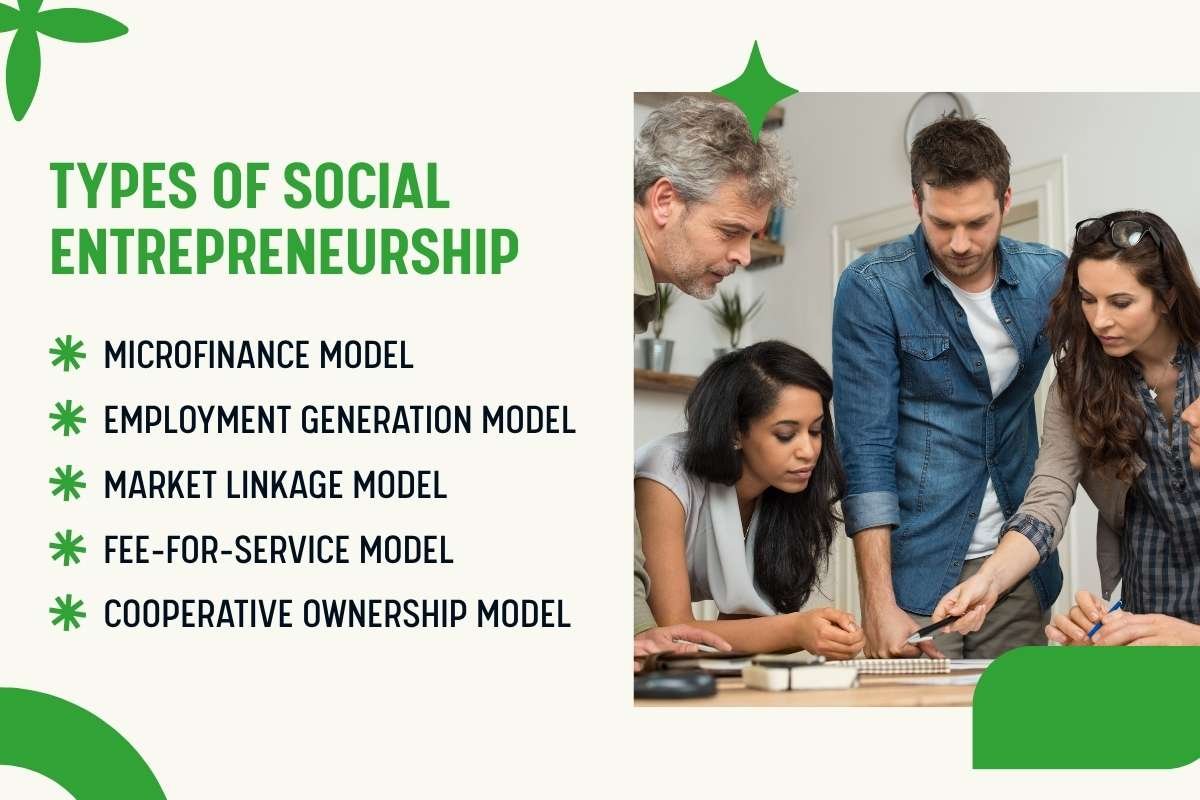
Not all social enterprises work in the same way. Some focus on local communities, while others operate on a larger scale. The business model depends on the social problem being solved, the target audience, and the source of funding. Here are the most common types of Social Entrepreneurship.
Type 1: Community-Based Model
The Community-Based Model focuses on solving problems within a specific community or region. These enterprises work closely with local people to identify challenges and create practical solutions. Their goal is to improve the quality of life while creating economic opportunities for residents.
For example, a village-based organization may train women in handicraft production and help them sell their products online. This creates jobs, increases household income, and supports local economic growth.
This model works well because community members actively participate in the solution, making the impact more sustainable over time.
Type 2: Nonprofit Social Enterprise
A Nonprofit Social Enterprise generates revenue through products or services but uses most or all of its earnings to support its social mission. Instead of distributing profits to owners or shareholders, the organization reinvests funds into expanding its programs and helping more people.
Many educational institutions, healthcare organizations, and skill-development centers follow this model. For example, a nonprofit school may charge affordable fees and use the revenue to improve facilities, hire teachers, and provide scholarships for underprivileged students.
This approach helps organizations become less dependent on donations and grants while maintaining their social purpose.
Type 3: Cooperative Model
In the Cooperative Model, members collectively own and manage the enterprise. Every member has a voice in decision-making, and profits are shared fairly among participants.
Agricultural cooperatives are a common example. Farmers join together to purchase supplies, access larger markets, and negotiate better prices for their products. By working as a group, they gain benefits that would be difficult to achieve individually.
This model promotes equality, community participation, and shared economic growth.
Type 4: Hybrid Model
The Hybrid Model combines business activities with a social mission. It earns revenue like a traditional company while also focusing on solving social or environmental challenges.
For example, a company may sell eco-friendly products and use part of its profits to fund environmental conservation projects. The commercial side generates income, while the social side creates a positive impact.
This model has become increasingly popular because it balances financial sustainability with meaningful social change.
Type 5: Social Business Model
The Social Business Model was popularized by Muhammad Yunus, the founder of Grameen Bank. The primary goal is to solve a social problem through a financially sustainable business.
Unlike traditional businesses, profits are not distributed to investors beyond their initial investment. Instead, earnings are reinvested to expand the organization’s impact and reach more people.
The Social Business Model proves that a company can remain financially stable while making a lasting difference in society.
Models of Social Entrepreneurship
Different organizations use social innovators in different ways to solve social problems while maintaining financial sustainability. Each model focuses on creating impact through a specific business approach.
➤ Microfinance Model
The Microfinance Model helps people who do not have access to traditional banking services.
These individuals often struggle to get loans because they lack credit history or collateral. Social enterprises provide small loans, savings accounts, and financial support to help them start businesses and improve their income.
A well-known example is Grameen Bank in Bangladesh. Through small loans, many low-income families have been able to start small businesses and become financially independent.
Why it matters: This model reduces poverty, encourages entrepreneurship, and helps people build a better future without relying on charity.
➤ Employment Generation Model
The Employment Generation Model focuses on creating jobs for people who face barriers to employment. This may include women from rural areas, people with disabilities, low-income communities, or individuals with limited education.
These organizations provide skill training, employment opportunities, and long-term career support. Instead of offering temporary assistance, they help people earn a stable income and become self-reliant.
Why it matters: Steady employment improves living standards, strengthens communities, and creates lasting economic growth.
➤ Market Linkage Model
Many small farmers, artisans, and local producers create quality products but struggle to reach larger markets. The Market Linkage Model connects these producers with customers, retailers, and businesses that can buy their products.
In India, many social enterprises help rural farmers sell directly to urban consumers. This reduces dependence on middlemen and increases earnings for producers.
Why it matters: Producers receive fair prices, customers gain access to quality products, and local economies become stronger.
➤ Fee-for-Service Model
The Fee-for-Service Model delivers important services at affordable prices. Instead of depending entirely on donations, the organization charges a reasonable fee that helps cover operating costs.
This model is common in healthcare, education, and skill development sectors. For example, some hospitals provide high-quality medical care at lower costs, making treatment accessible to more people.
Why it matters: People receive essential services at affordable rates, while the organization remains financially sustainable.
➤ Cooperative Ownership Model
In the Cooperative Ownership Model, the business is owned and managed by its members. These members may be farmers, workers, artisans, or local community groups. Profits and benefits are shared among everyone involved.
A famous example is India’s dairy cooperative movement, where thousands of farmers work together and share the rewards of collective success.
Why it matters: This model promotes fairness, community participation, and long-term economic development while reducing income inequality.
Challenges of Social Entrepreneurship
While a social innovator creates positive change, it also comes with unique challenges. Social entrepreneurs must solve community problems while keeping their businesses financially stable. This balance is not always easy, especially when resources are limited.
➤ Funding Difficulties
One of the biggest challenges in entrepreneurship is raising funds. Many investors focus mainly on profits and may hesitate to support businesses that prioritize social impact. As a result, social enterprises often struggle to secure enough capital for growth, technology, marketing, and expansion.
For example, a startup that provides affordable education to low-income children may attract less investment than a technology company promising high financial returns, even if its social impact is significant.
➤ Scaling Impact
A solution that works successfully in one location may not produce the same results elsewhere. Different regions have different cultures, economic conditions, and community needs. Because of this, social enterprises must adapt their strategies carefully when expanding.
For instance, a rural healthcare model that succeeds in one state may require major adjustments before it can work effectively in another region.
➤ Measuring Success
Traditional businesses measure success through revenue, profits, and market share. For a social innovator, success also includes social impact. Measuring improvements in education, health, employment, or environmental protection can be difficult because these results often take years to appear.
Social enterprises need strong data collection and reporting systems to prove that their efforts are creating real and lasting change.
➤ Talent Acquisition
Many social enterprises operate with limited budgets. This makes it challenging to attract and retain highly skilled professionals who may receive higher salaries from large corporations.
Despite this challenge, many professionals choose social enterprises because they want meaningful work and the opportunity to make a positive difference in society.
➤ Balancing Mission and Revenue
Maintaining a balance between social impact and financial sustainability is perhaps the most difficult challenge for social innovators. A business needs revenue to survive, but focusing too much on profits can weaken its social mission.
Successful social entrepreneurs constantly work to ensure that business growth supports their purpose rather than replacing it. This balance helps them create long-term impact while remaining financially healthy.
Indian Example: Rural Women Entrepreneurship
Several Indian initiatives support women entrepreneurs through self-help groups, digital inclusion programs, and community-owned enterprises. These programs help women become financially independent while creating local employment opportunities.
How Women CEOs Are Redefining Social Entrepreneurship in 2026?

Women leaders are bringing a fresh approach to social innovation by building businesses that focus on people as much as profits. Instead of solving only commercial problems, many women entrepreneurs are tackling issues such as healthcare, education, financial inclusion, sustainability, and women’s empowerment. Their work is creating long-term social impact while building sustainable organizations.
In 2026, women-led social enterprises are helping communities gain access to better opportunities, especially in underserved and rural areas. Through technology, innovation, and community-driven solutions, these leaders are proving that businesses can grow while creating meaningful change.
Inspiring women leaders in social entrepreneurship
1. Zubaida Bai – Founder of AYZH
Indian entrepreneur Zubaida Bai founded AYZH, a company focused on improving maternal healthcare for women in low-income communities.
She identified a serious healthcare gap and developed affordable solutions that improved health outcomes for mothers and newborns. Today, she is recognized globally for her contributions to social innovation and women’s health.
2. Leila Janah – Founder of Samasource
Leila Janah created Samasource with a mission to reduce global poverty through digital employment. Her organization connected people in low-income communities with digital work opportunities, helping thousands earn sustainable incomes. Her model showed how technology can create economic empowerment on a large scale.
3. Jessica Jackley – Co-Founder of Kiva
Jessica Jackley co-founded Kiva, one of the world’s best-known microfinance platforms. Kiva allows people to lend small amounts of money to entrepreneurs who may not qualify for traditional bank loans. Millions of entrepreneurs worldwide have benefited from this innovative approach to financial inclusion.
4. Safia Minney – Founder of People Tree
Safia Minney built People Tree as a pioneer in ethical and fair-trade fashion. Her company supports artisans and small producers while promoting sustainable business practices. She demonstrated that fashion businesses can generate profits while creating social and environmental value.
Women-led economic empowerment programs
Across India, women-led entrepreneurship initiatives continue to expand.
Programs focused on financial inclusion, digital literacy, self-help groups, and enterprise ownership are helping thousands of women become business owners. Recent government initiatives, such as SHE Marts, aim to strengthen women-led enterprises and grassroots entrepreneurship.
Why women leaders are driving change?
Women leaders often understand community challenges from a grassroots perspective. As a result, they build solutions that are practical, inclusive, and sustainable. Their businesses commonly focus on:
- Improving healthcare access
- Supporting women’s financial independence
- Expanding education opportunities
- Creating sustainable livelihoods
- Promoting environmental responsibility
Across India and globally, women-led initiatives are helping thousands of people access skills, jobs, funding, and business opportunities. Programs focused on digital literacy, self-help groups, and women-owned enterprises continue to strengthen local economies.
The future of social entrepreneurship

The future looks promising for entrepreneurship.
Technology is helping social enterprises reach more people than ever before.
Artificial intelligence, digital payments, mobile applications, and data analytics are making impact-driven businesses more efficient and scalable. At the same time, investors are showing greater interest in companies that generate measurable social value.
Young entrepreneurs are also entering the field with fresh ideas and strong social awareness.
As global challenges continue to grow, businesses that combine innovation, sustainability, and impact will likely play a bigger role in shaping the future economy.
The next generation of successful companies may not be judged only by profits but also by the positive change they create.
Conclusion
At its heart, social entrepreneurship proves that business can be a force for good.
Remember the question from the beginning: Can a business make money and still change lives?
The answer is a clear yes.
From Grameen Bank helping millions access financial opportunities to women entrepreneurs creating employment in rural communities, the evidence is everywhere. Purpose-driven businesses are solving real problems while building sustainable organizations.
The future belongs to entrepreneurs who think beyond profits and focus on lasting impact. Whether the goal is reducing poverty, improving education, supporting healthcare, or protecting the environment, a social innovator offers a practical path toward meaningful change.
A successful business does not have to choose between profit and purpose. The best businesses are proving that both can grow together.
FAQs
1. What is Social Entrepreneurship in simple words?
Social entrepreneurship is the practice of building businesses that solve social or environmental problems while generating enough revenue to remain sustainable.
2. What is the difference between entrepreneurship and Social Entrepreneurship?
Traditional entrepreneurship primarily focuses on profit. A social innovator focuses on both profit and positive social impact.
3. Who is the most famous social entrepreneur?
Muhammad Yunus, founder of Grameen Bank, is widely recognized as one of the most influential social entrepreneurs in the world because of his pioneering work in microfinance.
4. Why is Social Entrepreneurship important in 2026?
Social entrepreneurship helps address major challenges such as poverty, unemployment, financial inclusion, healthcare access, and environmental sustainability while creating long-term economic value.