

How women can negotiate is no longer a question of whether they should ask for more. It is about whether the right strategy can turn an ask into a better outcome.
In 2024, U.S. women earned 85 cents for every dollar earned by men in median hourly earnings, according to Pew Research Center. Yet research shows women are not simply failing to ask: men and women have been found to request raises and promotions at similar rates, while women were less likely to receive what they requested.
That makes negotiation more than a confidence exercise. How women can negotiate effectively depends on market data, measurable results, clear communication, and knowing when to push, pause, or trade.
From salary and promotions to flexible work and benefits, negotiation can influence both immediate compensation and longer-term career growth.
The goal is not to make women negotiate like men. It is to help women walk into important conversations prepared, informed, and ready to put a clear value on their work.
Why learning how women can negotiate requires a strategic approach
Negotiation is not simply about asking for more. For women, the context, wording, and expectations surrounding that task can influence the outcome.
Research shows that gender differences in negotiation are highly dependent on the situation, particularly when expectations are unclear or standards for negotiation are ambiguous. Cultural differences in negotiation can also shape how people communicate, approach authority, express disagreement, and respond to direct or indirect requests.
That is why how women can negotiate cannot be reduced to simply being more assertive. Strong negotiation skills for women combine preparation, evidence, timing, clear communication, and an understanding of the other side’s priorities. These principles also form the foundation of B2B negotiation tactics, where understanding the other side’s priorities is especially important.
What makes negotiation different for women?
- The likability trap: Women can face social penalties when they are perceived as overly assertive, making it important to pair confidence with clear reasoning.
- Context matters: A meta-analysis of 123 effect sizes involving 10,888 participants found that gender differences in negotiation outcomes varied significantly depending on factors such as experience, information, and the negotiation setting.
- Strong alternatives can create complications: Research involving more than 2,500 negotiators found that gender differences emerged when women had strong outside options, with some negotiations more likely to end in impasse.
The takeaway is simple: women do not need to negotiate like men to negotiate effectively.
Instead, how women can negotiate should focus on combining assertiveness with evidence, curiosity with clarity, and confidence with preparation.
That starts before the negotiation itself.
How women can negotiate starting with pre-negotiation preparation
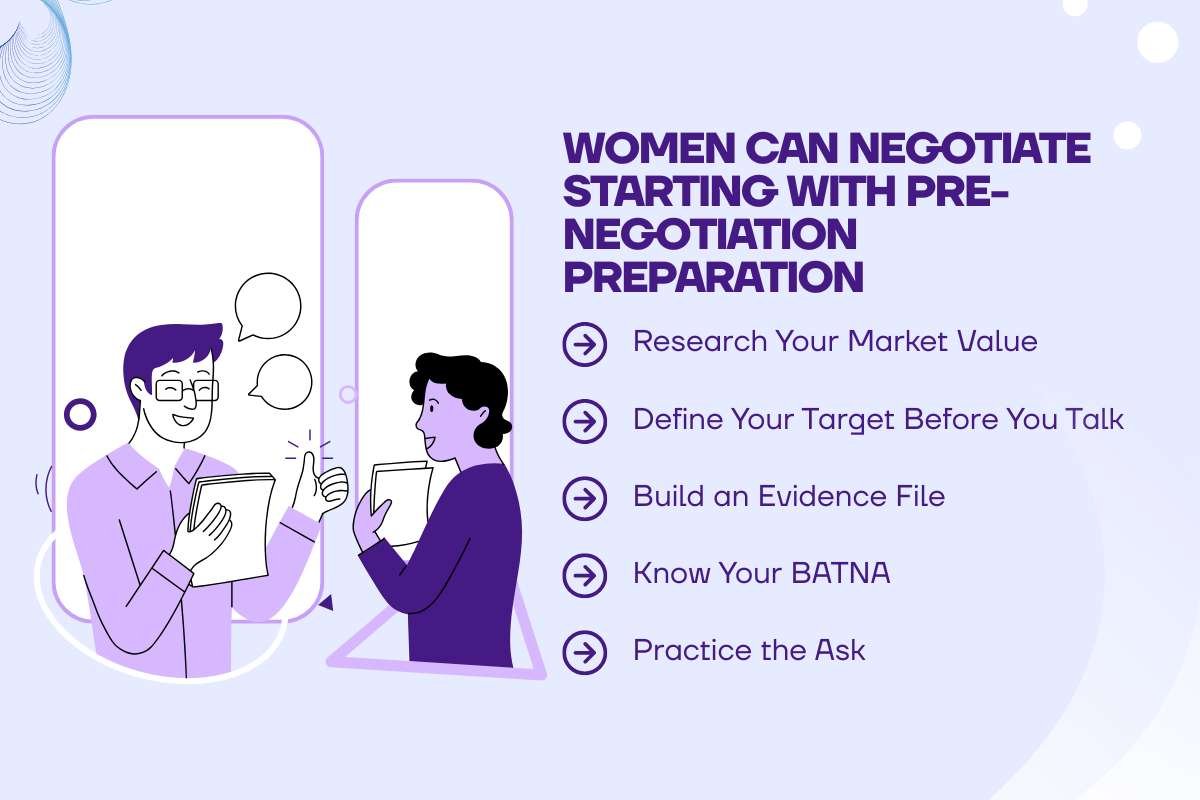
The strongest negotiation often happens before the conversation begins.
Preparation replaces guesswork with evidence, and that matters because women may encounter differences in the negotiation environment itself. A large field experiment involving nearly 2,500 job seekers found that when employers explicitly stated that wages were negotiable, the gender difference in willingness to negotiate disappeared.
So, when considering how women can negotiate salary or workplace benefits, start by building a case before making the ask.
1. Research your market value
Do not choose a salary figure based on what feels reasonable. Check:
- Salary ranges for similar roles
- Your experience and qualifications
- Industry and location
- Company size
- Scope of responsibilities
- Specialized skills
Recent research also shows why the starting point matters: a 2025 Organization Science study examining more than 700,000 initial salary offers found a 5.5% gender gap in initial offers, even after accounting for job, employer, occupation, location, and human-capital characteristics.
The takeaway: research the market before the employer’s number becomes your benchmark.
If you are wondering how women can negotiate without sounding unreasonable, market data gives you something stronger than personal opinion. It gives you a defensible number.
2. Define your target before you talk
Know three things:
- Ideal outcome: What would make the offer genuinely attractive?
- Target: What are you realistically aiming for?
- Walk-away point: What is the minimum you will accept?
This prevents you from making concessions simply because the conversation becomes uncomfortable.
Knowing these numbers is an important part of how women can negotiate with clarity instead of reacting emotionally to whatever the employer offers first.
3. Build an evidence file
Confidence is easier when you can point to proof.
Prepare 3–5 measurable examples of:
- Revenue generated
- Costs reduced
- Projects delivered
- Customers retained
- Processes improved
- Teams led
- New responsibilities taken on
Instead of saying:
“My workload has increased significantly.”
Say:
“My role has expanded to include two additional teams, and I delivered the project 15% ahead of schedule.”
Evidence makes your request easier to evaluate. For anyone thinking about how women can negotiate a raise or promotion, this is one of the most useful steps: turn your contribution into evidence that another person can understand quickly.
4. Know your BATNA
Your BATNA (Best Alternative to a Negotiated Agreement) is what you can do if the negotiation does not work out.
It could be another offer, a different internal role, freelance work, or simply staying in your current position while continuing your search.
You do not need to threaten the other side with your alternatives. You need to understand them yourself.
A strong alternative can help women negotiate less out of fear of rejection and more about making an informed decision.
5. Practice the ask
Write your opening sentence and say it aloud before the meeting.
For example:
“Based on my expanded responsibilities, measurable results, and current market benchmarks, I’d like to discuss adjusting my compensation to ₹X.”
Keep it specific, evidence-based, and direct.
Preparation does not guarantee that you will get everything you ask for. But it puts you in a much stronger position to explain why your request is reasonable and what you are willing to negotiate to get there.
What women can negotiate beyond BASE salary
A negotiation does not have to end with the salary figure.
If the base pay is fixed, there may still be room to improve the total value of the offer. Research on women’s career negotiations shows that women negotiate across areas including compensation, benefits of negotiating job title and role scope, work location, workload, work hours, leadership opportunities, and development opportunities.
What can you negotiate?
Understanding how women can negotiate means looking at the entire package rather than treating salary as the only negotiable item.
| Category | What You Can Ask For |
| Financial | Performance bonus, signing bonus, equity, stock options |
| Career Growth | Promotion timeline, title, training, certifications, conference funding |
| Flexibility | Remote or hybrid work, flexible hours, compressed schedules |
| Time & Benefits | Additional PTO, parental leave, wellness benefits |
| Role & Authority | Team size, project ownership, decision-making authority |
| Performance Reviews | Six-month salary review, defined promotion milestones |
Why flexibility deserves a place at the table
For women, flexibility can be more than a lifestyle perk. It can influence how work fits alongside other responsibilities and whether a role remains sustainable over time.
A 2026 meta-analysis covering 113 studies and 88,618 participants found that flexible working arrangements were associated with outcomes including greater job satisfaction, organizational commitment, autonomy, life satisfaction, and a better work-family interface.
Research specifically examining women negotiating flexible work arrangements also found that perceived power and organizational support can influence both the negotiation process and its outcomes.
So instead of treating flexibility as a personal favor, frame it as a workable arrangement with clear expectations. For a deeper look at this conversation, see how to negotiate flexible work arrangements while maintaining clear expectations around performance and availability.
“I’d like to discuss working remotely two days a week while maintaining the same availability, deadlines, and performance expectations.”
This is a useful example of how women can negotiate for something valuable without making the conversation solely about money.
Think Beyond “Yes or No”
If an employer cannot increase your salary, ask:
“What other parts of the package have flexibility?”
You may be able to trade across different priorities rather than giving up on the negotiation altogether.
The goal is not simply to get more money. It is to build a package that better reflects your value, career goals, and working needs.
Golden rules for how women can negotiate successfully
Good negotiation is not about talking the most or pushing the hardest. It is about knowing when to speak, when to ask, and when to pause. Understanding different negotiation styles can also help you choose an approach that fits the situation rather than relying on one communication style every time. Research has found that men and women ask for raises and promotions at similar rates, challenging the idea that women simply need to “ask more.”
The difference often comes down to how the negotiation is handled. For how women negotiate successfully, these five rules provide a practical framework.
Rule 1: lead with preparation, not apologies
You do not need to soften a reasonable request with “sorry,” “just,” or “I hope this is okay.”
Instead of:
“I’m sorry, but I was hoping we could discuss my salary.”
Say:
“I’d like to discuss my compensation based on my expanded responsibilities and results.”
Be respectful, but do not apologize for advocating for yourself.
Rule 2: connect your ask to business value
Make your contribution the center of the conversation.
Use evidence such as:
- Revenue generated
- Costs saved
- Projects delivered
- Customers retained
- Teams led
- Processes improved
Research on women’s career negotiations shows that successful negotiations can extend beyond pay to role development, leadership opportunities, and access to resources.
When considering how women can negotiate for more, the stronger question is not “Why do I need this?” but “Why does this make sense based on the value I bring?”
Rule 3: listen more before you counter
Do not rush to defend your position. One useful approach is the 70/30 rule in negotiation, where you aim to spend roughly 70% of the conversation listening and asking questions and 30% presenting your own position.
Ask:
“How did you arrive at this offer?”
“What flexibility is available within the package?”
“What would I need to achieve to reach the next compensation level?”
Research examining 38,564 speech turns from 239 negotiation recordings found that conversation patterns, including speaking time, pauses, interruptions, and listening, are connected to negotiation dynamics and outcomes.
Questions give you information. Information gives you leverage.
Rule 4: use the strategic pause
Once you make your ask, resist the urge to fill the silence.
If you say:
“Based on the role and market data, I’m targeting ₹22 lakh.”
and the other person pauses, letting them respond.
Research on negotiation found that silent pauses of at least three seconds were associated with greater value-creation behavior and outcomes.
Silence is not weakness. Sometimes, it is simply space for the other person to make the next move. Body language and negotiation also go hand in hand here. Maintaining a calm posture, steady eye contact, and a composed expression can reinforce confidence while keeping the conversation collaborative.
This is especially useful when considering how women can negotiate without feeling pressure to immediately soften or withdraw their request.
Rule 5: trade instead of giving in
If the employer cannot meet your salary request, do not immediately lower your number.
Ask what else can move:
“If the base salary is fixed, could we discuss a signing bonus, additional PTO, or an earlier compensation review?”
This keeps the negotiation moving without turning every disagreement into a concession.
The goal is not to win every point. It is to leave the conversation with a better outcome than the one you would have accepted without negotiating.
Language overhaul: what not to say when negotiating

The words you use can change the way your request is perceived. Research on gender and negotiation has found that women can face backlash for assertive self-advocacy, while being too cautious can also hurt perceptions of competence.
That does not mean women should make themselves smaller. It means the strongest language is often clear, evidence-based, and confident without being unnecessarily confrontational. When thinking about how women can negotiate effectively, language is part of the strategy.
| Avoid | Use Instead |
| “I’m sorry to ask, but could we discuss my salary?” | “I’d like to discuss my compensation based on my expanded responsibilities.” |
| “I was just wondering if there might be some flexibility.” | “Is there flexibility to move the offer to ₹X?” |
| “I’ll take whatever you think is fair.” | “Based on my research, comparable roles fall within the ₹X–Y range.” |
| “I really need a raise because my expenses have increased.” | “My responsibilities and measurable contributions have increased, and I’d like my compensation to reflect that.” |
| “I don’t want to sound demanding.” | “I’d like to discuss what would be appropriate for the scope of this role.” |
| “Can you maybe increase the salary a little?” | “Would you be able to move the base salary to ₹X?” |
Make your value the focus
A useful formula is:
Contribution + Evidence + Request
For example:
“I’ve taken ownership of three additional accounts and improved client retention by 18%. Given the expanded scope of my role, I’d like to discuss adjusting my compensation to ₹X.”
This is stronger than relying on confidence alone because the request is connected to something measurable.
It also shows how women can negotiate without making the conversation about personal worth. The focus stays on contribution and business value.
Replace apologies with directness
Words such as “sorry,” “just,” “maybe,” and “hopefully” can make a clear request sound uncertain.
Instead of:
“I was just hoping maybe we could talk about a raise.”
Say:
“I’d like to discuss a compensation adjustment based on my recent results.”
You can still be warm and collaborative. Direct does not have to mean aggressive.
Ask questions instead of making demands
When you encounter resistance, avoid turning the conversation into a standoff.
Try:
“What flexibility is available within the package?”
“What would need to happen for us to reach this number?”
“If the base salary is fixed, what other elements can we discuss?”
This approach is particularly useful because research on women’s career negotiations shows that negotiation can extend well beyond compensation to role development, leadership opportunities, and work-family arrangements.
The goal is simple: sound confident enough to state your value, but flexible enough to keep the conversation moving.
Plug-and-play scripts for common negotiation situations
Knowing the strategy is useful. Having the right words ready is even better.
A negotiation can feel harder when you are trying to think about your value, your tone, and your response at the same time.
These scripts show how women can negotiate common workplace situations without making the conversation sound rehearsed.
1. Negotiating a new job offer
“Thank you for the offer. I’m excited about the opportunity. Based on my experience, the responsibilities of the role, and the market range I’ve researched, I was targeting ₹X. Is there flexibility to move the offer closer to that figure?”
2. Asking for a raise or promotion
“Over the past year, my responsibilities have expanded to include X, Y, and Z, and I’ve delivered [specific results]. I’d like to discuss adjusting my compensation to reflect my current scope and contribution. What would be possible?”
If there is no budget:
“Could we agree on specific goals and a timeline for reviewing my compensation again?”
3. Negotiating flexible work
“I’d like to discuss working remotely two days a week while maintaining the same availability, deadlines, and performance expectations. Could we try this arrangement for three months and review how it’s working?”
4. Responding to a lowball offer
“Thank you for sharing the offer. Based on the role, my experience, and current market benchmarks, I was targeting ₹X–Y. Is there room to bring the offer closer to that range?”
If salary is fixed:
“Could we discuss the bonus, additional PTO, professional development support, or an earlier compensation review?”
5. Asking for more time
You do not have to negotiate and decide simultaneously.
“Thank you for the offer. I’d like some time to review the full package before making a decision. Could I get back to you by [date]?”
This gives you time to compare salary, benefits, flexibility, growth opportunities, and alternatives rather than focusing only on the headline number.
A simple formula to remember
For almost any workplace negotiation, use:
Appreciate → Evidence → Ask → Pause
“I’m excited about the opportunity. Based on X and Y, I was targeting ₹X. Is there flexibility to reach that figure?”
Then stop.
You do not need to immediately explain, apologize, lower your number, or fill the silence.
This four-step framework captures the core of how women can negotiate in a way that is direct without being unnecessarily aggressive.
The biggest mistakes to avoid when learning how women can negotiate

A negotiation can go wrong before the conversation even begins. And sometimes, the biggest mistake is assuming that women simply need to ask more aggressively.
Research increasingly challenges that idea. A 2024 Academy of Management Discoveries study found that women today report negotiating salaries as often, and in some cases more often, than men.
The focus, then, should be on negotiating strategically, not simply negotiating more.
1. Going in without market data
If you cannot explain where your number comes from, the conversation can become subjective.
Research examining more than 700,000 initial U.S. salary offers found a 5.5% gender gap in initial offers, even after accounting for several job and worker characteristics.
Better approach: research the market before the employer’s first number becomes your benchmark.
2. Assuming the first offer is final
Before accepting, ask:
- Is the salary negotiable?
- Is there a bonus?
- Is equity available?
- Can the review happen sooner?
- Is there flexibility around PTO or working arrangements?
- Can the title or scope be adjusted?
Look at the entire package. This is a key part of how women can negotiate because the first offer is often only one part of the conversation.
3. Filling silence with concessions
You make your ask.
The other person pauses.
You panic and say:
“But I could be flexible.”
Do not negotiate against yourself.
Make the request, pause, and let the other person respond.
4. Making the negotiation about personal need
Your financial needs may explain why you want more, but your contribution explains why the organization should consider it.
Connect your request to:
- Increased responsibilities
- Measurable results
- Market value
- Specialized expertise
- Business impact
5. Treating negotiation as a win-or-lose battle
If salary cannot move, trade across other priorities.
“If the base salary is fixed, could we discuss an earlier compensation review or additional PTO?”
Negotiation works best when it creates room for both sides rather than turning every disagreement into a standoff.
Conclusion:
How women can negotiate is not about asking more aggressively. It is about asking strategically with market data, measurable results, clear goals, and confidence.
Women are already negotiating; research challenges the idea that they simply fail to ask. Yet the U.S. gender pay gap remains, with women earning 85% of men’s median hourly earnings in 2024, according to Pew Research Center.
Understanding how women can negotiate is therefore not about turning every workplace conversation into a confrontation. It is about knowing your value, understanding the market, preparing evidence, asking clear questions, and knowing what else you can trade when the answer is “no.”
Strong negotiation can influence salary, flexibility, benefits, promotions, leadership opportunities, and long-term career growth.
But individual negotiation is only part of the solution. Transparent pay systems, fair promotion processes, and equitable workplace practices matter too.
The goal is simple: bring data to the table, communicate your value clearly, and negotiate without apologizing for it.
FAQs:
1. How can women negotiate salary with confidence?
Research the market range, document your achievements, set a target, and connect your request to measurable business value. Keep your language direct and avoid unnecessary apologies.
2. What should women negotiate besides salary?
Women can negotiate bonuses, equity, promotions, job titles, flexible work, PTO, professional development, review timelines, and other benefits when base salary has limited flexibility.
3. How can women respond to a low salary offer?
Thank the employer, explain your expected range using market data, and ask whether there is flexibility. If salary is fixed, negotiate other parts of the compensation package.
4. What should women avoid saying during a negotiation?
Avoid phrases such as “I’m sorry to ask,” “I’ll take whatever you think is fair,” or “I really need this raise.” Replace them with clear, evidence-based statements focused on your contribution and market value.
5. Why is negotiation important for women’s career growth?
Effective negotiation can influence salary, promotions, flexibility, benefits, and career opportunities. While it cannot solve systemic pay inequality alone, stronger negotiation skills can help women advocate more effectively for their value.