

A negotiation can change meaning across cultures. A pause may signal respect in one setting but uncertainty in another. A direct “no” can demonstrate confidence in one culture while sounding confrontational in another.
These cultural differences in negotiation become even more complex for women because expectations around assertiveness, warmth, authority, and collaboration can overlap with cultural norms. Research covering 185 studies across 30 societies found that culture can influence how gender differences appear in negotiation behavior and outcomes.
The answer is not to change who you are or soften your position. It is about understanding the context, recognizing different communication cues, and adapting your approach without compromising your value.
This article examines how cultural differences in negotiation influence communication, trust, hierarchy, and decision-making; how gender expectations can affect perceptions of assertiveness; and the practical strategies women can use to negotiate confidently across cultures.
Why cultural differences matter in negotiation
Cultural differences in negotiation can influence how people communicate, build trust, exchange information, approach authority, manage time, and express disagreement. Research on international negotiations has found that Cultural differences in negotiation can affect negotiation processes and even reduce joint profits when parties struggle to bridge different expectations.
But there is an important qualification: culture is not a personality test.
INSEAD’s cross-cultural negotiation research recommends focusing on the individual rather than treating nationality as a fixed script. It also emphasizes identifying the counterpart’s intentions, establishing shared norms, and using differences in preferences to create value.
That distinction changes how women should use cultural research.
Don’t think:
“They come from this culture so that they will negotiate this way.”
Think:
“This cultural background may influence expectations. What can I observe, ask, and verify?”
That approach turns cultural knowledge from a stereotype into a preparation tool. It also makes cultural differences in negotiation easier to manage because you are responding to actual behavior rather than assumptions.
Five cultural dimensions that can shape the conversation
Understanding the main dimensions behind cultural differences in negotiation can help women anticipate potential friction without assuming that every counterpart will behave according to a cultural stereotype.
1. Communication: direct vs. Indirect
Some negotiation environments favor explicit statements, direct disagreement, and clearly stated expectations. Others place greater emphasis on context, relationships, tone, and what is communicated indirectly.
These differences are also connected to broader negotiation styles, which can influence how people approach disagreement, collaboration, risk, and decision-making.
Research involving negotiations across different cultural contexts has found differences in the use of direct and indirect information-sharing strategies. It also found that information-sharing norms were more directly related to joint gains than broad cultural values alone.
For women, this matters because confidence does not always need to sound forceful.
If a counterpart says:
“That could be difficult.”
Don’t immediately reduce your demand.
Instead ask:
“Which part would be difficult, and what would make the proposal workable?”
You are still advocating for your position. You are simply gathering more information before deciding what the response means.
The words are only part of the message, however. Tone, pauses, facial expressions, posture, and eye contact can also affect how a response is interpreted, making body language in negotiation an important part of cross-cultural awareness.
This is one of the most practical ways to manage cultural differences in negotiation: clarify meaning before changing your position.
2. Hierarchy and power distance
Some organizations place considerable importance on titles, seniority, and formal authority. Others operate with relatively flat decision-making structures.
This can affect who speaks, who makes the final decision, and how disagreement is expressed.
Research on intercultural employment negotiations found that mismatches involving power distance and status could influence information exchange, cooperative goals, and joint outcomes.
That makes one question particularly valuable:
“Who else will be involved in the final approval?”
It can prevent a common mistake: negotiating hard with someone who does not actually have authority to commit.
For women, understanding hierarchy can be particularly useful when cultural differences in negotiation intersect with gender expectations around authority and leadership.
3. Individual achievement vs. Group priorities
In some environments, individual expertise and personal achievement are persuasive. In others, proposals may resonate more strongly when they demonstrate benefits for the wider team, organization, or long-term relationship.
This changes the framing, not the substance.
Instead of only saying:
“I led this transformation and delivered the results.”
You might say:
“The transformation delivered these results, and my role was responsible for leading the implementation across the relevant teams.”
The evidence stays the same. The emphasis changes according to what the audience values.
That is an important distinction when navigating cultural differences in negotiation: adapting your framing does not require reducing your contribution.
4. Time and decision-making
Not every negotiation moves at the same speed.
One counterpart may expect rapid responses and tight deadlines. Another may need consultation, relationship-building, or several rounds of internal approval.
A delayed answer, therefore, should not automatically be treated as rejection.
Before changing your offer, ask:
“What is the internal process for reaching a decision, and what timeline should we work toward?”
This separates process delays from negotiating resistance.
5. Relationship and trust
Some negotiators prefer to establish rapport before discussing detailed terms. Others want to move directly into objectives, pricing, scope, and deliverables.
A relationship-first conversation can feel inefficient if you are used to task-first negotiations. But if trust is part of how the other side evaluates potential partners, investing in the relationship may be commercially relevant.
The important distinction is between building trust and giving concessions.
You can spend time understanding the other side without automatically giving something away.
This balance is central to cultural differences in negotiation because relationship-building can affect how quickly the parties exchange information and how comfortable they feel discussing interests and constraints.
Cultural dimensions at a glance
| Cultural dimension | What may differ | Smart response |
| Communication | Direct vs. indirect | Clarify before interpreting |
| Hierarchy | Formal vs. egalitarian | Map decision authority |
| Priorities | Individual vs. collective | Frame value around relevant outcomes |
| Time | Fast vs. deliberative | Understand the decision process |
| Trust | Task-first vs. relationship-first | Build rapport without conceding |
These dimensions are useful for preparation, but they should never replace observation. The goal of studying cultural differences in negotiation is not to predict someone’s behavior perfectly; it is to prepare better questions and recognize potential areas of misunderstanding.
The gender layer: when assertiveness is interpreted differently

Cultural differences in negotiation do not operate in isolation. Gender expectations can influence how the same behavior is perceived. This is why men and women have different negotiation styles, and this needs to be considered alongside cultural context rather than treated as universal rules.
A highly assertive woman may be seen as decisive in one environment and unnecessarily aggressive in another. Conversely, a woman who prioritizes cooperation may be appreciated for building consensus but may also risk being perceived as less authoritative if her position is unclear.
Research supports the idea that women’s negotiation behavior can change depending on whether they are advocating for themselves or for someone else. Amanatullah and Morris found that women negotiating for themselves anticipated backlash and moderated their assertiveness, while that effect was reduced when they negotiated on behalf of others.
A larger meta-analysis found that gender differences in negotiation outcomes were not fixed. They were reduced when negotiators had more experience, information about the bargaining range, or were negotiating on behalf of another person.
The interaction between gender and cultural differences in negotiation therefore requires more than simply telling women to “be confident.”
The solution is not for women to become less assertive. It is to make assertiveness easier to justify, understand, and act on.
Instead of:
“I deserve a higher fee.”
Use:
“The expanded scope, additional responsibilities, and expected outcomes support a revised fee of X.”
The same principle applies beyond compensation. When negotiating job title and rolescope, women can strengthen their position by connecting the request to responsibilities, measurable outcomes, and organizational value rather than relying only on personal justification. The approach can also be applied when negotiating flexible work arrangements, where the strongest case connects flexibility to performance, responsibilities, and business outcomes.
The second statement is still firm. It simply gives the counterpart a business rationale for responding to the request.
How women can negotiate across cultures without losing leverage
Understanding cultural differences in negotiation matters only when they improve your decisions. The same principle applies to how women can negotiate effectively in everyday professional situations: preparation should come before adaptation, and flexibility should never replace a clear understanding of your own priorities. A practical cross-cultural negotiation process can be built around five stages.
1. Prepare your position before you adapt
Before researching the other side, establish your own position.
Know:
- Your target outcome
- Your minimum acceptable terms
- Your priorities
- Your trade-offs
- Your BATNA
- Your walk-away point
Harvard’s Program on Negotiation recommends identifying your own BATNA and considering the other side’s alternatives and interests as part of serious preparation. Its 2026 negotiation preparation checklist also recommends assessing cultural differences, hierarchy, objective benchmarks, authority, and the interests of the other party.
This matters because cultural adaptability becomes dangerous when you are unclear about what you are adapting from.
2. Research the organization, not just the country
Knowing that a counterpart operates in a particular national culture is only the beginning.
Look at:
- The organization’s communication style
- Industry norms
- Leadership structure
- Previous business relationships
- Decision-making process
- Level of formality
- Whether the negotiation is relationship-driven or transaction-focused
INSEAD specifically cautions against relying too heavily on national culture and recommends focusing on the individual and the specific negotiation context.
Your research should create better questions, not predetermined conclusions. This is especially important because cultural differences in negotiation can exist within the same country. Industry, company culture, professional experience, and individual personality may be just as relevant as national background.
3. Ask before you interpret
Ambiguity is unavoidable in cross-cultural negotiation. Guessing what ambiguous language means is optional.
Instead of:
“So you don’t agree?”
Ask:
“Which part of the proposal would you like to revisit?”
Instead of:
“When can you make a decision?”
Ask:
“What steps are required before the agreement can be approved?”
Questions do two things at once: they reduce misunderstanding and reveal information.
This also requires disciplined listening. The 70/30 rule in negotiation can serve as a simple reminder to spend more of the conversation listening and asking questions rather than rushing to fill every silence, although it should not be treated as a universal, research-backed formula.
Research on negotiation strategy shows that information exchange is closely connected to value creation.
4. Separate positions from interests
Suppose a client says:
“We need a lower price.”
You could immediately negotiate the price.
Or you could ask:
“What is driving the budget constraint?”
Perhaps the real issue is cash flow, procurement rules, internal approval, volume, or timing.
That creates additional variables to negotiate.
You might trade:
- Price for volume
- Scope for timeline
- Payment terms for discount
- Contract length for pricing
- Implementation support for commitment
These exchanges are particularly useful in business-to-business settings, where effective B2B negotiation tactics often involve trading across multiple variables rather than negotiating price in isolation.
Harvard’s negotiation research similarly emphasizes looking beyond single-issue bargaining and identifying trade-offs that can create value for both sides. This approach is particularly effective when cultural differences in negotiation make the other side’s initial position difficult to interpret. Instead of guessing what they mean, uncover the interest behind the position.
5. Make the final agreement explicit
A polite “yes” is not necessarily a complete agreement.
Before closing, confirm:
What + Who + When + Approval + Next step
For example:
“To confirm, we agreed to the revised scope, delivery by June 15, and final approval from procurement. I’ll send the updated proposal today.”
This is especially useful when the negotiation involves different communication norms or multiple decision-makers.
Common mistakes women should avoid in cross-cultural negotiations
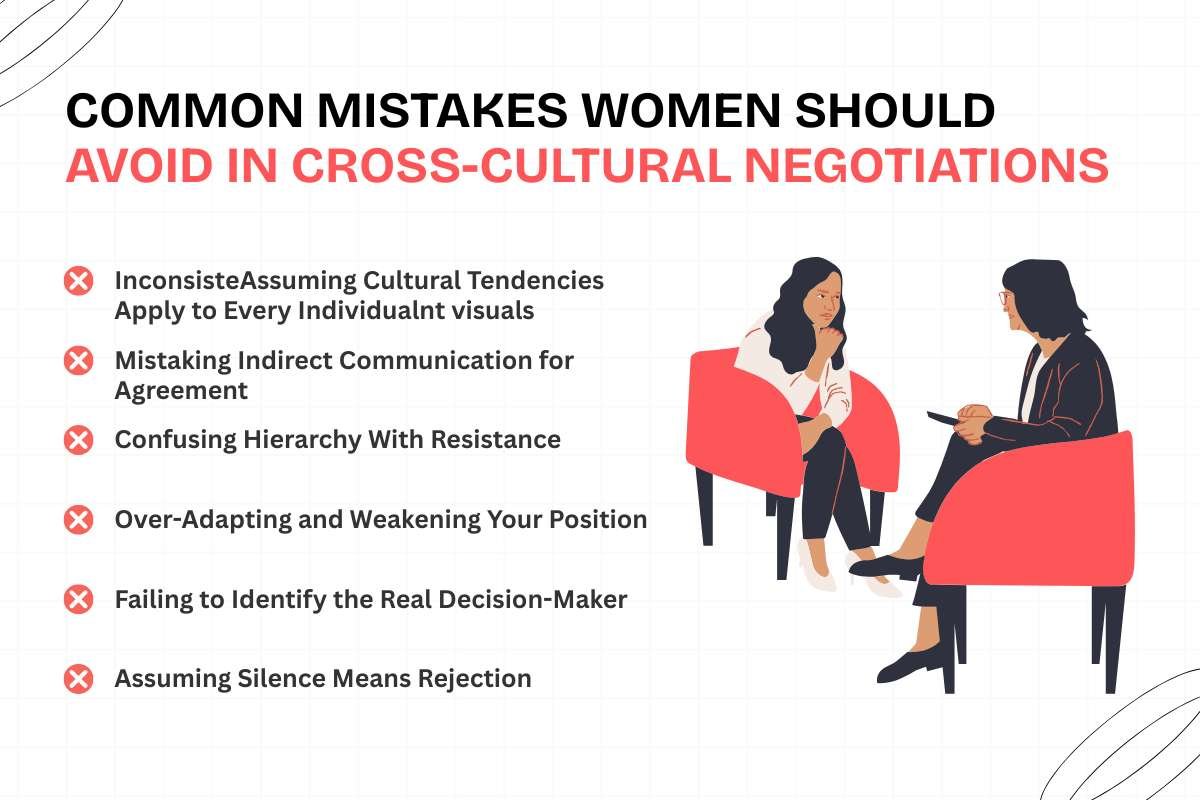
Knowing cultural differences in negotiation is only half the skill. Knowing when not to rely on them is the other half.
Cross-cultural negotiation can go wrong when preparation turns into assumption or when adaptability becomes over-accommodation. Research has found that negotiators can actually adjust too far toward their counterpart’s perceived cultural style, creating misunderstandings rather than reducing them.
1. Assuming cultural tendencies apply to every individual
A cultural pattern is a starting point, not a prediction.
Assuming that every negotiator from a particular country will communicate, make decisions, or respond to conflict in the same way can cause you to misread the person in front of you. Professional background, personality, experience, and organizational culture also shape negotiation behavior.
Better approach: Research the culture, then observe the individual.
2. Mistaking indirect communication for agreement
A polite or noncommittal response does not necessarily mean “yes.”
Phrases such as “We will consider it” or “That could be difficult” may leave room for disagreement. Instead of filling the silence with your own interpretation, ask a neutral follow-up question.
Try: “What concerns would we need to address before moving forward?”
3. Confusing hierarchy with resistance
A counterpart who cannot give an immediate answer may not be rejecting your proposal. They may need approval from someone with greater authority.
Better approach: Ask early how decisions are made and who needs to be involved before an agreement becomes final.
4. Over-adapting and weakening your position
Cultural adaptability does not mean abandoning your normal negotiation style or making unnecessary concessions.
In fact, research on American and Japanese negotiators found that both sides sometimes adapted too far toward their assumptions about the other culture, which contributed to communication clashes.
Remember: Adapt your delivery, not your bottom line.
5. Failing to identify the real decision-maker
Negotiating effectively with the wrong person can leave you starting over at the final stage.
Before discussing your most important terms, understand:
- Who recommends the decision?
- Who approves it?
- Who can change the terms?
- Who has influence but not formal authority?
This is particularly important in cultures and organizations where hierarchy plays a significant role.
6. Assuming silence means rejection
Silence is one of the easiest negotiation signals to misinterpret. It can indicate reflection, discomfort, disagreement, or simply a preference for processing information before responding.
Rather than rushing to fill the gap or immediately improving your offer, pause and ask:
“What are your thoughts on this proposal?”
Allow the other party to define what the silence actually means.
Phrases women should avoid (and what to say instead)
The words you choose can shape how your confidence, flexibility, and authority are perceived. This becomes even more important when cultural differences in negotiation affect how directness, politeness, and hierarchy are interpreted.
Research on negotiation language shows that hedges, disclaimers, and overly tentative phrasing can affect perceptions of power, although the impact depends on the context and whether the negotiation is competitive or collaborative.
The goal is not to sound tougher. It is to sound clear, credible, and intentional. Having a few prepared negotiation scripts women can use can make that shift easier, particularly when the conversation becomes uncomfortable or culturally unfamiliar.
| Avoid saying | Say instead | Why it works |
| “I’m sorry, but could we possibly discuss the price?” | “I’d like to discuss the pricing based on the scope and value.” | Removes unnecessary apology |
| “I’m not sure if this is reasonable…” | “Based on the scope, this is the range I’m proposing.” | Communicates confidence without aggression |
| “Would it be okay if we asked for…?” | “Could we discuss including this in the agreement?” | Turns a hesitant request into a clear discussion |
| “I completely understand if that’s not possible.” | “What would need to change to make this workable?” | Keeps the conversation open |
| “I’ll accept whatever works for you.” | “Let’s identify terms that work for both sides.” | Shows flexibility without surrendering leverage |
| “This is probably too much to ask.” | “Here’s what I’m proposing and why.” | Shifts attention from self-doubt to evidence |
1. Avoid apologetic language
Words such as “sorry,” “just,” “maybe,” and “I was wondering” can unnecessarily weaken an otherwise reasonable request.
Instead of:
“Sorry, I just wanted to ask whether there might be some flexibility on the timeline.”
Try:
“Could we discuss some flexibility on the timeline?”
The second version remains polite while making the request unmistakably clear.
2. Avoid overly aggressive language
Cultural adaptability works both ways. Being confident does not require sounding confrontational.
Instead of:
“This is my final offer. Take it or leave it.
Try:
“This is the strongest position we can support given the scope. How can we move forward from here?”
This protects your boundary while creating space for collaboration particularly valuable in relationship-oriented negotiation environments.
3. Replace self-doubt with evidence
Women can sometimes soften requests because they anticipate negative reactions to assertiveness. Research has found that women negotiating for themselves may face backlash for behavior perceived as overly demanding.
One effective response is to anchor your position in objective evidence rather than personal justification.
Instead of:
“I feel that I deserve a higher fee.”
Try:
“The expanded scope, additional responsibilities, and expected outcomes support a revised fee of X.”
The shift is subtle but powerful: from personal preference to business rationale.
A practical 5c framework for cross-cultural negotiation
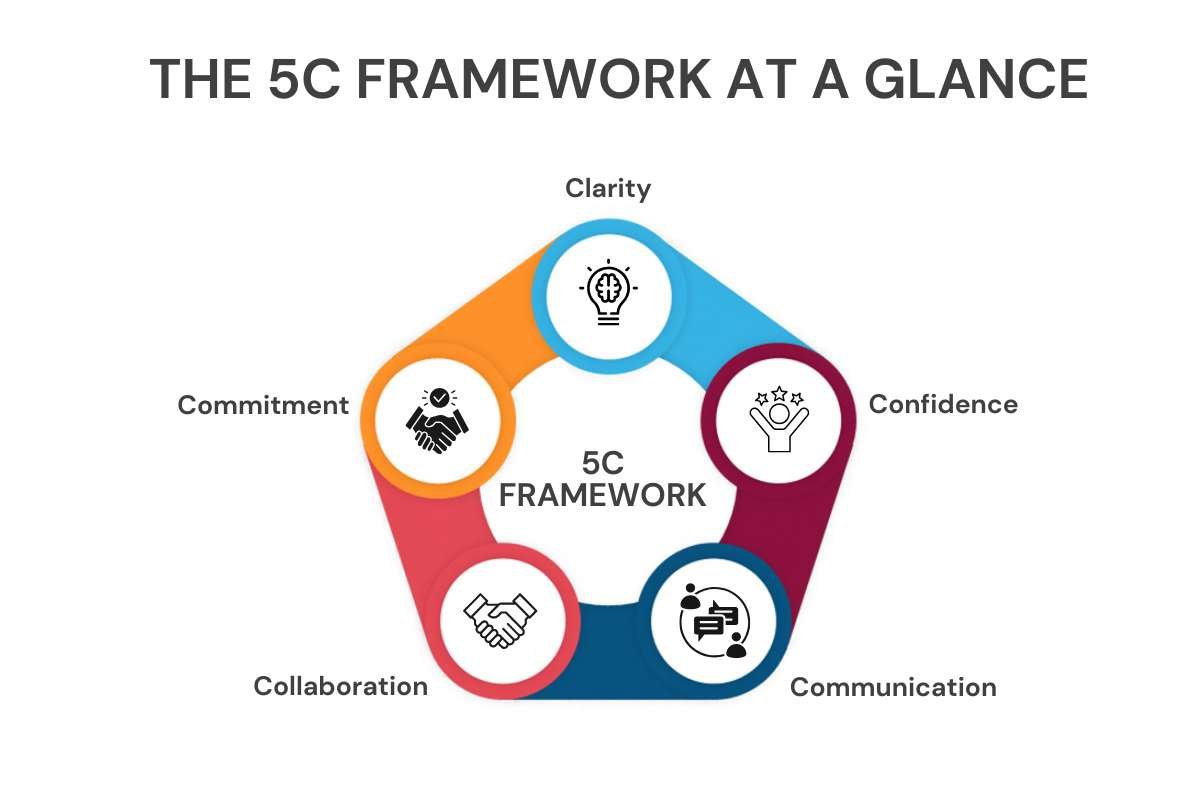
Cross-cultural negotiation becomes easier when you have a simple structure to fall back on.
The 5C framework, Clarity, Confidence, Communication, Collaboration, and Commitment, is a practical model for preparing and managing the negotiation from first conversation to final agreement.
This is not a universally established negotiation model; rather, it brings together behaviors consistently emphasized in cross-cultural negotiation research, including clear communication, adaptability, shared interests, and relationship-building.
1. Clarity: know what you want
Before adapting to the other side, be clear about your own position.
Define:
- Your target outcome
- Your minimum acceptable terms
- Your priorities
- Your BATNA
- Where you can make trade-offs
Cultural flexibility becomes risky when you are unclear about your own boundaries.
Ask yourself: What am I willing to change, and what is non-negotiable?
Confidence does not mean dominating the conversation. It means being comfortable stating your value, asking for what you need, and holding your position when challenged.
2. Confidence: hold your position
For women navigating different expectations around assertiveness, confidence can be communicated through preparation, calm delivery, evidence, and consistency.
Instead of over-explaining a request, state it clearly and support it with relevant facts.
Your goal: Adapt your tone without apologizing for your position.
3. Communication: make meaning explicit
Different expectations around directness, silence, formality, and language can create unnecessary ambiguity. Keep important messages simple:
Position → Reason → Question
For example:
“We can support the proposed timeline if the scope remains unchanged. Which option would work best for your team?”
Avoid idioms, sarcasm, vague commitments, and culturally specific expressions that may not translate well. Clear communication and active listening are repeatedly identified as important competencies in intercultural negotiation.
4. Collaboration: look beyond positions
Cross-cultural negotiation should not become a contest over who gives up more. Identify the interests underneath each position and look for options that create value for both sides.
A clear written recap can prevent a polite “yes” from becoming a completely different interpretation later. The communication channel can also matter. Knowing when to negotiate in person versus over email can help you decide when nuance, relationship-building, or a written record is most valuable. Cross-cultural negotiation guidance similarly recommends managing expectations and confirming commitments rather than relying on assumptions.
If the other party wants a lower price while you need to protect margins, for example, consider whether volume, contract length, payment terms, scope, or implementation support could create a better trade-off.
This shifts the conversation from:
“Who compromises?”
To:
“What can we change to make the agreement work for both sides?”
5. Commitment: turn agreement into action
A negotiation is not complete when both parties say yes. It is complete when everyone understands what happens next.
Before closing, confirm:
- What was agreed
- Who is responsible
- What needs approval
- Key deadlines
- Next steps
- How changes will be handled
A clear written recap can prevent a polite “yes” from becoming a completely different interpretation later. The communication channel can also matter. Knowing when to negotiate in person versus over email (comparison) can help you decide when nuance, relationship-building, or a written record is most valuable. Cross-cultural negotiation guidance similarly recommends managing expectations and confirming commitments rather than relying on assumptions.
The 5C framework at a glance
| The 5C | Core question | What it protects |
| Clarity | What exactly do I want? | Your priorities |
| Confidence | Can I state and defend my value? | Your leverage |
| Communication | Have we understood each other correctly? | Meaning |
| Collaboration | How can we create mutual value? | The relationship |
| Commitment | What happens after we agree? | The outcome |
Used together, the 5Cs create a practical balance: adapt to the culture, stay clear about your interests, and make every important agreement explicit.
Conclusion:
Cultural differences in negotiation can influence communication, trust, hierarchy, decision-making, and the way assertiveness is interpreted. But culture should never become an excuse for making assumptions about the person across the table.
For women, the challenge can be more nuanced. Gender expectations may shape how assertiveness and self-advocacy are perceived, while cultural expectations can change what “assertive,” “respectful,” or “collaborative” looks like in a particular setting. Research shows that these effects are contextual rather than universal.
The strongest response is neither rigidity nor over-adaptation.
It is strategic flexibility.
- Research the context.
- Prepare your alternatives.
- Listen for interests.
- Ask instead of assuming.
- Adapt your communication.
- Protect your boundaries.
- Put important agreements in writing.
Most importantly, don’t confuse cultural intelligence with making yourself smaller.
You can be respectful without being passive, collaborative without being accommodating, and culturally adaptable without compromising the value you bring. The goal is simple: adapt your approach, not your worth.
FAQs
1. How do cultural differences impact women’s negotiation styles?
Cultural differences can influence how assertiveness, silence, hierarchy, relationship-building, and disagreement are interpreted. Research shows that the interaction between culture and gender can affect negotiation performance, but the effect varies across cultural contexts rather than following one universal pattern.
2. What is the golden rule of cross-cultural negotiation?
Adapt your approach, not your objectives. Learn how the other side communicates and makes decisions, but keep your priorities, boundaries, and value proposition clear.
3. How should women handle indirect communication during negotiations?
Avoid interpreting ambiguous statements as either agreement or rejection. Ask neutral questions such as, “What would need to change for this proposal to work?” This allows you to gather information before changing your position.
4. Is the 70/30 rule necessary in cross-cultural negotiation?
The 70/30 listening rule can be used as a personal listening discipline, but it should not be treated as a research-backed universal formula. The more important principle is to listen actively enough to understand priorities, constraints, concerns, and decision-making dynamics before responding.
5. What are the biggest mistakes women should avoid when negotiating across cultures?
The most common mistakes include stereotyping cultural behavior, mistaking politeness for agreement, overlooking decision-makers, over-adapting, neglecting BATNA preparation, and weakening a position simply to appear agreeable. The better approach is to research the context, observe the individual, ask clarifying questions, and negotiate from clear priorities.