
An impressive executive career does not automatically translate into board visibility. Leading teams, managing budgets, and driving transformation matter, but boards ask a different question: What can this person contribute in the boardroom?
That is why knowing how to build a board profile that gets you noticed matters.
The opportunity for women is growing. In 2025, women accounted for 47% of first-time director appointments in the U.S., while 56% of first-time directors were diverse candidates, according to Spencer Stuart.
At the same time, boards are becoming more specific about the expertise they need. For example, 83% of S&P 500 companies disclosed AI as a risk in 2025, but only 2.7% of directors disclosed AI expertise.
The takeaway is simple: you do not need to offer everything a board needs. You need to make your distinctive value easy to recognize.
What is a board profile?
A board profile that gets you noticed is a concise presentation of your professional experience, expertise, achievements, and perspective specifically for board opportunities.
It is different from an executive résumé.
An executive résumé focuses on proving that you can perform a particular job. A board profile should demonstrate your ability to contribute to the areas covered by what board directors actually do, including:
- Strategy
- Risk oversight
- Financial discussions
- Long-term decision-making
- Governance
- Constructive challenge
- Stakeholder management
For example:
Executive résumé:
Led a 500-person technology organization responsible for digital transformation.
Board profile:
Technology and transformation executive with experience overseeing enterprise-wide digital change, AI adoption, and technology risk.
The second version immediately communicates potential board value.
How to build a board profile that gets you noticed
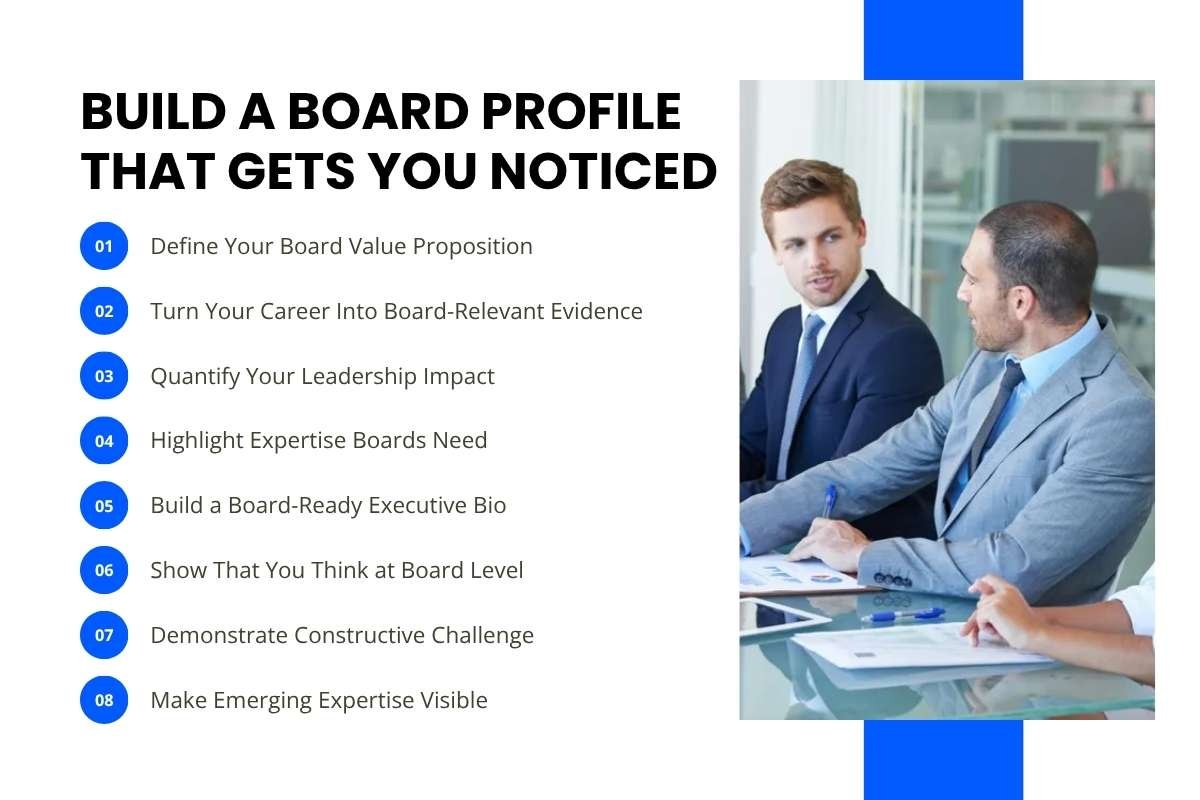
1. Define your board value proposition
Start with one question:
Why would a board want you in the room?
Avoid generic descriptions such as “experienced leader” or “strategic thinker.” Identify the combination of expertise and experience that makes you distinctive.
For example:
Consumer and digital transformation executive with experience scaling businesses across emerging markets, leading technology change and advising senior leadership on customer strategy and growth.
Your value proposition should connect:
Expertise + Evidence + Board relevance
If you are a finance leader, emphasize capital allocation, financial oversight, M&A, and risk.
If you are a technology leader, highlight digital transformation, AI, cybersecurity, and technology governance.
If your background is in people leadership, focus on succession, culture, and organizational transformation.
2. Turn your career into board-relevant evidence
Your career probably contains more board-relevant experience than your résumé currently shows.
Look for decisions involving:
- Business strategy
- Capital
- Risk
- Regulation
- Technology
- Crisis management
- Market expansion
- Acquisitions
- Restructuring
- Leadership succession
These experiences demonstrate judgment. They can come from executive roles, advisory positions, committee work, or non-profit board experience, particularly when they demonstrate governance, oversight, and strategic decision-making.
Instead of:
Managed international operations.
Try:
Led expansion across three international markets, balancing regulatory, operational, and investment considerations while building regional leadership teams.
The second statement tells a board more about how you think.
This is an important part of how to build a board profile that gets you noticed: translate responsibilities into evidence of judgment, scale, complexity, and decision-making.
3. Quantify your leadership impact
A strong board profile shows scale.
Look for evidence such as:
- Revenue or P&L managed
- Team size
- Markets entered
- Percentage growth
- Cost savings
- Investments overseen
- Acquisitions
- Transformation budgets
- Customer growth
For example:
Led a 700-person business through a restructuring that reduced operating costs by 12% while protecting core revenue.
is stronger than:
Led a major organizational restructuring.
You do not need numbers in every sentence. Use them where they demonstrate scale, complexity, or impact.
4. Highlight expertise boards need
Do not try to list every skill you have developed.
Choose the areas where you have genuine depth and evidence.
Potential board-relevant expertise includes many of the skills most valued in board directors, such as:
- Strategy
- Finance
- Risk
- M&A
- AI
- Cybersecurity
- Digital transformation
- Sustainability
- Consumer insight
- International markets
- Human capital
- Regulation
Specialized expertise can be a powerful differentiator.
Spencer Stuart’s 2025 Director Pulse Survey found that 92% of directors said cybersecurity expertise had a positive impact on board oversight, while 92% said the same about digital and technology expertise. AI and financial expertise were each rated positively by 87% of respondents.
This gives women a useful way to think about their positioning.
Do not simply say:
“I am an experienced executive.”
Ask:
“What specific business challenge can my experience help a board understand or oversee?”
5. Build a board-ready executive bio
Your board bio should be concise and strategic.
A useful structure is:
Current leadership identity → Core expertise → Signature experience → Board contribution → Industry or geographic perspective
Example Board Bio
Priya Sharma is a technology and business transformation executive with more than 20 years of experience leading digital strategy, organizational transformation, and international growth. She has held senior leadership roles across technology and consumer businesses, overseeing large-scale transformation programs and complex operating environments. Her expertise includes AI strategy, digital transformation, technology risk, customer growth, and leadership development. She brings cross-market experience and a strong understanding of how technology, people, and business strategy intersect.
The bio does not list every job she has held.
It creates a clear picture of who she is, what she knows, and why a board might need her.
When considering how to build a board profile that gets you noticed, the executive bio is one of the most important assets because it can be adapted for board introductions, search-firm conversations, speaker profiles, LinkedIn, and board databases.
6. Show that you think at board level
One major difference between an executive profile and a board profile is perspective.
Understanding the roles and responsibilities as women on corporate boards can help candidates frame their experience around oversight, judgment, and long-term decision-making.
Executives describe what they did.
Board candidates need to demonstrate how they think.
Compare:
Managed a major AI implementation.
With:
Led enterprise AI transformation while evaluating technology investment, operational risk, governance, and long-term business impact.
The second statement shows broader judgment.
A board is not simply asking:
“Can we implement this?”
It is also asking:
“Should we do this, what could go wrong, and how should management be held accountable?”
Your profile should demonstrate that you understand this distinction.
7. Demonstrate constructive challenge
Board members are not expected to agree with everyone.
They need to ask difficult questions, challenge assumptions, and maintain productive relationships with management.
Your profile can demonstrate this through experience such as:
- Leading difficult strategic decisions
- Managing crises
- Challenging established business models
- Advising CEOs
- Working with investors
- Managing regulatory scrutiny
- Making decisions under uncertainty
Avoid simply calling yourself a “strong communicator.”
Show situations where you used communication and judgment to influence important decisions.
8. Make emerging expertise visible
AI provides a good example of why board profiles need to evolve.
The Conference Board found that only 2.7% of S&P 500 directors disclosed AI expertise in 2025, even as AI became a major business and governance issue.
If you have genuine experience in an emerging area such as AI governance, cybersecurity, climate risk, or digital transformation, do not bury it at the bottom of your résumé.
Make it part of your headline, summary, or core expertise.
You should not claim expertise simply because a skill is trending.
But if you have credible experience, make sure the market can see it.
How women can make their board profiles more visible

A strong profile is only useful if the right people see it. For women pursuing board opportunities, building this visibility is an important part of how to get your first board seat as a woman.
Board opportunities can involve existing director networks, board chairs, CEOs, and executive search firms. That makes visibility important.
1. Build relationships before you need a seat
Develop relationships with:
- Existing directors
- Board chairs
- CEOs
- Investors
- Executive search professionals
- Industry associations
Do not make every conversation a request for a board seat.
Instead, make your expertise memorable.
2. Build a visible point of view
Consider:
- Writing industry articles
- Speaking at events
- Joining expert panels
- Publishing thoughtful LinkedIn posts
- Contributing to research
- Discussing emerging business risks
The objective is not to become a social-media personality.
It is to create professional evidence of your expertise.
What should women include in a board cv?
A board CV should prioritize relevance over completeness. Alongside your experience and expertise, relevant board readiness programs for women can also demonstrate preparation for board-level responsibilities, particularly when they strengthen your understanding of governance, risk, and oversight.
Include:
- Professional headline: A concise description of your board value.
- Board value proposition: Two or three sentences explaining your strongest contribution.
- Core expertise: Focus on five to eight relevant areas.
- Career highlights: Prioritize achievements demonstrating strategy, scale, and judgment.
- Board and advisory experience: Clearly separate governance experience from executive roles.
- Committee-relevant expertise: Include relevant audit, risk, remuneration, nomination, technology, or sustainability experience.
- Industry and geographic experience: Highlight markets and sectors where you have meaningful experience.
Common board profile mistakes women should avoid
- Making the profile too long: A board profile that gets you noticed is not your complete career history.
- Using generic language: Words such as “visionary,” “dynamic,” and “passionate” mean little without evidence.
- Being overly modest: If you led an initiative, say so. Do not reduce your contribution to “supported” or “helped” when you were responsiblefor the outcome.
- Making diversity your main qualification: Being a woman can add an important perspective, but it should not be your entire valueproposition. Lead with expertise, experience, and judgment.
- Trying to appear qualified for everything: A profile claiming expertise in every function can become less credible. Specific beats broad.
- Making the profile entirely operational: Show how your operational experience translates into strategy, oversight, risk assessment, and long-term decision-making.
How do boards choose directors?
Boards often begin by identifying a gap in their existing skills.
They may need someone with:
- Technology expertise
- Financial experience
- International exposure
- Consumer knowledge
- Cybersecurity expertise
- Industry experience
- Sustainability knowledge
The nomination or governance committee may then develop a candidate profile.
Candidates can emerge through:
- Existing director networks
- CEOs and senior executives
- Investors
- Executive search firms
- Professional associations
- Personal recommendations
That means your profile should be specific and memorable.
If a chair says, “We need someone who understands AI risk and has international growth experience,” your profile should make it immediately obvious if you fit that description.
A simple board profile that gets you noticed formula for women

If you are unsure where to start, use this formula:
I am a [leadership identity] with expertise in [two or three areas]. I have [evidence of scale or impact] and experience in [industry/geography]. I bring a board’s perspective on [specific strategic issues].
For example:
I am a consumer and technology executive with expertise in digital transformation, AI strategy, and international growth. I have led large-scale transformations across multiple markets and managed complex customer and technology operations. I bring boards a practical perspective on technology investment, customer strategy, organizational transformation, and emerging digital risk.
This is far stronger than:
Senior executive with extensive leadership experience.
Board profile checklist
Before sending your profile to a potential board contact, ask:
- Does my profile explain my board value within 30 seconds?
- Is my expertise specific?
- Have I shown measurable impact?
- Does my experience demonstrate strategic judgment?
- Have I included the scale of my leadership?
- Is my financial and commercial experience clear?
- Have I demonstrated governance awareness?
- Does my profile show how I think, not just what I have done?
- Have I highlighted expertise relevant to current board needs?
- Does my LinkedIn profile communicate the same positioning?
- Would a search consultant know what type of board role suits me?
Once an opportunity does emerge, it is equally important to assess whether the role is right for you by considering the questions to ask before accepting a board seat.
If the answer is yes, your profile is doing more than documenting your career.
It is positioning you for the boardroom.
Conclusion:
Knowing how to build a board profile that gets you noticed is ultimately about making your value easy to understand.
You do not need to list every achievement from your career. You need to identify the experiences that demonstrate judgment, expertise, commercial understanding, and strategic perspective.
For women pursuing board opportunities, that means being intentional about how their careers are presented.
Lead with your strongest expertise. Quantify your impact. Show how you have handled complexity. Make relevant emerging skills visible. Demonstrate that you understand the difference between managing a business and overseeing one.
Most importantly, do not wait for a board vacancy to start building your profile.
Build the profile. Build the relationships. Build the visibility. Then make sure the right people know exactly what you can bring to the boardroom.
FAQs:
1. What should aboard profile that gets you noticed include?
A board profile should include your leadership expertise, measurable achievements, industry experience, strategic strengths, governance knowledge, and the specific value you can bring to a board.
2. How can women make their board profiles stand out?
Focus on specific expertise, quantify leadership impact, highlight board-relevant experience, and demonstrate strategic judgment. How to build a board profile that gets you noticed starts with making your unique board value clear.
3. How long should a board profile that gets you noticed be?
A board profile should be concise and focused, usually around one to two pages. Prioritize experience and achievements that demonstrate strategic, commercial, financial, or governance value.
4. Should a board profile be different from an executive résumé?
Yes. An executive résumé focuses on your ability to perform a job, while a board profile emphasizes strategic oversight, risk, governance, judgment, and long-term decision-making.
5. How can I improve my chances of being noticed for board opportunities?
Build relationships with directors, board chairs, CEOs, and search professionals while developing visible expertise through speaking, writing, and industry contributions. How to build a board profile that gets you noticed also depends on ensuring the right people can clearly understand your expertise.