
If you are searching for how to get your first board seat as a woman, the process starts long before you apply for a director position.
Corporate boards need directors who can contribute to strategy, oversee risk, understand financial performance, challenge management constructively, and exercise independent judgment. That makes board recruitment different from conventional executive hiring.
The opportunity for women is growing, although progress remains uneven. According to MSCI’s 2025 Women on Boards and Beyond report, women held 28.3% of board seats globally in 2025, up from 27.3% in 2024. Nearly half of the companies covered had reached at least 30% female board representation.
In the U.S., women accounted for 38% of new S&P 500 director appointments in 2025, according to Spencer Stuart. Its research also found that 38% of new directors were first-time directors, showing that previous public-company board experience isn’t always required.
So, how to get your first board seat as a woman is less about waiting until you have the perfect board résumé and more about demonstrating board readiness.
1. Understand what boards look for
The first step in understanding how to get your first board seat as a woman is knowing what boards actually need.
Directors don’t manage day-to-day operations. They provide oversight and contribute to decisions involving strategy, risk, CEO succession, financial performance, and long-term value creation. Understanding what board directors actually do (T1) can help you assess whether your executive experience translates effectively into board-level contribution.
Your experience may be particularly valuable in areas such as:
- Finance and capital allocation
- Technology and AI
- Cybersecurity
- Marketing and customer strategy
- International expansion
- Risk management
- Human resources and succession
- Sustainability
- Mergers and acquisitions
- Digital transformation
- Entrepreneurship
Spencer Stuart’s 2025 U.S. Board Index found that 30% of new S&P 500 directors had current or former CEO experience, while 29% had financial backgrounds.
But you don’t need to be a former CEO or CFO.
Ask instead:
What expertise can I bring that this particular board needs?
A technology executive, for example, shouldn’t simply present herself as someone who leads technology. Highlighting expertise in AI adoption, digital transformation, and technology risk makes the potential board-level value much clearer.
2. Define your board value proposition
A major part of learning to get your first board seat is defining what makes you valuable beyond your current job title.
Ask:
What would a board gain by having me in the room?
Your answer should connect your experience with a business challenge.
For example:
“I bring cybersecurity and technology transformation expertise to boards navigating digital risk and AI adoption.”
Or:
“I bring international growth and consumer strategy expertise to companies expanding into new markets.”
Your value proposition should combine expertise, leadership experience, perspective, and judgment.
Being a woman can contribute to board diversity, but diversity shouldn’t be the entirety of your pitch. Boards need to understand the specific expertise and strategic value you bring.
3. Can you get your first board seat as a woman without board experience?

Yes.
If you’re researching how to get your first board seat as a woman and worrying about a lack of board experience, don’t assume you’re automatically disqualified.
Spencer Stuart reported that 38% of new S&P 500 directors in 2025 were first-time public-company directors. Women represented 47% of those first-time appointments.
You can also develop relevant experience through:
- Advisory boards
- Nonprofit boards
- Startup boards
- Industry associations
- Professional committees
- University boards
- Community organisations
These opportunities, including non-profit board experience (T2), can expose you to governance, committees, financial oversight, strategic decisions, and stakeholder accountability.
Focus on what you actually contributed. Did you participate in strategic planning, review financial performance, assess risk, or challenge an important decision?
Such experiences can help demonstrate that you understand the difference between governance and management.
4. Identify the expertise that makes you board-ready
This is closely connected to the skills that are most valued in board directors (T2), particularly strategic thinking, financial literacy, risk oversight, and industry-specific expertise.
There is no single route to the boardroom. One company may need a financial expert, while another may need someone with technology, cybersecurity, consumer, or international-growth expertise.
| Your expertise | Potential board value |
| Finance | Financial oversight and capital allocation |
| Technology | AI and digital transformation |
| Cybersecurity | Technology and data risk |
| Marketing | Customer and brand strategy |
| HR | Talent and succession |
| Legal | Regulation and governance |
| Operations | Scaling and resilience |
| Sustainability | ESG and stakeholder issues |
| Entrepreneurship | Innovation and growth |
| International business | Global expansion |
Review your career and identify the areas where you have repeatedly solved complex problems. This is particularly important for women on corporate boards (pillar), where candidates need to demonstrate the specific expertise and strategic value they can bring to a board.
Ask:
- What decisions have I influenced?
- What business challenges have I solved?
- Where do senior leaders seek my advice?
- What expertise could complement an existing board?
Your answers can reveal the boards where your experience is most relevant.
5. Create a board-specific résumé
If you’re serious about securing your first board seat as a woman, don’t rely entirely on the résumé that built your executive career.
An executive résumé often emphasises responsibilities, team size, and operational achievements. A board résumé should make strategic impact and judgment more visible.
Instead of:
“Managed a global team of 400 employees.”
Consider:
“Led a multi-market transformation that strengthened operational resilience and supported long-term growth.”
Highlight:
- Strategic decision-making
- Financial responsibility
- Risk management
- Crisis leadership
- Business transformation
- Governance exposure
- Industry expertise
- Stakeholder management
- Leadership and succession
Your LinkedIn profile should reinforce the same positioning. Anyone reviewing your profile should quickly understand what type of board would benefit from your experience. This is also why learning how to build a board profile that gets you noticed (T2) is important before you begin actively pursuing board opportunities.
6. Build governance experience before your first corporate seat

Another important step in learning how to get your first board seat as a woman is gaining practical governance exposure.
You don’t have to wait for your first corporate appointment to develop boardroom skills.
An advisory board vs corporate board (comparison) experience can provide strategic exposure, while a nonprofit board can introduce you to governance and committees.
Choose these opportunities strategically based on the type of board you eventually want to join.
Your goal is to build evidence that you can:
- Evaluate strategy
- Understand financial information
- Assess risk
- Ask challenging questions
- Work effectively with other directors
- Think independently
- Maintain the boundary between governance and management.
Your first board-related experience doesn’t have to be prestigious. It needs to be relevant and credible. For women who want structured preparation, board readiness programs for women (T2) can also provide governance education, boardroom preparation, and opportunities to build relevant networks.
7. Build a board-focused network
When pursuing your first board seat as a woman, relationships matter.
Board opportunities don’t always follow the same recruitment process as executive roles.
Relationships with directors, CEOs, investors, and search professionals can increase your visibility when relevant opportunities arise.
Build relationships with:
- Existing board directors
- CEOs and founders
- Investors
- Executive search consultants
- Private equity and venture capital professionals
- Industry leaders
- Women already serving on boards
Instead of immediately asking, “Do you know of a board opening?” try framing the conversation around your expertise:
“I’m building toward my first independent board role and am particularly interested in companies where my experience in digital transformation and growth could be useful. I’d value your perspective on where that expertise might be relevant.”
This creates a conversation about your capabilities rather than simply asking someone to find you a vacancy.
8. Make your expertise visible
Choose two or three areas you want associated with your professional identity, such as:
- AI and technology strategy
- Cybersecurity
- Consumer growth
- Sustainability
- Financial transformation
- International expansion
- Talent and succession
Then demonstrate that expertise through:
- Industry events and panels
- Professional articles and insights
- LinkedIn content
- Governance organisations
- Women-focused leadership networks
- Speaking opportunities
The goal isn’t to constantly announce that you’re looking for a board seat.
It is to become known for expertise that boards need. It also helps to understand how board diversity mandates around the world in 2026 (T1) are influencing board composition and director searches.
Spencer Stuart’s 2025 research found technology and telecommunications were the most common industry backgrounds among female director appointments, accounting for 22%, followed by consumer goods and services at 16%.
The lesson is simple: build visibility around expertise, not just ambition.
9. Prepare for board-level interviews

Preparing for board interviews is an essential part of securing your first board seat as a woman.
A board interview can cover:
- Corporate strategy
- Financial performance
- Risk
- CEO succession
- Governance
- Industry disruption
- Crisis management
- Stakeholder relationships
Being able to discuss these areas confidently requires a clear understanding of the roles and responsibilities of women on corporate boards (T1), particularly how directors contribute to oversight, strategy, and accountability without taking over management’s responsibilities.
Prepare examples that demonstrate judgment rather than simply execution.
You may be asked:
“Tell us about a time you challenged a major business decision.”
Or:
“What do you see as the biggest strategic risk facing our organisation?”
These questions help boards assess whether you can think beyond your functional expertise.
You should also be comfortable disagreeing respectfully. A strong director doesn’t simply agree with management; she asks questions that help the organisation consider risks, opportunities and alternatives.
10. Evaluate the board before you accept
Knowing how to get your first board seat as a woman is only half the equation. You also need to know whether a board seat is worth accepting.
Before saying yes, investigate:
- The company’s financial position
- Ownership structure
- Business strategy
- Major risks
- Existing directors
- Governance practices
- Potential conflicts of interest
- Expected time commitment
- Directors and officers insurance
- Your legal and fiduciary responsibilities
Ask yourself:
Would I be comfortable having my professional reputation associated with this organisation if something went wrong?
The considerations can also differ depending on whether you’re evaluating women on private company boards vs public company boards (comparison), particularly when it comes to governance structures, disclosure requirements, shareholder expectations and regulatory obligations.
11. Understand board compensation
Compensation is another practical consideration when learning how to get your first board seat as a woman.
Corporate directors may receive:
- Annual cash retainers
- Equity
- Committee fees
- Meeting fees
- Chair fees
Compensation varies by company, industry, geography, and responsibilities.
For S&P 500 companies, Spencer Stuart’s 2025 Board Index provides detailed data on director compensation, including cash retainers, equity awards, and additional compensation for leadership roles.
However, compensation shouldn’t be the only consideration for a first board opportunity.
A well-chosen seat can provide governance experience, strategic exposure, professional credibility, relationships, and a pathway to future board opportunities.
12. Common mistakes women should avoid
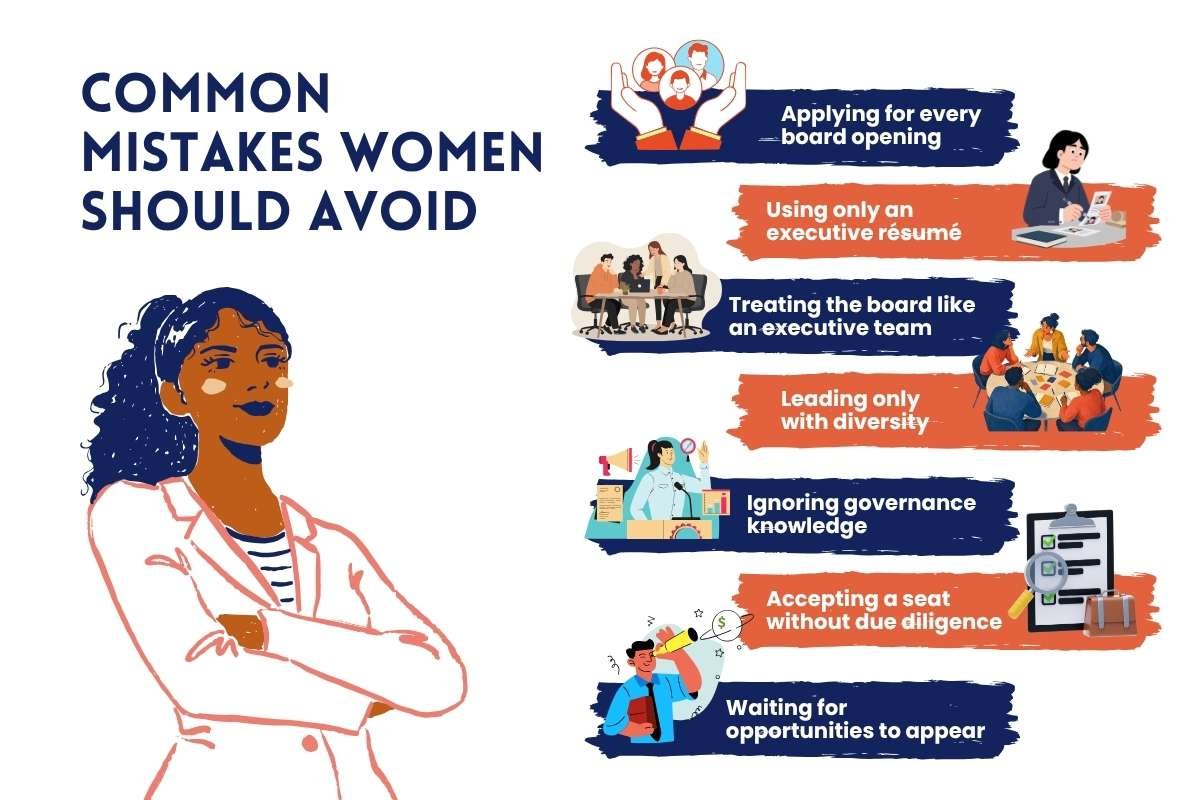
If you’re learning about your first board seat as a woman, avoid these common mistakes:
| Applying for every board opening | Target organisations where your expertise genuinely fits. |
| Using only an executive résumé | Make strategic impact, governance and judgment visible. |
| Treating the board like an executive team | Directors oversee management rather than running daily operations. |
| Leading only with diversity | Your perspective can strengthen diversity, but expertise should remain central to your proposition. |
| Ignoring governance knowledge | Executive success doesn’t automatically translate into board readiness. |
| Accepting a seat without due diligence | Investigate the organisation, board dynamics, risks and responsibilities carefully. |
| Waiting for opportunities to appear | Develop relationships and visibility before a board search begins. |
Your 10-step roadmap to your first board seat
If you’re serious about securing your first board seat as a woman, use this roadmap:
- Audit your career: Identify your strongest strategic achievements.
- Identify your board expertise: Determine what you can contribute that boards need.
- Define your value proposition: Explain your board-level value clearly.
- Build a board résumé: Turn executive achievements into strategic evidence.
- Strengthen governance knowledge: Learn the difference between oversight and management.
- Gain governance experience: Consider advisory, nonprofit, or startup opportunities.
- Build relationships: Connect with directors, CEOs, investors, and search consultants.
- Increase visibility: Become known for a specific area of expertise.
- Prepare for board interviews: Practise discussing strategy, finance, risk, and governance.
- Conduct due diligence: Evaluate the company and board before accepting the appointment.
Conclusion:
Securing your first board seat as a woman is ultimately about demonstrating why your expertise belongs in the boardroom.
The data shows meaningful progress. Women held 28.3% of global board seats in 2025, according to MSCI, while women accounted for 38% of new S&P 500 director appointments, according to Spencer Stuart.
But progress at the aggregate level doesn’t eliminate the need for individual candidates to stand out.
The strongest answer to get your first board seat as a woman is to build a profile around expertise, strategic judgment, governance knowledge, visibility and relationships.
Your first appointment may begin with an advisory role, an introduction through your professional network, a conversation with another woman director, or a recruiter recognising a specific area of expertise.
Start building before the opportunity appears. Your first board seat isn’t just another title; it can be the foundation of your board career.
FAQs
1. How do I become a board member with no experience?
If you’re figuring out how to get your first board seat as a woman without previous board experience, start by building governance-related experience through advisory boards, nonprofit boards, startup boards, professional associations, or committees. Demonstrate how your leadership experience translates into strategy, financial oversight, risk management, and governance.
2. What qualifies you to be a board member?
There is no single qualification. Boards typically look for strategic judgment, leadership experience, financial literacy, relevant industry or functional expertise, governance knowledge, and the ability to provide independent oversight.
3. Can women get paid to be board members?
Yes. Corporate directors may receive cash retainers, equity, committee fees, or other compensation. The amount varies by company, industry, location, and responsibilities.
4. Is being a board member worth it?
A well-chosen board seat can provide governance experience, strategic influence, professional visibility, valuable relationships and a pathway to additional board opportunities. However, the quality and fit of the board should matter more than the title alone.
5. How Long Does It Take to Get Your First Board Seat as a Woman?
There is no fixed timeline. It depends on your experience, board readiness, network, visibility, and the opportunities you pursue. Building governance experience and strong board relationships can help shorten the path