

Negotiating job title and role scope is not just about asking for a more impressive title. It is about making sure your official position reflects the responsibilities, ownership, and decisions you already handle.
The solution is to compare your original role with your current responsibilities, document the results you have delivered, identify the level that best matches your work, and negotiate for the right combination of title, scope, authority, and progression.
Maybe you were hired to support a project but now run it. You may be mentoring newer employees even though you are not officially a manager. Perhaps you are making decisions about budgets, clients, or strategy that were never part of your original job description.
If that sounds familiar, it may be time to talk about more than salary.
Negotiating your job title and role scope means ensuring your official position reflects the work you are actually doing.
This matters for women because career progression gaps can build over time. In 2024, women in the U.S. earned 85% of men’s median hourly earnings, according to Pew Research Center. Pew Research Center and McKinsey’s Women in the Workplace 2025 report also found that for every 100 men promoted to manager, only 93 women were promoted. At the C-suite level, women held just 29% of positions.
That does not mean women simply need to “negotiate harder.” Research from Harvard’s Program on Negotiation has challenged the idea that women merely need to ask more often, pointing instead to factors such as workplace structures, opportunities, and how negotiations are received.
So the conversation should be bigger than:
“Can I get a raise?”
It should also include:
“Does my role still match the level at which I am working?”
These conversations are an important part of developing strong negotiation skills for women, particularly when the goal is to make career progression more visible and measurable.
Why Job Title and Role Scope Matter for Women?
Your job title tells people your formal level. Your role scope tells them what you actually own.
Those two things should broadly match.
Consider two professionals applying for the same Senior Manager position. One has officially held the Senior Manager title for three years. The other has spent three years doing similar work but still has a Manager title.
Their experience may be comparable, but the first candidate’s resume immediately communicates the level at which they have worked.
That is one reason negotiating job title and role scope can matter beyond your current employer. Your title appears on your resume, LinkedIn profile, professional introductions, and future job applications.
A good title should not simply sound senior. It should accurately communicate your level of responsibility. The same principle applies to the way you approach the conversation. Knowing how women can negotiate effectively can help you communicate your values and expectations without making the discussion unnecessarily confrontational.
Before negotiating, ask:
- Does my title match the level of work I perform?
- Does my scope resemble comparable roles?
- Do I have the authority needed to deliver my responsibilities?
- Does my current title support the direction I want my career to take?
- Would an outside employer understand my level from my title alone?
Signs Your Role Has Outgrown Your Job Title
You may want to consider negotiating your job title and role scope when your responsibilities have changed significantly, but your official position has not.
Look for signs such as:
- You regularly make decisions that your manager previously handled.
- You lead projects from planning through completion.
- You mentor or train other employees.
- You manage important clients or senior stakeholders.
- You control budgets or resources.
- You represent your team in leadership meetings.
- You are accountable for business results rather than simply completing tasks.
- You coordinate work across several teams or departments.
One extra responsibility does not automatically mean you need a new title. The stronger case is when your ownership, authority, and accountability have consistently increased.
What Does Role Scope Actually Include?
Role scope can cover much more than your daily tasks.
| Area | What it can look like |
| People | Managing employees, mentoring team members, or leading cross-functional teams |
| Money | Controlling budgets or approving spending |
| Projects | Owning delivery, timelines, and results |
| Clients | Managing important accounts or senior stakeholders |
| Strategy | Making decisions that affect a product, team, or business |
| Results | Being accountable for revenue, customer growth, efficiency, or other outcomes |
The important question is not whether you have more work. It is whether you have more ownership, accountability, and decision-making authority. That distinction is central to negotiating job title and role scope.
Make Sure Your Title Supports Your Career Story
A job title is one of the simplest ways recruiters, hiring managers, and professional contacts understand your career level. That is why negotiating job title and role scope matters beyond your current employer.
The goal is not to choose the most senior-sounding title. It is to make sure your title accurately reflects your responsibilities, authority, and results.
If your role has changed significantly, your career story should not depend on someone eventually noticing. Make the change visible, measurable, and clear.
The Hidden Problem: Doing the Job Without Having the Title
This is one of the clearest situations where negotiating job title and role scope becomes important: you are already performing at a higher level, but the organisation has not formally recognised the change.
One of the easiest traps to fall into is informal leadership. You might be the person everyone comes to for answers. You may train new employees, run meetings, coordinate several departments, and solve problems that normally sit with a manager.
Yet your official title never changes.
For example, imagine Priya was hired as a Marketing Specialist. A year later, she is:
- Running campaigns from start to finish
- Managing an agency
- Presenting results to the leadership team
- Controlling part of the marketing budget
- Training two new team members
She is clearly doing more than she was hired to do.
The conversation should not be:
“I have too much work.”
It should be:
“My level of ownership has changed, and I would like my role to reflect that.”
That is a much stronger starting point.
What Can You Negotiate Besides Salary?
Salary is important, but it is not the only thing on the table. When negotiating job title and role scope, look at the entire role rather than treating the title as a standalone request.
When your role changes, consider the full package.
| What you can negotiate | Why it matters | Example |
| Job title | Communicates your professional level | “Could this be aligned with the Senior Manager?” |
| Responsibilities | Defines what you actually own | “Can I own this product from strategy through delivery?” |
| Decision-making authority | Gives you the power to deliver results | “Can I approve spending within this budget?” |
| Team leadership | Builds formal management experience | “Will I have direct reports?” |
| Visibility | Gives senior leaders a clearer view of your work | “Could I present the quarterly results?” |
| Promotion timeline | Prevents vague promises | “Can we agree on a six-month review?” |
You do not have to ask for all of these.
The point is to look at the role as a whole.
The same broader approach can help when learning how to negotiate flexible work arrangements. Depending on your role, you may be able to discuss remote or hybrid work, flexible start and finish times, compressed schedules, or specific in-office days alongside your title and responsibilities.
A bigger title without authority may not solve the problem. Likewise, more responsibility without recognition can leave you doing higher-level work without receiving the career credit that comes with it.
When Should You Negotiate Job Title and Role Scope?
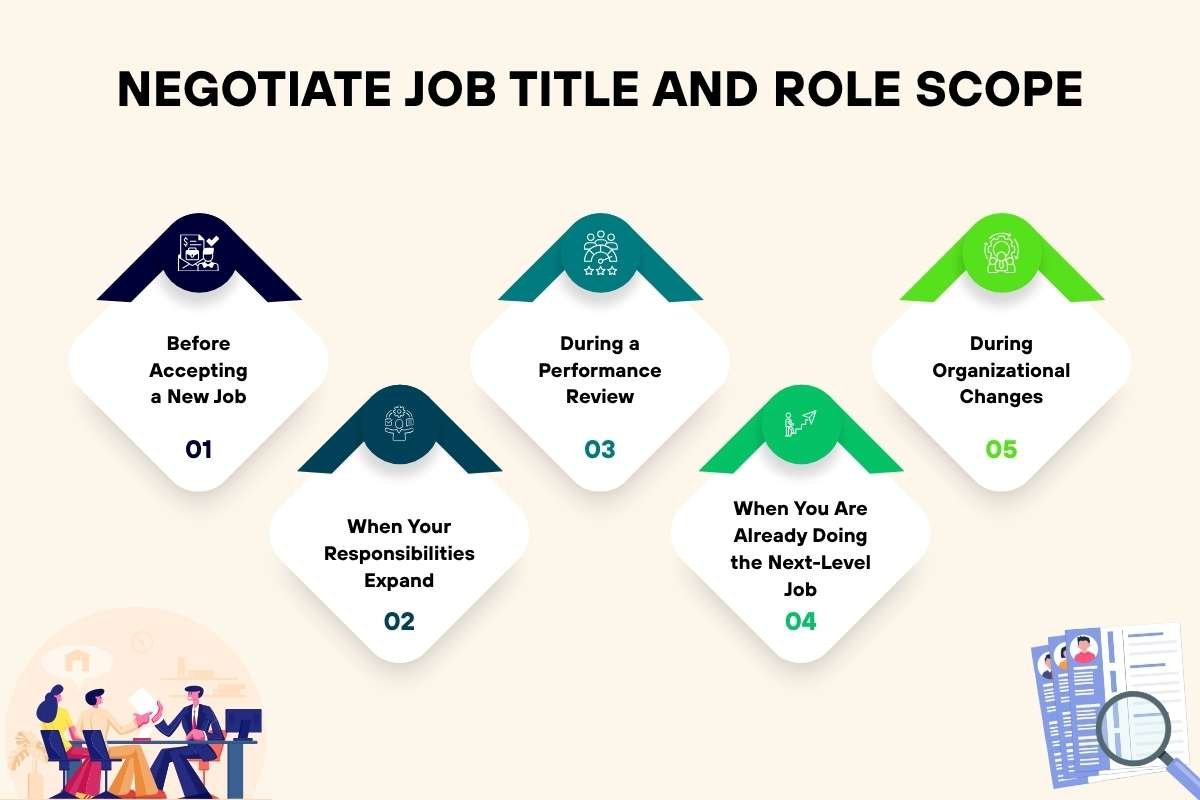
You do not have to wait for your annual performance review. There is no single “right” moment for negotiating job title and role scope. The conversation can happen before accepting a job, when your responsibilities expand, during a performance review, or when organisational changes significantly alter your role.
This approach is also consistent with modern performance-management practices. SHRM describes effective performance management as an ongoing process involving regular communication, feedback, development, and goal-setting rather than something that happens only during an annual review.
Expert insight: Kim Janson, an organisational and employee development expert interviewed by SHRM, recommends keeping career and future-focused conversations ongoing rather than treating them as one-off events. She notes that regular discussions can help connect an employee’s goals with concrete plans and results.
Read the SHRM interview with Kim Janson
That means you do not need to wait for a formal review to raise a question about your role. If your responsibilities, decision-making authority, or level of ownership have changed, you have a valid reason to start the conversation.
1. Before Accepting a New Job
A job offer is a good time to clarify expectations.
Ask:
- What will I own?
- Who will report to me?
- Who will I report to?
- Which decisions can I make myself?
- What budget will I control?
- What does success look like in the first year?
If the answers sound like a more senior role than the title suggests, bring it up before accepting.
You can say:
“Based on the responsibilities we have discussed, it sounds like the role includes ownership beyond what I would normally associate with this title. Could we talk about whether the title and scope accurately reflect those expectations?”
This keeps the conversation focused on the role itself, rather than making it sound like you simply want a more impressive title.
2. When Your Responsibilities Expand
Not every extra task deserves a promotion.
The stronger case is when the change is substantial and ongoing.
For example:
| Before | Now |
| Supporting customer accounts | Managing major clients |
| Handling routine requests | Handling escalations |
| Assisting with renewals | Negotiating renewals |
| Supporting retention efforts | Being responsible for retention |
That is more than simply having a busy month. It is a different level of responsibility.
Keep track of these changes as they happen. Document the projects you own, decisions you make, people or clients you manage, and measurable results you deliver. This gives you evidence when you discuss whether your current title still matches your role.
3. During a Performance Review
Performance reviews give you an easy opportunity to connect your results to your career level.
Try this structure:
What I was hired to do → What I now own → What I achieved → What role matches that level
This is more convincing than simply saying:
“I feel ready for a promotion.”
You can make the conversation more specific by asking:
“Based on the responsibilities I currently handle and the results I have delivered, how does my role compare with the expectations for the next level?”
That shifts the discussion from whether you feel ready to whether your current work matches the organisation’s expectations for a higher-level role.
Performance reviews can still be useful for this conversation, but they should not be the only opportunity. CIPD also notes that formal performance reviews are part of a broader performance-management process and that organisations are increasingly using more regular conversations alongside structured reviews.
CIPD’s Performance Reviews factsheet
4. When You Are Already Doing the Next-Level Job
Sometimes the clearest sign that you are ready for the next level is that you are already doing much of the work.
Ask your manager:
“What distinguishes my current level from the next one?”
If you are already meeting most of those expectations, ask what is still missing and how long it will take to review your progress.
You can also ask:
“What specific outcomes would you need to see from me before you would consider changing my level or role scope?”
This gives you something concrete to work toward instead of leaving the conversation with a vague promise to “keep doing well.”
5. During Organizational Changes
Restructuring, team expansion, a new manager, or changes in reporting lines can alter your role significantly.
These moments are a natural opportunity to ask whether your title, responsibilities, and authority still make sense.
For example, if you were originally hired as an individual contributor but now lead projects, make decisions for other employees, manage important clients, or take ownership of a wider business function, the change may warrant a broader conversation about your role.
You can say:
“My responsibilities have changed quite a bit since I started. Now that the team structure and ownership have changed, could we review whether my current title and role scope still reflect what I am responsible for?”
The goal is not to turn every organisational change into a promotion request. It is to make sure your title, authority, responsibilities, and expectations remain aligned.
Do a Role Audit Before You Negotiate
Before negotiating job title and role scope, compare the job you were hired to do with the job you are actually doing.
| When you joined | What you do now |
| Supported projects | Own projects from start to finish |
| Assisted with reporting | Present results to leadership |
| Worked with one team | Coordinate several teams |
| Followed an approved budget | Controlled part of the budget |
| Supported client accounts | Managed important client relationships |
How to Build a Strong Case for Negotiating Job Title and Role Scope

You do not need a 20-slide presentation.
A simple record of your strongest examples is often enough.
Step 1: Compare Your Original Role With Your Current Role
Look at your original job description.
Then write down what you do now.
Pay particular attention to:
- Team responsibility
- Budget responsibility
- Strategic decisions
- Client ownership
- Project ownership
- Cross-functional leadership
For example:
| When you joined | What you do now |
| Supported product launches | Owns product launches |
| Assisted with reporting | Presents results to leadership |
| Worked with one team | Coordinates several teams |
| Followed a budget | Controls part of the budget |
This makes the change easier to see.
Step 2: Add Results
This is where your argument becomes much stronger.
Instead of:
“I manage several projects.”
Say:
“I took ownership of three projects and helped deliver them two weeks ahead of schedule.”
Instead of:
“I improved the process.”
Say:
“I redesigned the reporting process and reduced monthly reporting time by 30%.”
The exact numbers will depend on your work. The principle is simple:
Show what changed because you took ownership.
Step 3: Check What Similar Roles Look Like
Do not choose a title simply because it sounds impressive.
Look at comparable positions and compare:
- Team size
- Budget
- Decision-making
- Business responsibility
- Seniority
- Strategic ownership
Titles vary between companies. A “Lead” in one organization may have more responsibility than a “Manager” in another.
For this reason, when negotiating job title and role scope, compare responsibilities, reporting relationships, decision-making authority, and business impact, not just the title itself.
You are comparing the job, not just the label.
Step 4: Decide What You Actually Want
Before the conversation, know your preferred outcome.
| Level | Example |
| Ideal | Senior Manager title + expanded scope + authority + salary review |
| Acceptable | Senior Manager title + expanded scope + six-month compensation review |
| Minimum | Written progression criteria + defined responsibilities + review date |
You may not get everything at once. Knowing your priorities helps you decide what to negotiate first.
The Four Things to Align When Negotiating Job Title and Role Scope
Think about four things together:
- Title — What are you called?
- Scope — What do you own?
- Authority — What can you decide?
- Progression — What happens next?
These pieces should make sense together.
| Situation | What it means | What to do |
| High scope + low title | You are doing more than your title suggests | Ask for title alignment or a clear path |
| High title + low scope | The title sounds senior, but the role lacks substance | Ask what responsibilities come with it |
| High responsibility + low authority | You are accountable without enough control | Negotiate decision-making power |
| Clear scope + clear authority + clear progression | The role is well aligned | Focus on performance and future growth |
How to Negotiate Without Making It Awkward
Negotiating job title and role scope does not require you to become confrontational. The strongest conversations are usually clear, specific, and supported by evidence. The same approach applies to B2B negotiation tactics, where preparation, clear objectives, and evidence can help both sides move beyond a simple price-focused discussion.
You do not need to sound aggressive to be clear.
The approach can also vary depending on the situation and the person you are negotiating with, so understanding different negotiation styles can help you choose an approach that fits the conversation.
Your delivery matters too. Tone, posture, eye contact, and even the pauses you leave after making your request can affect how confidently the message comes across. This is where body language and negotiation can become particularly useful.
Start with what has changed.
For example:
“Over the past year, my role has expanded quite a bit. I’m now responsible for X, Y, and Z, and I’ve delivered [result]. I’d like to discuss whether my title and scope should be updated to reflect that.”
Then stop talking.
You do not need to immediately explain why you deserve it, apologize for asking, or offer a smaller request before your manager has responded.
1. Keep the Ask Specific
Instead of:
“I want more growth opportunities.”
Try:
“I’d like to discuss moving into a Senior Manager role based on the scope I currently manage.”
Instead of:
“I want more responsibility.”
Try:
“I’d like to take ownership of the product budget and have authority to approve spending within the agreed limit.”
A clear request is easier to discuss.
2. Do Not Negotiate Against Yourself
Avoid weakening your own request before the employer responds.
For example:
“I’d like to move into a Senior Manager role, but maybe Manager would be fine.”
Make the request, explain the evidence, and give the other person space to respond. Giving the other person space to respond is important because negotiation is not only about making your case. The 70/30 rule in negotiation is another useful way to think about balancing what you say with how carefully you listen to the other side.
3. Ask Questions When You Hear “No”
A “no” can mean several different things.
Ask:
“What would need to be true for this title change to be approved?”
Or:
“Is the issue the role structure, performance expectations, budget, or timing?”
Once you know the real problem, you can decide what to negotiate next.
Scripts for Negotiating Job Title and Role Scope
If you are unsure how to phrase the conversation, preparing a few examples in advance can make it easier to start. These negotiation scripts women can use can help you frame requests around titles, responsibilities, authority, and progression.
1. If You Are Negotiating a New Offer
“I’m excited about the role. Based on the responsibilities we discussed, particularly ownership of [area], I’d like to discuss whether the position could be aligned with a [title].”
2. If Your Current Role Has Grown
“When I joined, my role focused on [original responsibility]. It has since expanded to include [new responsibilities], and I’ve delivered [result]. I’d like to discuss aligning my title and scope with the role I’m now performing.”
3. If You Want More Authority
“I’m comfortable taking responsibility for this outcome. To deliver it effectively, I’d also need decision-making authority over [budget/resources/approvals]. Can we discuss that?”
4. If You Want a Promotion Timeline
“If the title change cannot happen immediately, could we agree on the specific results I need to deliver and set a review date now?”
5. If You Are Asked to Wait
“I understand. What would you need to see from me before making the change, and when could we review it?”
How to Handle Employer Pushback

A “no” does not always mean the conversation is over. When negotiating job title and role scope, a rejection can also reveal what is actually preventing the change.
It may tell you what the real obstacle is.
If You Are Asked to “Prove Yourself”
Sometimes an employer may genuinely want to see sustained performance before changing your title. That is not necessarily unreasonable. The problem is when there is no clear finish line.
Ask:
“What would I need to achieve to demonstrate that I’m ready for the next level?”
Then follow up with:
“Could we agree on a review date now?”
For example:
“If I meet these targets over the next six months, could we formally review the role for Senior Manager?”
This turns “prove yourself” into a measurable plan instead of an indefinite promise.
| What your employer says | How you can respond |
| “HR has fixed titles.” | “What is the closest level that reflects this scope?” |
| “You need more experience.” | “What specific experience or results would demonstrate readiness?” |
| “Everyone is taking on more.” | “Could we look at the level of ownership and accountability in my role?” |
| “There is no budget.” | “Could we discuss title and scope now and set a compensation review date?” |
| “We can revisit this later.” | “What should happen before then, and can we put a review date on the calendar?” |
1. “HR Has Fixed Titles”
If the company genuinely has standardized titles, do not spend the entire conversation arguing over one label.
Instead, ask:
“Given the responsibilities of the role, which existing level would best match this scope?”
You may also be able to negotiate authority, responsibilities, or progression.
2. “You Need More Experience”
Ask what “more experience” actually means.
“What would being ready look like?”
If the answer is vague, ask for examples.
“More leadership” is vague.
“Lead the next two cross-functional projects and present the results to senior leadership” is much clearer.
3. “Everyone Is Taking on More”
Bring the discussion back to ownership, not workload.
“I understand that responsibilities can increase across the team. In my case, these responsibilities have become a consistent part of my role and include ownership of [specific area]. Could we discuss whether the current role level still reflects that scope?”
4. “There Is No Budget”
A budget problem is a compensation problem, not necessarily a reason to end the entire conversation.
You might negotiate the title now and agree to review compensation later.
Just make sure “later” has a date.
5. “We Can Revisit This Later”
Ask:
“What needs to happen before we revisit this, and can we put a date on the calendar?”
A specific date makes the conversation much more useful.
What If the Company Still Says No?
Sometimes the answer really is no.
Your next step is to understand why.
Ask:
“Could you help me understand what is preventing the change right now?”
The response may also be shaped by workplace culture, communication norms, or the environment in which the negotiation takes place. In cross-cultural workplaces, understanding cultural differences in negotiation can help you adjust your approach while keeping your underlying request clear.
Then determine whether the reason is something you can realistically change.
If the company says you need more experience, ask for measurable criteria.
If it says there is no role at that level, ask when the structure might change.
If it says there is no budget, ask whether title or scope can change now
If you repeatedly take on more responsibility while your title, authority, and progression stay unchanged, it is worth asking whether the role is still helping your career.
Whatever the outcome, do not leave with an open-ended promise. A useful result should give you either a change now, a clear progression plan, or a clear explanation of what is preventing the change.
| Outcome | What it looks like |
| Immediate change | Title, scope, or authority changes now |
| Clear progression plan | Specific goals, review date, and expected level |
| Clear constraint | You understand why the company cannot make the change |
Conclusion:
Negotiating your career is about more than asking for more money.
Sometimes the most important conversation is about whether your title, responsibilities, and authority still match the work you are doing.
For women, that conversation can matter at every stage of the career ladder. McKinsey’s 2025 data shows that women remain underrepresented at every level of the corporate pipeline, with the gap becoming particularly visible at the move into management and at the C-suite level.
The answer is not simply to demand a bigger title.
Instead:
- Look at how your role has changed.
- Keep track of the results you have delivered.
- Compare your responsibilities with similar roles.
- Decide what you actually want.
- Ask clearly.
- Get specific about what happens next.
And remember: a title is most valuable when there is real responsibility behind it.
If you are already doing higher-level work, you should not have to pretend it is “just helping out” forever.
Your role should tell an accurate story about the value you bring.
Frequently Asked Questions:
1. What is the best way for a woman to negotiate a job title change?
Connect the request to the work you already do. Explain how your responsibilities have changed, give examples of results, and ask for a title that accurately reflects your current level.
2. Should you negotiate your job title or salary first?
You do not necessarily have to choose. Look at the entire role, including title, responsibilities, authority, visibility, and compensation. If salary cannot change immediately, other parts of the role may still be negotiable.
3. Can you negotiate role responsibilities before accepting a job?
Yes. Before accepting an offer, ask what you will own, who you will manage, who you will report to, and what decisions you can make. If the responsibilities sound more senior than the title, raise the issue before accepting.
4. What if my company refuses to change my job title?
Ask why. If the problem is company policy, budget, or timing, find out what can change now and what would need to happen for a future change. Always try to get a clear review date.
5. How do you negotiate when you are already doing work above your title?
Start by comparing your original job description with your current responsibilities. Highlight the work you now own, the results you have achieved, and the decisions you make. Then ask whether your title and authority should be brought in line with that role.