

How to negotiate flexible work arrangements can make the difference between asking for a favour and presenting a strong business case. For women, flexibility is not about working less. It can mean staying productive, protecting career momentum, and making demanding careers more sustainable.
The need is clear. A 2026 Pew Research Center study found that 71% of working parents say working from home would be highly helpful, yet only 23% have substantial flexibility to do so.
When considering how to negotiate flexible work arrangements, this gap shows why a clear, evidence-based proposal matters.
Women also have more at stake when flexibility disappears. Among workers in jobs that can be done remotely, 49% of women say they would be unlikely to stay with their employer if working from home were no longer allowed, compared with 43% of men.
But flexibility can come with another challenge: visibility.
That is why the goal should not simply be to ask, “Can I work from home?”
Instead, frame the conversation around:
“Here is a work arrangement that will help me deliver strong results while meeting the team’s needs.”
That shift turns a personal request into a professional business case and gives you a stronger position at the negotiating table.
Why flexible work matters for career continuity?
For women, flexibility is not simply about having a more convenient workday. It can determine whether a career continues moving forward or gets interrupted.
The World Economic Forum’s Global Gender Gap Report 2025 found that women are 55.2% more likely than men to take career breaks. Their breaks also last longer on average, 19.6 months compared with 13.9 months for men. Women are more likely to cite full-time parenting as the reason for stepping away.
This context is central to how to negotiate flexible work arrangements, particularly when flexibility can help prevent avoidable career interruptions.
Flexible work can provide an alternative to that all-or-nothing choice. Instead of leaving a demanding role when personal responsibilities change, women may be able to adjust where or when they work while remaining connected to their careers.
There is evidence that this flexibility can support progression too. McKinsey’s 2025 research across 324 organisations employing around 1.4 million people in India, Nigeria and Kenya found that flexible work arrangements and family and personal-care policies were associated with higher promotion rates for women, particularly at the middle-management level.
Flexible work can therefore help women:
| Benefit | How flexibility can help |
| Stay in the workforce | Less rigid schedules can make it easier to remain in a role when responsibilities change. |
| Protect productivity | Reduced commuting and fewer unnecessary interruptions can create more time for focused work. |
| Avoid stepping back | Flexibility can offer an alternative to reducing hours or leaving a role altogether. |
| Maintain career momentum | Staying involved in projects, leadership opportunities, and professional networks can support progression. |
But flexibility alone is not enough.
McKinsey’s Women in the Workplace 2025 research found that women who work most of the time remotely are less likely to have sponsors and less likely to have been promoted than women who work mostly on-site. Flexibility stigma the assumption that employees using flexible arrangements are less committed can play a role.
That means a successful negotiation has two goals: create a sustainable way of working and protect your visibility within the organisation.
A flexible schedule should support your career, not quietly move you out of the promotion pipeline.
Flexible work is more than working from home
Before negotiating, define exactly what flexibility means for your role. Your responsibilities, collaboration requirements, and level of autonomy should shape the proposal, which is why understanding negotiation job title and role scope can be useful when determining what is reasonable to request.
Flexible work can change where you work, when you work, or how your work is organised. The International Labour Organization recognises several forms of flexible working-time arrangements, while workplace practices also include remote, hybrid, flexitime, and compressed schedules.
1. Location-based flexibility
This changes where you work.
Options include:
- Fully remote work: Working away from the usual workplace full-time.
- Hybrid work: Splitting working days between home and the office.
- Occasional remote work: Working from home on specific days or when the role permits it.
- Geo-flexible work: Working from an agreed location outside the usual office, where company policy allows.
The OECD distinguishes between full-time and part-time remote work, with the latter allowing employees to work remotely for only some days or hours.
2. Time-based flexibility
You can also negotiate when you work without necessarily changing the total number of hours.
This could include:
- Flexitime: Choosing start and finish times within agreed limits.
- Staggered hours: Starting earlier or later than the standard schedule.
- Core hours: Being available during fixed collaboration hours while having flexibility outside them.
- Compressed workweeks: Working the same total hours across fewer days.
For example, you might shift from 9 a.m.–6 p.m. to 8 a.m.–5 p.m. if that better suits your responsibilities while maintaining team coverage.
3. Task-based flexibility
Flexibility can also change how work gets organised.
For example:
- Replacing unnecessary meetings with written updates
- Using asynchronous communication for non-urgent work
- Establishing specific collaboration windows
- Agreeing on response-time expectations
- Protecting blocks of time for focused work
The ILO notes that technology has made greater flexibility possible but also warns that constant connectivity can blur the boundaries between work and personal time.
The important thing is to choose the arrangement that fits your actual role.
If your job depends on client meetings, a hybrid model may make more sense than fully remote work. If your role is largely independent and deadline-driven, adjusted hours or asynchronous workflows may be easier to negotiate.
The more precisely you define the arrangement, the easier it becomes to make a credible case.
That level of specificity is one of the most important principles in how to negotiate flexible work arrangements because it gives the employer a practical proposal to evaluate.
The business-first negotiation strategy

Once you know what you want, the next challenge is how to present it.
A strong negotiation is not about proving that your personal circumstances matter more than business needs. It is about showing that your proposed arrangement can work for both sides. This business-first approach is also relevant to B2B negotiation tactics, where understanding the other party’s priorities, addressing objections and demonstrating mutual value can strengthen the case you present.
Harvard’s Program on Negotiation recommends understanding what flexible-work options your organisation already considers acceptable. Requests that fit existing practices may be easier to negotiate than arrangements requiring an entirely new exception. The way you approach the conversation can also depend on the situation and the people involved, so understanding different negotiation styles can help you decide when to be assertive, when to collaborate, and when to focus on finding common ground.
1. Lead with output, not personal need
Your personal reasons may be important, but they do not have to be the centre of your pitch.
Instead of:
“I need to work from home because my commute is difficult.”
Try:
“I’d like to propose working remotely two days a week. I can maintain my current deadlines, remain available during core hours, and be in the office for meetings that require in-person collaboration.”
The second version gives your manager something concrete to evaluate.
Before the conversation, prepare evidence such as:
- Projects delivered on time
- Performance targets achieved
- Client or stakeholder feedback
- Revenue or efficiency improvements
- Responsibilities you already manage independently
- Examples of successful remote or flexible work
The objective is simple: make the arrangement easy to assess.
This is a useful rule for how to negotiate flexible work arrangements: make the proposed change specific enough that a manager can assess its impact on performance, coverage, and collaboration.
2. Use the 70/30 listening rule
A useful approach is the 70/30 rule in negotiation: spend roughly 70% of the conversation listening and asking questions and 30% presenting your proposal.
It is not a rigid formula. It simply prevents the conversation from becoming a long defence of your request.
Ask:
- “What would be your biggest concern with this arrangement?”
- “Which parts of my role need me to be physically present?”
- “Are there particular days when the team needs more coverage?”
- “What would you need to see for this to work?”
- “Would you be more comfortable testing the arrangement first?”
Listening helps you identify the actual obstacle. It also reinforces the value of taking a collaborative approach rather than treating the discussion as a win-or-lose exchange. Understanding collaborative negotiation vs competitive approaches can help you choose a strategy that protects your interests while addressing your employer’s concerns.
Understanding those objections is essential to negotiating flexible work arrangements because the best proposal directly addresses the manager’s real concern.
If your manager is worried about client coverage, solve that problem. If collaboration is the concern, establish fixed office days. If response time is the issue, agree on clear availability.
3. Propose a low-risk trial
If your manager is hesitant about making a permanent change, reduce the perceived risk by proposing a trial.
For example:
“Would you be open to trying this for 60 or 90 days? We could review project delivery, availability, and team feedback before deciding whether to continue.”
Agree on clear measures:
| Area | Success measure |
| Deadlines | Work delivered on schedule |
| Availability | Agreed response times maintained |
| Collaboration | Required meetings attended |
| Performance | Existing goals maintained |
| Team impact | No recurring workflow issues |
This makes flexibility feel less like a permanent concession and more like a measurable working experiment.
A trial-based approach can make negotiating flexible work arrangements feel lower-risk while giving both sides evidence for a longer-term decision.
Scripts and positioning: what to say and what to avoid
How you present the request matters. A flexible-work conversation can quickly become defensive if it sounds apologetic, demanding, or overly personal. Having practical examples of negotiation scripts women can use can make it easier to communicate a flexible-work request with confidence and clarity.
The conversation also involves more than words. Tone, posture, eye contact, and overall presence can influence how a request is received, making body language and negotiation another important part of preparation.
The goal is to sound confident, specific, and collaborative.
High-Impact Scripts
| Situation | What to say |
| Hybrid schedule | “I’d like to propose working remotely on Mondays and Fridays while being in the office Tuesday through Thursday. This would allow me to maintain my responsibilities and availability while giving me dedicated time for focused work.” |
| Fully remote | “I’d like to discuss whether my role could be performed fully remotely. My responsibilities are largely independent, and I can maintain our existing deadlines, meeting commitments, and response times. I’d be happy to discuss a trial period.” |
| Adjusted hours | “I’d like to shift my working hours from 9 a.m.–6 p.m. to 8 a.m.–5 p.m. I would continue covering the team’s core hours and maintaining the same workload and deadlines.” |
| Compressed workweek | “I’d like to explore whether a compressed schedule could work for my role. I’m proposing to maintain my current weekly workload across four days, with clear coverage requirements and a review period.” |
What not to say—and how to pivot
Avoid:
“I’m really sorry to ask this, but…”
You do not need to apologise for making a legitimate workplace request.
Try:
“I’d like to discuss a flexible arrangement that could work well for my role.”
Also avoid:
“I hope this doesn’t make you think I’m less committed.”
That can introduce a concern your manager may not have considered.
Instead:
“My commitment to the role and my performance expectations would remain unchanged.”
Be careful with personal oversharing, too. You can explain your circumstances without giving your manager every detail.
Instead of:
“My childcare schedule has changed because my partner works late on Tuesdays, my mother is travelling, and I have…”
Try:
“I’m looking for a more sustainable schedule that allows me to manage responsibilities outside work while maintaining my professional commitments.”
Finally, avoid an ultimatum unless you genuinely mean it:
“I need this arrangement, otherwise I’ll have to leave.”
A better approach is:
“If this exact arrangement isn’t workable, I’d be interested in discussing alternatives that could address the same concern.”
You are not asking for special treatment. You are proposing a way of working that both sides can evaluate.
That framing captures the core of how to negotiate flexible work arrangements: the request should be presented as a workable professional arrangement, not an exception that requires an apology.
Step-by-step: how to get your request approved
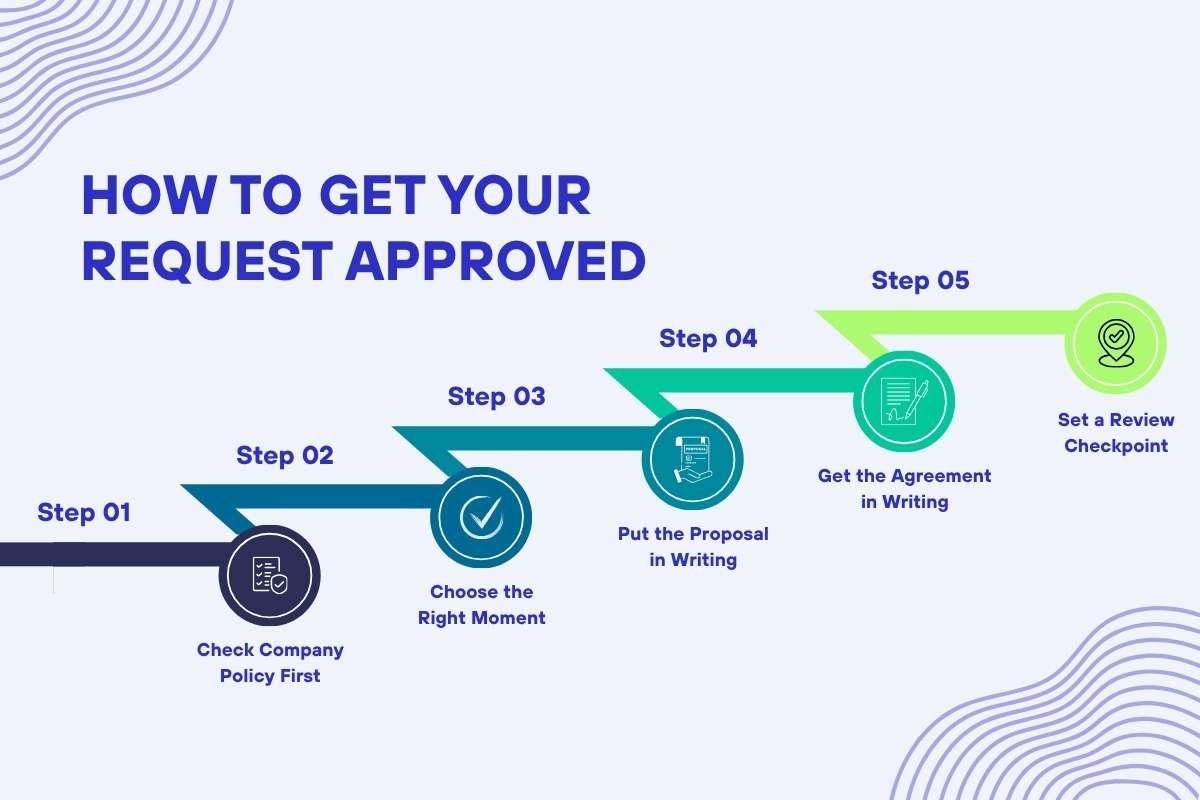
A strong conversation is only the beginning. Turn your request into a clear proposal that your manager can evaluate.
1. Check company policy first
Before negotiating, review:
- Remote and hybrid-work policies
- Flexible-hours guidelines
- Eligibility requirements
- Required office days
- Approval procedures
- Existing precedents
You may discover that you do not need a special exception. If employees in similar roles already work remotely twice a week, that precedent can strengthen your case.
2. Choose the right moment
Timing can affect how receptive your manager is.
Consider raising the request:
- During a performance or goal-setting discussion
- After completing a major project
- When taking on new responsibilities
- During an internal role change
- When discussing a new position
- When the team is reviewing its working model
Recent evidence of reliability and results gives your request additional weight. For anyone learning how to negotiate flexible work arrangements, recent performance evidence is often more persuasive than a detailed explanation of personal circumstances.
3.Put the proposal in writing
A simple one-page proposal can cover:
| Element | What to include |
| Schedule | Which days or hours will change? |
| Availability | When will you be reachable? |
| Communication | Which channels will you use? |
| Response times | How quickly will you respond? |
| In-person commitments | Which meetings require office attendance? |
| Performance measures | How will success be assessed? |
| Review date | When will the arrangement be reassessed? |
Clear expectations make the arrangement easier for everyone to manage.
4. Put the proposal in writing
A verbal “yes” is encouraging, but written terms prevent misunderstandings later.
After the conversation, send a short confirmation:
“Thanks for discussing the flexible arrangement today. Just to confirm, I’ll work remotely on Mondays and Fridays, remain available during core hours, attend required in-person meetings, and review the arrangement on [date].”
5. Set a review checkpoint
Agree on a review after 30, 60, or 90 days.
Assess:
- Are deadlines still being met?
- Is communication working?
- Are there coverage gaps?
- Does the team need adjustments?
- Are performance goals unchanged?
The goal is to make flexibility structured, accountable, and measurable. That is the central objective of how to negotiate flexible work arrangements: create flexibility without weakening expectations or career visibility.
What to do when your request is rejected?
A flexible-work request does not always end with a yes. Sometimes the answer is “not in this form” rather than “not at all.”
First, understand the reason.
Some roles genuinely require physical presence, specific equipment, secure systems, or consistent on-site coverage. Data-security requirements can also restrict how confidential information is accessed outside the workplace.
If your request is rejected, ask:
“Could you help me understand which part of the role makes this arrangement difficult?”
That tells you whether the obstacle is location, timing, coverage, security, or something else.
Turn “No” Into “Not Yet”
Once you understand the objection, modify the proposal.
If two remote days are not possible, ask about one.
If fully flexible hours are difficult, suggest a fixed alternative schedule.
If permanent flexibility is uncertain, propose a temporary arrangement.
For example:
“If two remote days aren’t workable, would you be open to testing one day for the next 60 days and reviewing it based on team and performance needs?”
You can also ask:
“What would need to change for this arrangement to become workable?”
This turns the conversation from whether flexibility is possible to what conditions would make it possible. That shift can make how to negotiate flexible work arrangements more productive because it moves the discussion toward solutions rather than a simple yes-or-no decision.
Negotiating flexible work during a job offer
A job offer is another important opportunity to negotiate working arrangements.
Harvard’s Program on Negotiation recommends looking beyond salary when negotiating an offer and considering issues such as remote work, flexibility, and responsibilities. If the negotiation involves an international employer or colleagues from different workplace cultures, understanding cultural differences in negotiation can also help you adapt your communication around directness, hierarchy, and decision-making.
The ideal time is after receiving the offer but before making a final commitment.
For example:
“I’m very excited about the role. Before I accept, I’d like to discuss the working arrangement. Would the team be open to a hybrid schedule with two remote days each week?”
Research published in Harvard Business Review has also found that candidates’ fears that negotiating would automatically cause an offer to be withdrawn are often overstated.
Across seven studies, researchers found that negotiating an offer was unlikely to jeopardise it.
Still, negotiation does not mean making demands.
If remote work is important to you, say so clearly but connect it to how you will perform in the role.
The objective is not to win every point. It is to build a working arrangement that makes sense for both you and the employer. Ultimately, how to negotiate flexible work arrangements is about finding a sustainable structure that supports performance and organisational needs.
Protecting yourself from proximity bias
Getting flexibility approved does not mean the negotiation ends. The next challenge is ensuring your schedule does not quietly become a career disadvantage.
A complete how-to negotiate flexible work arrangements strategy therefore includes a plan for visibility, sponsorship and access to high-impact opportunities.
McKinsey’s Women in the Workplace 2025 research found that women who work most of the time remotely are less likely to have a sponsor and less likely to have been promoted than women who work mostly on-site.
Flexibility stigma, the assumption that employees using flexible arrangements are less committed or productive, can contribute to this gap. These differences also raise questions about how negotiation behaviour and assertiveness are perceived differently at work, including whether men and women have different negotiation styles.
Recognise proximity bias
Proximity bias occurs when employees who are physically closer to decision-makers receive more attention, opportunities, or recognition simply because they are seen more often.
It can appear as:
- Being left out of informal conversations that lead to opportunities
- Hearing about projects after someone else has already been selected
- Getting fewer opportunities to present to senior leaders
- Being overlooked for high-visibility assignments
- Receiving less informal feedback
- Being evaluated on visibility rather than results
Not every missed opportunity is proximity bias. Look for repeated patterns.
Ask yourself:
- Am I consistently missing opportunities that office-based colleagues receive?
- Are my contributions recognised in the same way?
- Am I still being considered for stretch assignments?
- Do senior leaders know what I am working on?
- Am I receiving the same quality of feedback and career conversations?
Keep a factual record of your work:
| What to track | Why it matters |
| Major projects | Shows scope and ownership |
| Business results | Connects work to measurable impact |
| Presentations | Demonstrates visibility |
| Stretch assignments | Shows development opportunities |
| Leadership interactions | Tracks access to decision-makers |
| Feedback and recognition | Creates evidence of performance |
This gives you something concrete to discuss if a pattern emerges.
Keep your career visible while working flexibly

You do not need to be constantly visible to be remembered. But you do need to make your work easy to see.
Create a simple rhythm for communicating progress:
- Completed: What you delivered
- Impact: The result or business value
- Next: What you are working on
- Support needed: Where you need a decision or input
For example:
“This week, I completed the client onboarding project, reducing the expected turnaround time by two days. Next week, I’ll focus on the reporting workflow. I need approval on the final process by Wednesday.”
This gives your manager a clear picture of your contribution without requiring you to be online constantly.
Also, protect access to senior people and important opportunities.
McKinsey’s research found that employees with sponsors were promoted at nearly twice the rate of those without sponsors. A mentor may provide advice, but a sponsor actively advocates for your advancement and can connect you with high-value opportunities.
Make your career goals explicit:
“I’d like to work toward a senior role over the next year. Which projects or responsibilities would help demonstrate that I’m ready?”
That keeps career progression part of the conversation instead of allowing flexibility to become a separate track.
Set boundaries so flexibility does not become always-on work
Flexibility should give you more control over your time, not make you permanently available.
Strong negotiation of flexible work arrangements also requires boundaries so flexibility does not become an expectation of constant availability.
The ILO recommends clearly defining when remote workers are expected to be contactable and when they are not.
Before beginning your arrangement, clarify:
- Core working hours
- Expected response times
- What counts as urgent
- Preferred communication channels
- Meeting windows
- Non-working hours
For example:
“I’ll be available from 8 a.m. to 5 p.m. and will respond to urgent requests within 30 minutes during those hours. Outside that window, I’ll respond the next working day.”
Predictable boundaries benefit both you and your team.
Most importantly, keep your career goals measurable. Track the projects you own, business results you deliver, leadership responsibilities you take on, skills you develop, feedback you receive, and progress toward promotion criteria.
Flexibility should change where or when you work, not whether decision-makers see your value.
Conclusion:
Flexible work should be treated as a professional arrangement, not a personal concession.
For women, the goal is not simply to secure flexibility. It is to make sure that flexibility supports long-term career growth rather than quietly limiting it.
Go into the negotiation prepared. Define what you want, connect it to business outcomes, anticipate concerns, propose practical solutions, and put the final arrangement in writing.
These steps provide a practical framework for how to negotiate flexible work arrangements while keeping the discussion focused on performance, accountability, and career growth.
Once it is approved, protect your boundaries. Keep your work visible. Stay connected to
decision-makers. Continue pursuing high-impact projects and make your career ambitions clear.
Most importantly, flexibility does not have to mean less ambition.
You can work remotely and lead major projects. You can protect your personal time and still pursue a promotion. You can build a career that gives you flexibility without asking you to shrink your goals.
The right work arrangement should make your career more sustainable, not make it smaller.
FAQs:
1. How should women ask for flexible work arrangements?
Start with a specific proposal rather than a general request. Explain how the arrangement will support productivity, availability, and business outcomes, and offer clear measures or a trial period.
2. What is the best way to negotiate flexible working hours?
Explain the exact hours you want, confirm that you will cover the team’s required hours, and show that your workload, deadlines, and performance expectations will remain unchanged.
3. Should I mention personal reasons when negotiating flexibility?
You can provide context, but you do not need to disclose every personal detail. Keep the conversation focused on the arrangement, your responsibilities, and how you will maintain performance.
4. What if my manager says no to remote work?
Ask what specifically makes the proposal difficult. Then consider alternatives such as fewer remote days, adjusted hours, fixed office days, or a temporary trial.
5. Can flexible work hurt women’s career progression?
It can if flexible workers lose access to sponsorship, high-visibility projects, or informal networks. That is why women should deliberately maintain visibility, communicate results, and continue discussing career progression.
Sources:
- https://www.pewresearch.org/social-trends/2026/06/16/how-workplace-benefits-and-flexibility-shape-parents-ability-to-balance-work-and-family/
- https://www.facebook.com/forbes/posts/nearly-half-46-of-workers-said-they-would-consider-leaving-their-job-rather-than/989786146344709
- https://www.weforum.org/stories/2025/06/global-gender-gap-report-2025-key-findings
- https://artofprocurement.com/blog/supplier-negotiations-in-strategic-sourcing