

Women held 28.3% of corporate board seats globally in 2025, up from 27.3% in 2024, according to MSCI. Nearly half of the companies covered by MSCI had at least 30% women on their boards.
That progress is changing the conversation around women in boardrooms. The focus is no longer only on how many women hold board seats, but also on how they participate in governance and contribute to strategic decisions.
In 2026, boards are navigating artificial intelligence, cybersecurity, sustainability, workforce changes, and increasingly complex risks. Women reshaping board governance in 2026 are becoming part of these conversations through their expertise across technology, finance, operations, law, sustainability, human resources, and other fields.
How women are reshaping board governance in 2026?
Women directors have the same fiduciary responsibilities and oversight duties as other board members. Understanding the roles and responsibilities of women on corporate boards helps clarify how their expertise and experience translate into meaningful governance contributions.
Women directors can contribute to board governance by:
- Questioning assumptions behind major decisions
- Strengthening oversight of emerging risks
- Contributing expertise to board committees
- Examining workforce and leadership issues
- Supporting effective technology and AI oversight
- Bringing different professional experiences into strategic discussions
These contributions reflect what board directors actually do, from questioning management decisions and overseeing risks to contributing to strategic discussions. This creates a broader progression:
Seat → Participation → Influence → Leadership
The goal is not simply greater representation, but meaningful participation in the decisions that shape companies.
5 corporate governance priorities for 2026
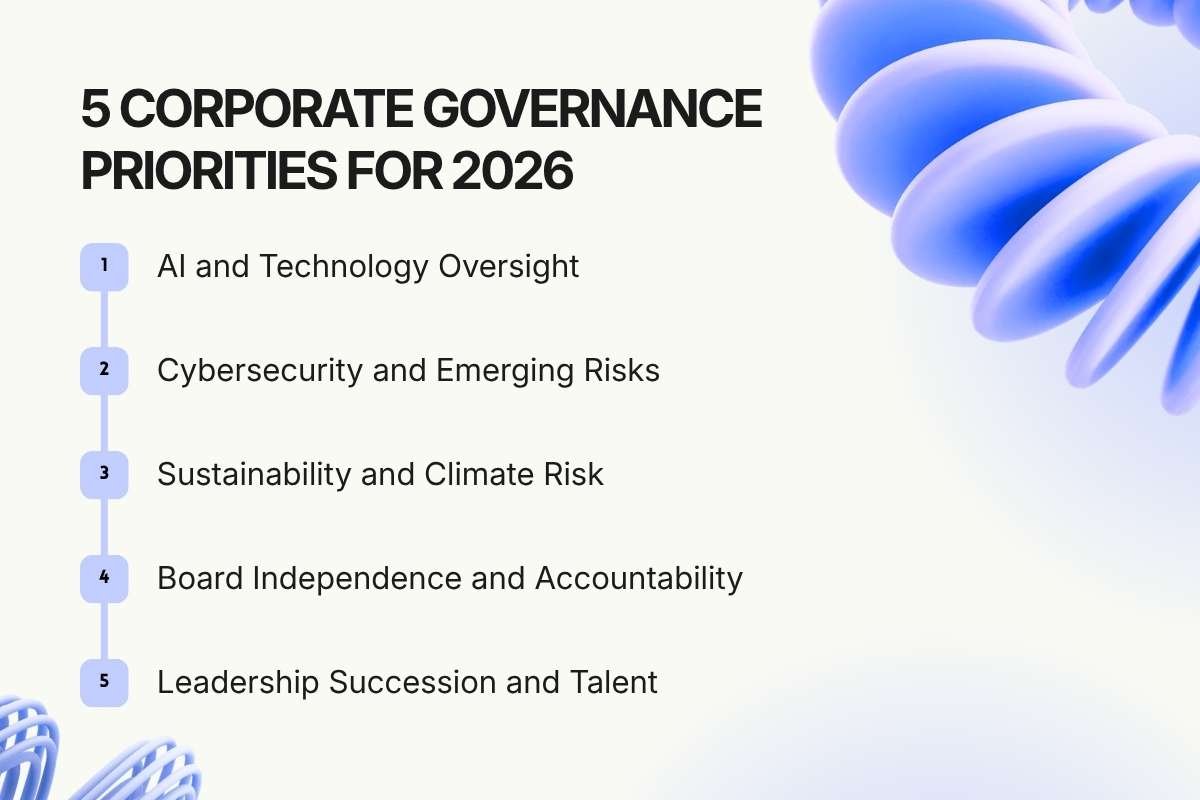
As women reshaping board governance in 2026 take part in discussions around technology, risk, sustainability, accountability, and leadership, their role increasingly extends beyond board representation to meaningful oversight and strategic contribution.
1. AI and technology oversight
Artificial intelligence is becoming a board-level issue as companies integrate it into products, operations, customer experiences, hiring processes, financial decisions, and internal workflows.
Boards do not necessarily need every director to be an AI specialist. However, directors need enough understanding to ask management the right questions.
For example, boards may need to examine:
- Where is AI being used across the business?
- What data is being used to train or operate AI systems?
- Who is accountable for AI-related decisions?
- How are privacy, bias, security, and regulatory risks being managed?
- What happens when an AI system produces an incorrect or harmful result?
- Is the company measuring the financial and operational impact of AI investments?
Women directors with backgrounds in technology, data, law, risk, operations, or digital transformation can contribute directly to these discussions.
Their contribution can be particularly relevant when AI decisions affect employees, customers, data, or regulatory compliance. Effective oversight requires directors to understand both the potential value of new technology and the governance structures surrounding it.
2. Cybersecurity and emerging risks
Cybersecurity is no longer solely an IT concern. A serious incident can affect operations, finances, customer trust, regulatory compliance, and corporate reputation.
Boards increasingly need regular visibility into how management identifies, prioritizes, and responds to cyber risks.
Directors with experience in technology, compliance, crisis management, finance, and risk can contribute to these conversations by asking whether the company has appropriate controls, response plans, reporting mechanisms, and accountability structures.
Women with experience in these areas can therefore contribute to governance discussions that extend well beyond traditional boardroom responsibilities.
3. Sustainability and climate risk
Sustainability remains connected to corporate strategy, regulatory requirements, supply chains, investment decisions, and long-term risk.
Boards may need to examine climate exposure, resource use, supply-chain resilience, sustainability reporting, transition plans, and the credibility of corporate commitments.
Women with experience in sustainability, energy, supply chains, finance, operations, and ESG-related functions can bring relevant expertise to these discussions.
The board’s role is not simply to support sustainability initiatives. It is also to understand how sustainability-related risks and opportunities could affect the company’s business model, capital allocation, reputation, and long-term resilience.
4. Board independence and accountability
Effective governance requires directors to independently scrutinize management decisions.
Board composition, director independence, committee structures, board evaluations, disclosure practices, and clear lines of responsibility all contribute to accountability.
Women directors can participate in these processes in the same way as other directors, while their individual professional backgrounds may add useful perspectives to board discussions.
Strong governance also requires directors to be willing to ask difficult questions when information is incomplete, assumptions appear weak, or risks are not adequately addressed.
5. Leadership succession and talent
Succession planning is another important board responsibility. Directors need to consider whether companies have the leadership capabilities required for future growth and whether there are credible plans for replacing key executives when necessary.
Leadership succession is another area where women reshaping board governance in 2026 can contribute through experience in executive leadership, talent management, and organizational transformation.
This goes beyond identifying a potential CEO successor. Boards may also need to consider leadership pipelines, critical skills, executive development, organizational culture, and the capabilities required as the business changes.
Women directors with executive leadership, talent management, human resources, or organizational transformation experience can contribute directly to these discussions. Together, these areas show how women reshaping board governance in 2026 can contribute to the oversight of technology, risk, sustainability, accountability, and leadership succession.
Women’s representation on corporate boards

The growing representation of women reshaping board governance in 2026 reflects broader changes in corporate board composition, although progress remains uneven across markets. MSCI reported that women held 28.3% of global board seats in 2025, compared with 27.3% in 2024. It also found that 48.7% of companies had at least 30% women on their boards.
Regulatory requirements are also shaping board composition. See board diversity mandates around the world in 2026 for a closer look at these developments.
Representation is one measure of progress, but women reshaping board governance in 2026 are also part of a broader conversation about participation, influence, committee leadership, and strategic decision-making.
From board seat to board influence
For women building board careers, securing a seat is only the beginning. For those pursuing their first appointment, how to get your first board seat as a woman can help clarify what boards look for in prospective directors.
Once appointed, directors can build influence through committee participation, informed questioning, strategic discussions, and relevant expertise. Over time, this can create opportunities to lead committees or the board. Nonprofit board experience can also provide exposure to governance responsibilities and help women build a board-ready profile, particularly for those looking to gain practical experience before pursuing additional board opportunities.
The progression is simple: Seat → Participation → Influence → Leadership.
What women reshaping board governance in 2026 means for future directors?

As board responsibilities expand to include AI, cybersecurity, sustainability, risk, and succession, women seeking board roles need a combination of governance knowledge and relevant expertise.
Board readiness programs for women can help professionals prepare for board responsibilities, while understanding the skills most valued in board directors can help them identify and strengthen relevant capabilities.
A clear value proposition can also help women build a board profile that gets them noticed when positioning their executive experience for board opportunities.
Conclusion:
Women reshaping board governance in 2026 are contributing to a broader shift from representation to meaningful participation and influence. As boards navigate AI, cybersecurity, sustainability, risk, and leadership succession, directors with relevant expertise can play an important role in strengthening oversight and decision-making.
For women pursuing board careers, securing a seat is only the starting point. Building expertise, participating actively in committees, asking informed questions, and taking on leadership responsibilities can help turn representation into influence.
As board expectations continue to evolve, the focus will increasingly be not only on who has a seat at the table, but also on how directors contribute to effective, accountable, and forward-looking governance.
FAQs
1. What are the top corporate governance priorities for 2026?
The major priorities include AI oversight, cybersecurity, sustainability, board accountability, and leadership succession.
2. What percentage of board members are women?
Women held 28.3% of global corporate board seats in 2025, according to MSCI.
3. What are the key corporate governance trends for 2026?
Key trends include greater oversight of AI and emerging technology, cybersecurity, sustainability, board independence, risk management, and succession planning.
4. What are the five pillars of corporate governance?
There is no single universally accepted five-pillar framework. Common governance principles include accountability, transparency, independence, responsibility, and fairness, although frameworks vary across jurisdictions and organizations.
5.How are women reshaping board governance in 2026?
Women are contributing expertise across strategy, risk, technology, sustainability, talent, and leadership, while the focus of board diversity increasingly extends from representation to participation and influence.