

A board seat can give women a voice in major business decisions, but Women on private company boards vs. public company boards can have different experiences. Board size, ownership, regulations, shareholder expectations, and public visibility all shape the role.
In India, women held 29% of director positions in private companies versus 20% in public companies in January 2026. Globally, women held 28.3% of board seats at large- and mid-cap companies in 2025, according to MSCI.
So, what really changes between private and public boards?
Women on private vs. public company boards: what’s the difference?
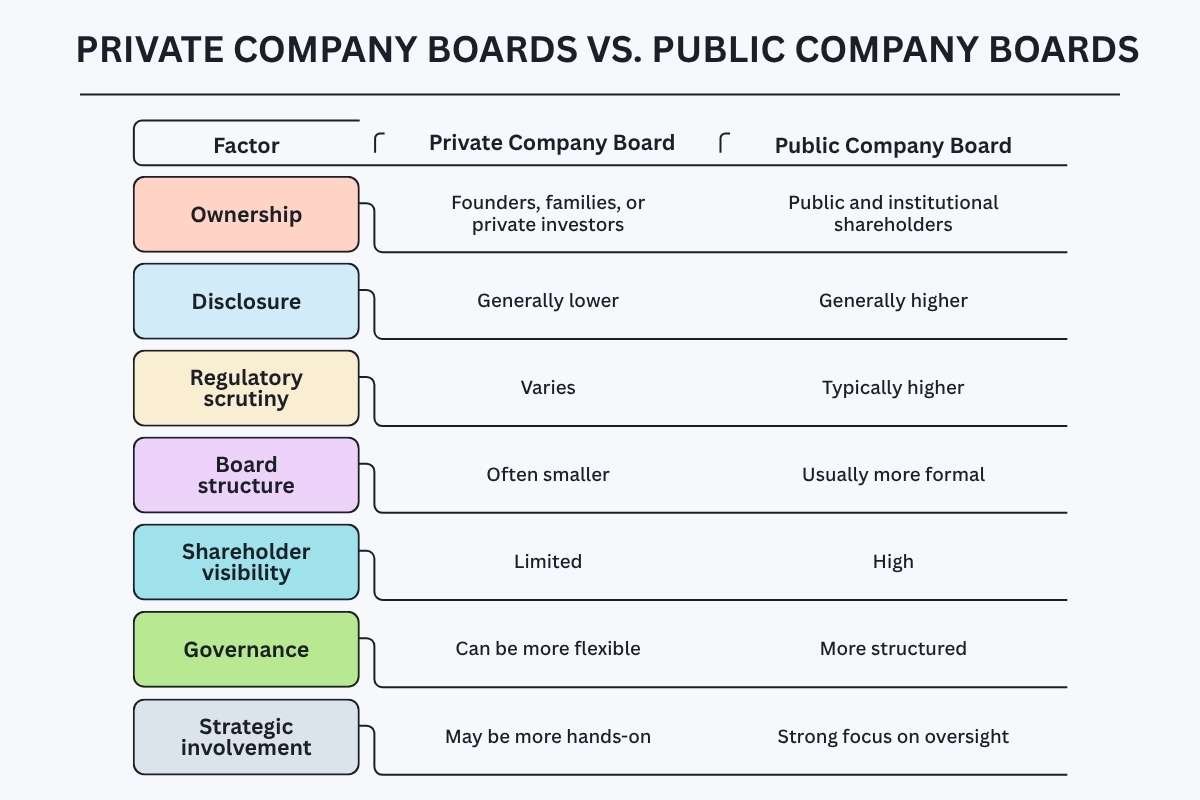
Directors on both private and public company boards have core responsibilities around oversight, governance, strategy, and acting in the company’s interests.
These responsibilities are broadly consistent across board types, although the way directors apply them can vary by company structure. A deeper look at roles and responsibilities as women on corporate boards can help prospective directors understand what board service involves beyond simply attending meetings.
The major differences come from ownership, regulation, and visibility.
| Factor | Private Company Board | Public Company Board |
| Ownership | Founders, families, or private investors | Public and institutional shareholders |
| Disclosure | Generally lower | Generally higher |
| Regulatory scrutiny | Varies | Typically higher |
| Board structure | Often smaller | Usually more formal |
| Shareholder visibility | Limited | High |
| Governance | Can be more flexible | More structured |
| Strategic involvement | May be more hands-on | Strong focus on oversight |
For women, these differences can affect both how they enter the boardroom and what they are expected to contribute once they get there.
Where do women hold more board seats?
There is no single global dataset directly comparing private and public companies. In India, women represented 29% of directors in private companies compared with 20% in public companies in January 2026.
Understanding women on private vs. public company boards requires looking at how ownership, regulation, and company size affect board composition.
For larger listed companies globally, MSCI reported that women held 28.3% of board seats in 2025, up from 27.3% in 2024. These figures use different populations and methodologies, so they should not be treated as a direct private-versus-public comparison.
How public company boards can differ for women directors?
Public-company boards generally face greater regulatory and shareholder scrutiny than private boards. This makes board diversity mandates around the world in 2026 especially relevant for women considering public-company opportunities.
For women considering women on private vs. public company boards, public-company roles can involve greater regulatory and shareholder scrutiny.
Women directors may gain experience in:
- Corporate governance and financial reporting
- Executive compensation and succession
- Risk, compliance, and cybersecurity
Public companies also typically have formal committees such as audit, nomination, and compensation committees. Understanding what board directors actually do helps women see how these committees support their broader oversight responsibilities.
What is different about private company boards?

Private boards can operate with greater flexibility, although the experience varies significantly between companies.
A founder-led startup, family business, and private-equity-backed company can have very different board structures and expectations.
Women directors may work closely with founders, investors, or family shareholders and become involved in decisions involving:
- Business expansion
- Fundraising
- Leadership hiring
- Succession planning
- Digital transformation
- Mergers and acquisitions
- Risk management
This can give women valuable hands-on experience in strategic decision-making.
Private boards can also be an important stepping stone for women who want to build a broader board portfolio before pursuing larger or publicly listed companies. Non-profit board experience can offer another way to develop governance, oversight, and strategic decision-making experience while building a board portfolio.
For women considering different forms of board experience, it is also useful to understand advisory boards vs corporate boards , including differences in authority, responsibilities, and governance expectations.
What does this mean for women seeking their first board seat?
A first board seat does not have to come from a major listed company. Understanding how to get your first board seat as a woman can help prospective directors identify suitable opportunities and build relevant governance experience.
Private-company boards can help women develop practical governance experience while working closely with owners, executives and investors. Depending on the company, the role may involve strategy, technology, finance, risk or succession.
For women exploring women on private vs. public company boards, a private-company appointment can provide practical governance experience before pursuing more complex board roles.
The experience of women on private vs. public company boards can vary significantly depending on ownership structure and the company’s governance model.
Public-company boards, meanwhile, can provide experience within a more formal governance and disclosure environment.
For women building a board career, understanding the broader landscape of women on corporate boards can help put private and public board opportunities into context. The focus should then be on developing a strong record of board-relevant expertise.
A compelling board profile should demonstrate the skills most valued in board directors, including:
Business expertise + governance knowledge + strategic judgment + relevant industry experience.
A senior executive title alone may not be enough. How to build a board profile that gets you noticed is ultimately about showing the specific expertise, experience, and perspective you can bring to board-level decisions.
Skills women need for both types of boards
Whether the board is private or public, directors need strong financial literacy, strategic thinking, risk management, and governance knowledge. Women preparing for their first appointment can also consider board readiness programs for women to strengthen these skills.
Public-company directors may also need deeper familiarity with disclosure requirements, independence, conflicts of interest, committees, and fiduciary responsibilities.
Women on private vs. public company boards: quick comparison: quick comparison
| Private Boards | Factor | Public Boards |
| Usually lower | Visibility | Usually higher |
| Can be flexible | Governance | More formal |
| Limited | Disclosure | Extensive |
| Often close | Owner interaction | More shareholder-facing |
| May be highly hands-on | Strategic role | Strong oversight focus |
| Depends on ownership | Investor scrutiny | Generally higher |
| Can build practical expertise | Board experience | Can build public-market governance experience |
What should women consider before accepting a board seat?

The type of company is only one part of the decision. For women comparing women on private company boards vs. public company boards, the specific responsibilities and risks of the individual board matter just as much.
Before accepting a board position, women should examine:
- The company’s financial position
- Ownership structure
- Board dynamics
- Expected time commitment
- Director liability
- D&O insurance
- Conflicts of interest
- Governance practices
- Access to information
- The actual responsibilities of the role
A board seat should be assessed as a governance responsibility, not simply as an impressive addition to a résumé.
Conclusion:
Women on private vs. public company boards involves more than comparing the number of women in each group.
Women on private vs. public company boards can involve different levels of regulation, visibility, and strategic involvement. Private boards can offer closer involvement with owners and strategic decisions, while public boards generally bring greater regulatory oversight, disclosure, and shareholder visibility.
For women planning a board career, either can provide valuable experience. The key is understanding the responsibilities of the specific board and building expertise that demonstrates clear value at the boardroom table.
FAQs
1. What percentage of corporate boards are women?
Women held 28.3% of board seats at large- and mid-cap companies globally in 2025, according to MSCI.
2. Are women on private company boards more common than on public company boards?
It depends on the market and dataset. In India, women represented 29% of directors in private companies versus 20% in public companies in January 2026.
3. Should a private company have a board of directors?
A board can provide strategic oversight, accountability, and governance even when a company is privately held. Legal requirements vary by jurisdiction and company structure.
4. Do companies with women on the board perform better?
Research has found associations between greater board gender diversity and financial performance, but this does not establish that women directors alone cause better financial results.
5. What should women consider before accepting a board seat?
Women should assess the company’s financial health, ownership, governance, board culture, time commitment, conflicts of interest, director liability, and D&O insurance.