
Key Takeaways:
- A Historic Breakthrough for Gender Representation in Football
- Merit-Based Selection Is Reshaping Elite Officiating
- A Symbolic Moment for the Future of Global Football
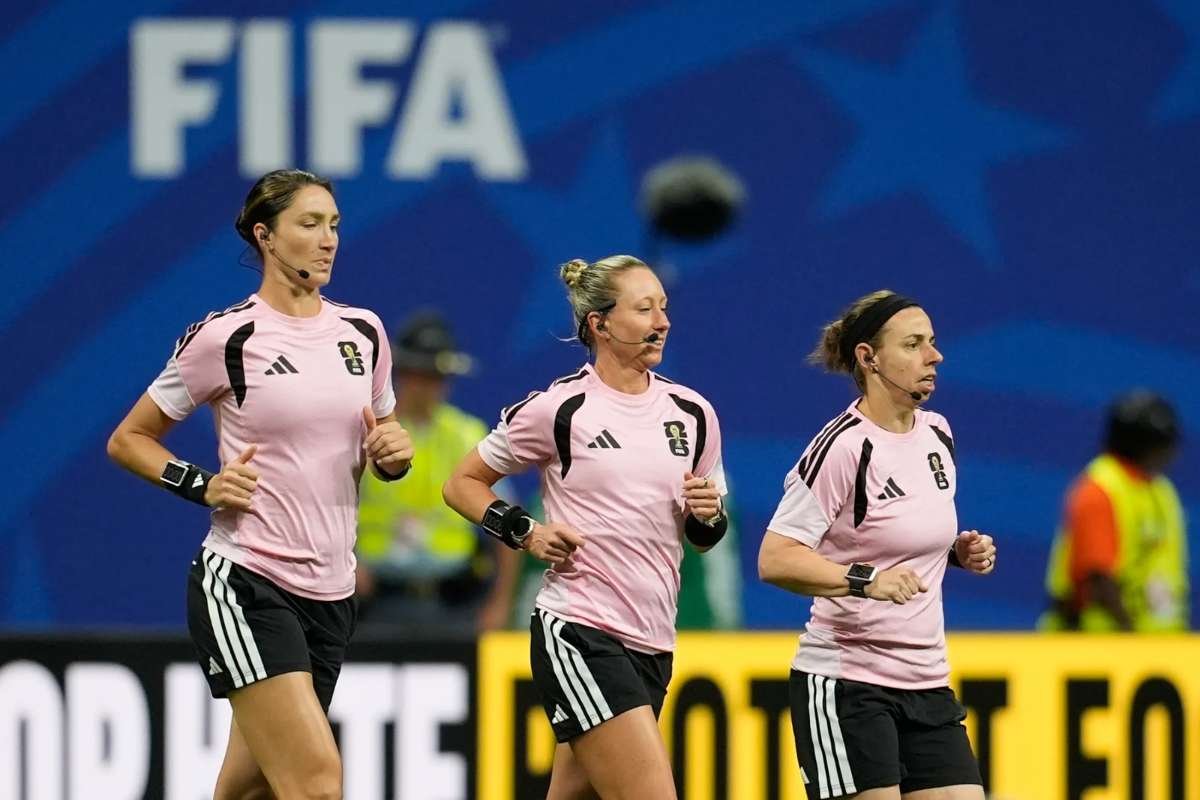
Atlanta witnessed a defining moment in football history during a 2026 FIFA World Cup group-stage match, as an all-female officiating team took charge of a men’s international fixture for the first time on such a prominent global stage. The match, held at one of Atlanta’s key World Cup venues, marked a significant shift in the sport’s long-standing traditions and highlighted the growing role of women in elite-level football officiating.
The referee team was led by experienced American official Tori Penso, who served as the center referee, supported by assistant referees Kathryn Nesbitt and Brooke Mayo. Together, they officiated the match between South Africa and the Czech Republic, managing all aspects of gameplay, including fouls, disciplinary actions, stoppage decisions, and overall match control.
Their appointment drew global attention not only because of the scale of the tournament but also due to the rarity of an all-women refereeing crew in a men’s World Cup match. While women officials have previously been part of international tournaments in mixed capacities, this particular fixture stood out as a landmark moment where an entire on-field officiating team was composed of women at football’s highest competitive level.
The smooth execution of the match further reinforced the increasing confidence placed in women referees to manage high-intensity men’s games under global scrutiny.
Years of Progress Behind the Historic Appointment
The presence of the all-female officiating team in Atlanta was the result of years of structured development within global football’s refereeing pathways. Each member of the crew brought extensive experience from domestic leagues, international tournaments, and FIFA-sanctioned competitions, where performance-based evaluations have gradually opened doors to more inclusive opportunities.
Tori Penso has built a strong reputation as one of the leading referees in international football. She has officiated in Major League Soccer and has previously taken charge of major FIFA tournaments, including high-profile women’s competitions. Known for her calm authority and precise decision-making, she has consistently demonstrated the ability to manage high-pressure matches at elite levels.
Assistant referee Kathryn Nesbitt has also established herself as one of the most accomplished officials in the international football circuit. With experience across top-tier domestic competitions and global tournaments, she is widely recognized for her accuracy in offside decisions, sharp positioning, and consistent performance in fast-paced matches.
Brooke Mayo represents a newer wave of FIFA officials rising through the ranks of international refereeing. Her inclusion in a FIFA World Cup fixture reflects her steady progression through competitive officiating structures and highlights FIFA’s ongoing commitment to identifying and promoting talent based on merit and performance standards.
Collectively, the trio’s appointment to a men’s World Cup match signals a significant shift in football governance, where officiating assignments are increasingly determined by fitness benchmarks, technical evaluations, and consistency rather than traditional gender-based limitations.
A Defining Symbol of Inclusion at the 2026 World Cup
The 2026 FIFA World Cup, jointly hosted across the United States, Canada, and Mexico, has already been recognized for several historic milestones, and the Atlanta match stands among its most symbolic. Beyond the competition itself, the tournament has become a platform for showcasing evolution in football’s administrative and operational systems, including advancements in officiating standards and technology.
The all-female referee crew’s presence reflects a broader transformation that has been unfolding within FIFA over the past decade. Women officials have gradually moved from officiating women’s tournaments and select youth or lower-tier men’s matches to taking charge of elite international fixtures. The Atlanta game represents one of the clearest examples yet of that progression reaching the highest stage of global football.
On the field, the officiating team handled the match with composure and authority, maintaining control over the game’s tempo and ensuring fair play in a competitive environment. Their performance demonstrated that elite refereeing is defined by skill, judgment, and professionalism rather than gender, reinforcing the principle that merit is the key determinant at the highest level of the sport.
The significance of the moment extended far beyond the 90 minutes of play. Inside the stadium and among viewers worldwide, the sight of an all-women officiating crew managing a men’s World Cup match stood as a powerful symbol of progress in global sport. It reflected an evolving football culture that is increasingly inclusive, performance-driven, and open to redefining long-standing norms.
As the 2026 FIFA World Cup continues across North America, the Atlanta fixture is expected to be remembered not only as a competitive group-stage encounter but also as a historic turning point, one where the game’s rules were enforced by a team that embodied the future of football officiating.
Visit CIO Women Magazine for the latest business and technology insights.