
Attentional intelligence is the ability to control, direct, and manage focus across tasks, helping you decide what deserves attention and what should be ignored. This article explains that concept and then dives deep into five practical strategies to boost attentional intelligence, showing how they help reduce distractions, improve focus, and create better control over where your attention goes.
You laugh and like the funny cat video and scroll on. It is then that you are suddenly hit with a realisation. You never completed that important task that you needed to do! How did you end up browsing through your social media?
According to the American Psychological Association, the average attention span on a single screen is roughly 40 to 47 seconds.
Most people do not lose focus in one clear moment. It happens through constant small shifts, jumping between thoughts, switching tasks before they are finished, and letting interruptions decide what gets attention next. Over time, these patterns quietly shape how clearly or how scattered thinking becomes.
Improving this is less about effort and more about method. Strategies to boost attentional intelligence focus on practical ways to train attention itself and reduce unnecessary fragmentation.
In this article, we will look at some such strategies that can help you focus on the task at hand and not let you get distracted by the unnecessary background noise. But what exactly do people mean by attentional intelligence?
Attentional intelligence is the ability to control, direct, and manage focus across tasks and environments. It helps a person decide what deserves attention, what should be ignored, and when to shift focus without losing clarity. This skill supports sustained concentration on important work while reducing mental overload from distractions.
So then, how do you improve your attention? Especially when you need it the most? Let us find out!
The 5 effective strategies to boost attentional intelligence
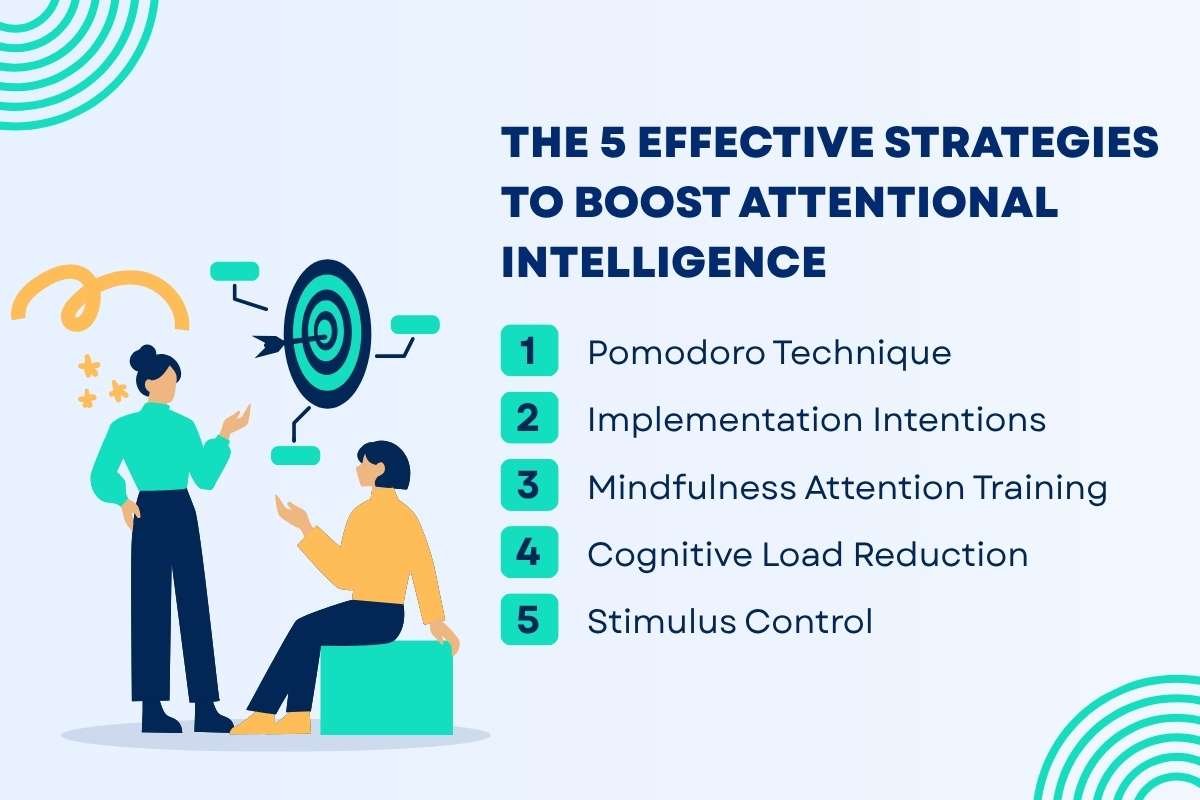
Distractions do not disappear on their own. They need to be managed with clear and practical strategies. Once you understand what pulls your attention away, the next step is to take control of it. The following strategies to boost attentional intelligence focus on reducing mental noise and creating better control over where your attention goes.
1. Pomodoro technique

- What it is: Francesco Cirillo created this method in the late 1980s. It is a time management system that divides work into fixed focus intervals with short breaks. The goal is to train the brain to sustain attention in controlled bursts instead of long, unstable sessions.
- How it works: The brain struggles to maintain deep focus for long periods without mental fatigue. Short cycles reduce cognitive overload and help reset attention before it drops. Breaks prevent mental saturation and improve task continuity across sessions.
- How to implement it: Set a timer for 25 minutes and focus on one task only. Avoid switching tasks during the session. Take a 5-minute break after each cycle. After four cycles, take a longer break of 15 to 30 minutes.
- Drawbacks: It can interrupt deep work where an uninterrupted flow is needed. Some tasks also do not fit neatly into short cycles. It fails when users treat breaks as distractions or ignore the structure.
2. Implementation intentions
- What it is: Peter Gollwitzer developed this strategy in the 1990s. It is based on forming “if-then” plans that link situations to specific actions. It reduces reliance on making decisions in real-time.
- How it works: The brain consumes energy when making repeated decisions. Predefined responses reduce this load and improve reaction speed. It also limits impulsive choices that weaken focus.
- How to implement it: Create clear conditional rules like “If I open social media, then I close it within 10 seconds.” Apply similar rules for distractions, task starts, and task switches. Keep rules simple and consistent.
- Drawbacks: It fails when conditions are unclear or too complex. It also loses effectiveness if the user does not follow through consistently. Overloading with too many rules can reduce compliance.
3. Mindfulness attention training

- What it is: Jon Kabat Zinn developed mindfulness-based stress reduction in the 1970s. It trains attention by focusing on present moment awareness without judgment. This is why it remains one of the most effective strategies to boost attentional intelligence in demanding environments.
- How it works: The brain often drifts between thoughts and external stimuli. Mindfulness helps detect this drift early and redirect attention. This strengthens the ability to stay anchored on one focal point.
- How to implement it: Practice 10 to 15 minutes daily in a quiet space. Focus on breathing or body sensations. When thoughts arise, observe them and return attention without resistance.
- Drawbacks: It requires consistent long-term practice to show results. Many users expect quick improvements and lose motivation. It also does not directly eliminate distractions, only improves response to them.
4. Cognitive load reduction
- What it is: John Sweller introduced cognitive load theory in the 1980s. It explains how working memory has a limited capacity for processing information. Overloading this system reduces attention quality.
- How it works: When tasks are simplified, the brain processes information more efficiently. Reduced load frees mental resources for focus and decision-making. This improves accuracy and reduces attention breakdown.
- How to implement it: Break large tasks into smaller, sequential steps. Remove unnecessary details and secondary inputs. Present information in a clear, structured format before execution.
- Drawbacks: It fails when tasks remain complex even after breakdown. Some environments require multitasking, which increases the load again. Over-simplification can also slow progress if not balanced.
5. Stimulus control

- What it is: Based on B.F. Skinner’s behavioral research, this method focuses on shaping attention through environmental triggers. It connects behavior patterns with physical and digital surroundings.
- How it works: The brain associates locations and cues with specific behaviors. A controlled environment reduces automatic distraction responses. Over time, this strengthens focus habits in similar settings.
- How to implement it: Remove unnecessary notifications and alerts. Use a dedicated workspace only for focused tasks. Keep the environment minimal and free of competing stimuli.
- Drawbacks: It fails in unpredictable or shared environments. Digital distractions can still override physical control. It also requires strong discipline to maintain consistency.
What are the distractions that cause you to lose attention?
Understanding attention is only half the picture. The other half is recognising what consistently pulls it away, often without warning or intention. Many of these interruptions do not feel disruptive in the moment, yet they slowly break the flow of thought and make it harder to stay engaged with meaningful work. There are two main types of distractions:
1. Internal distractions
➤ What they are
Internal distractions come from within the mind. They include thoughts, emotions, memories, and mental fatigue that interrupt attention during tasks. These do not need any external trigger and often appear during focused work.
➤ Common forms
- Self doubt
- Daydreaming
- Stress loops
- Multitasking thoughts
- Hunger
- Tiredness
- Low motivation
➤ Why they happen
They often appear when tasks feel unclear, difficult, or unstructured. The brain looks for escape when it struggles to process information smoothly. Emotional pressure also pushes attention toward unrelated thoughts as a coping response.
➤ Impact on attention
Internal distractions pull attention away from the task and reduce sustained focus. They weaken working memory, increase mental switching, and lower accuracy during complex tasks. Over time, they reduce the brain’s ability to stay stable on one line of thought.
Read More: How to Control Workplace Distractions?
2. External distractions

➤ What they are
External distractions come from the environment and compete directly for attention. These include sounds, notifications, people, devices, and visual interruptions that break focus during work.
➤ Common forms
- Phone alerts
- Social media notifications
- Background noise
- Conversations
- Cluttered workspaces
- Visual movement in the environment
➤ Why they happen
They are caused by high stimulation environments and weak control over attention triggers. Unstructured spaces and constant device access increase exposure. Many digital systems are also designed to repeatedly capture attention.
➤ Impact on attention
External distractions break focus cycles and reduce deep work capacity. They force the brain to restart concentration repeatedly, which increases cognitive load and mental fatigue. Over time, they weaken sustained attention and reduce overall attentional control.
Conclusion:
The real challenge is not getting attention in the first place, but keeping it steady long enough for meaningful work to take shape. Most disruption does not feel dramatic. It builds through choices that seem small in the moment but change how thinking flows across the day.
Strategies to boost attentional intelligence focus on reshaping those choices. They bring structure to how focus is directed, how distractions are handled, and how mental energy is used across tasks. With the right approach, attention becomes less reactive and more intentional, allowing deeper thinking to actually finish what it starts.
FAQs
1. What are strategies to boost attentional intelligence?
They are practical methods used to improve focus, manage distractions, and guide attention more deliberately.
2. Can attentional intelligence be improved?
Yes, it can be developed through various strategies to boost attentional intelligence, like consistent practice, better focus habits, and reduced multitasking.
3. Why is attentional intelligence important?
It helps improve clarity, decision-making, and the ability to complete tasks without losing focus midway.
Thank You For Reading!
See More
How Female Executives Can Benefit from Attention Intelligence Today?