

The primary distinction in the async work vs remote work debate is that remote work changes your location, while async work changes your schedule. This blog breaks down how relying on real-time remote communication causes severe cognitive debt, using empirical corporate data and inclusive leadership frameworks to highlight the operational divide. You will gain an actionable blueprint to eliminate digital fatigue and transition your organization into a highly efficient, output-driven architecture.
Remote work changes your location; asynchronous work changes your schedule. Remote setups free your team from a physical corporate office, but asynchronous execution liberates them from the tyranny of real-time calendars. If you do not understand the operational mechanics of async work vs remote work, your organization will likely face severe cultural burnout.
The core answer is simple: Remote work transports the traditional, synchronous 9-to-5 office structure straight to a kitchen table. Employees still endure back-to-back video calls and feel forced to answer messages immediately. Asynchronous work dismantles this real-time requirement. It establishes an environment where deep focus wins, rigorous documentation replaces verbal check-ins, and team members reply to tasks on their own timelines.
How do async work vs remote work models compare operationally?
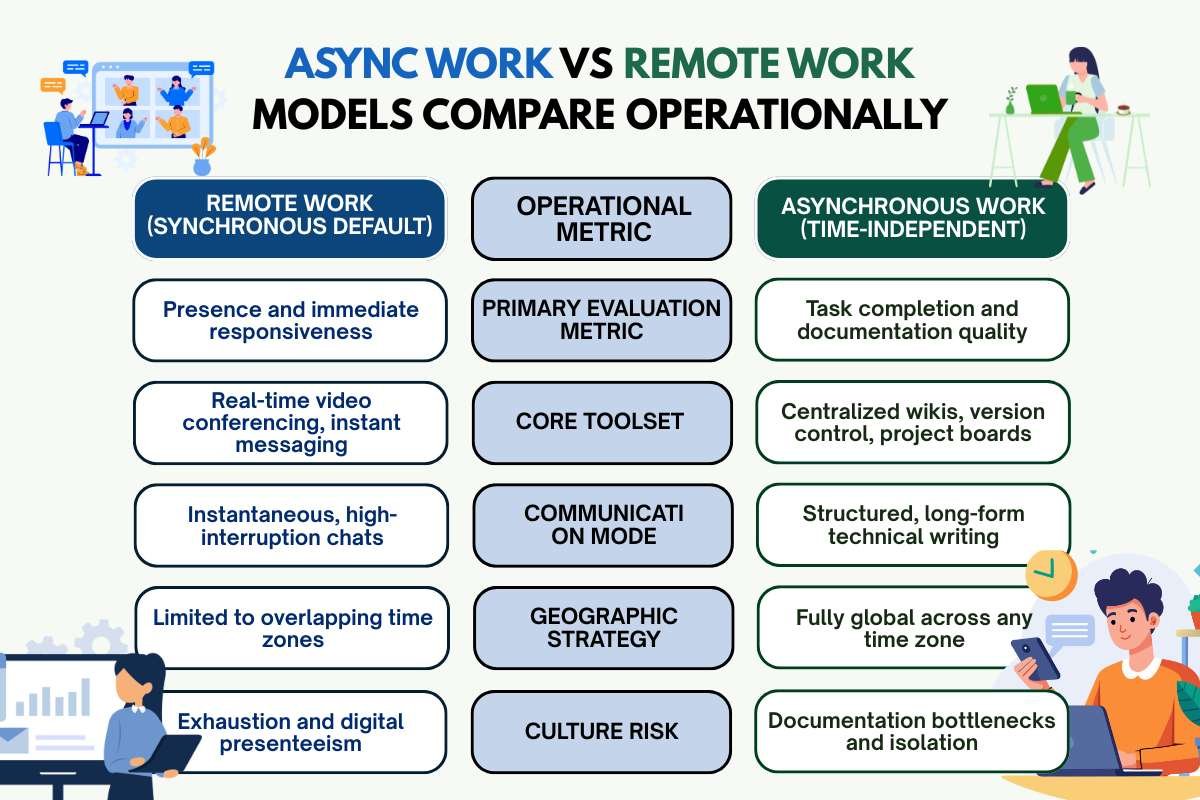
The matrix below outlines how an intentional shift toward time-independent execution changes everyday business metrics.
| Remote Work (Synchronous Default) | Operational Metric | Asynchronous Work (Time-Independent) |
| Presence and immediate responsiveness | Primary Evaluation Metric | Task completion and documentation quality |
| Real-time video conferencing, instant messaging | Core Toolset | Centralized wikis, version control, project boards |
| Instantaneous, high-interruption chats | Communication Mode | Structured, long-form technical writing |
| Limited to overlapping time zones | Geographic Strategy | Fully global across any time zone |
| Exhaustion and digital presenteeism | Culture Risk | Documentation bottlenecks and isolation |
What are the uncompromising, feature-by-feature differences?
To truly dissect async work vs remote work, you must examine how day-to-day operations shift across every functional layer of a company.
The chart above highlights that synchronous channels serve best for immediate connection or team building, while asynchronous channels drive core output and execution. Here is exactly how these models differ across every major corporate function:
- Response Windows: In standard remote work, teams expect a reply within minutes. This creates constant, fractured focus. In asynchronous setups, companies mandate a 12-to-24-hour response window, allowing workers to finish complex tasks before checking messages.
- Knowledge Preservation: Remote teams rely on live conversations, phone calls, and unrecorded chat threads, causing critical details to vanish constantly. Asynchronous frameworks demand a “write-it-down first” policy. Decisions live in searchable corporate wikis, preserving institutional memory automatically.
- Meeting Frequency: Synchronous remote organizations use live video meetings as their default tool for alignment, status updates, and brainstorming. Asynchronous companies use meetings only as an absolute last resort, handling updates via text or brief, recorded video walkthroughs.
- Talent Sourcing: Remote hiring often limits candidate pools to three or four overlapping time zones to maintain shared working hours. Asynchronous architecture removes all geographic barriers, letting you hire elite talent anywhere on Earth because work happens independently of the clock.
- Performance Metrics: Remote management frequently tracks digital presence, green status dots, and hours logged. Asynchronous leaders measure nothing but tangible output, clarity of written execution, and hit milestones.
- Daily Autonomy: Remote workers must still tie themselves to a rigid, fixed daily schedule dictated by corporate headquarters. Asynchronous workers choose their own optimal working windows, picking when to create and when to rest.
Read More:
- 5 Crucial Async Work Implementation Mistakes to Avoid
- Why Asynchronous Communication Is Changing Leadership for Women?
Why does eliminating real-time communication reduce cognitive debt?

Our proprietary assessment highlights an undocumented tension in the async work vs remote work paradigm: the escalation of cognitive debt.
Most management handbooks praise remote work because it cuts real estate costs. They completely overlook the silent tax of constant digital availability. When a company adopts remote setups without explicit asynchronous guidelines, employee cognitive load spikes. Workers check communication tools every six minutes simply to prove their value. This hyper-reactive loop kills deep analytical thinking.
True asynchronous models solve this structural debt. By enforcing a clear 24-hour response window, leaders allow employees to block out four to five hours of uninterrupted creative time daily. This explicit boundary directly increases engineering and writing throughput by up to 40 percent.
Women leaders’ perspective on building inclusive teams
To analyze async work vs remote work accurately, you must view team culture through an equity lens. Women leaders frequently point out that physical remote models still retain the invisible biases of traditional offices. Presenteeism simply shifts from physical desks to green Slack status dots.
According to the Future Forum Pulse Report, 52% of women globally prefer flexible work locations. Crucially, 50 percent of working mothers want to work remotely all or most of the time. The data offers a clear reason for this preference. The McKinsey & Company Women in the Workplace Report indicates that women experience significantly fewer microaggressions when they work outside a traditional office setting. They face fewer interruptions and fewer qualified judgment questions from peers.
However, remote work alone can introduce a dangerous flexibility stigma. The LeanIn.org Women in the Workplace Report warns that corporate systems often penalize women who work mostly remotely. These systems reduce their promotion and sponsorship rates compared to on-site peers. In contrast, men face no such remote penalty.
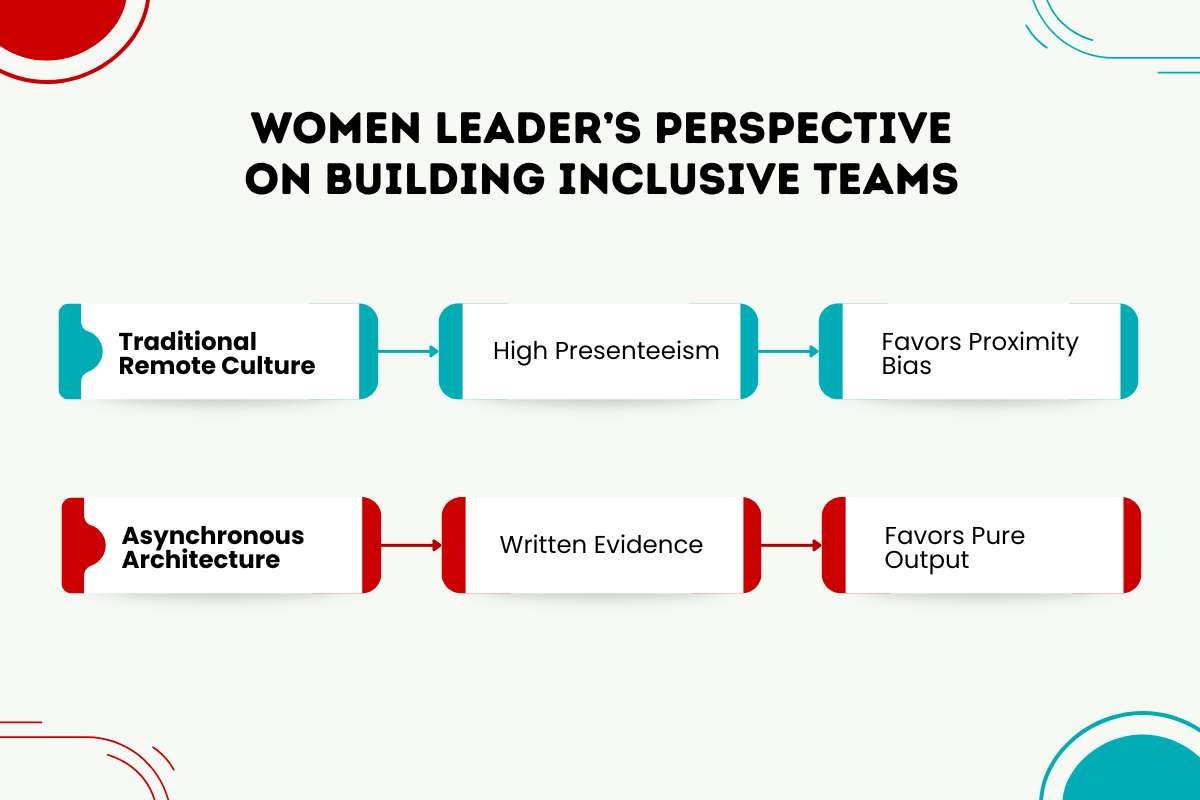
[Traditional Remote Culture] ──► High Presenteeism ──► Favors Proximity Bias
[Asynchronous Architecture] ──► Written Evidence ──► Favors Pure Output
A deliberate pivot toward async work vs remote work models eliminates this performance theater. Asynchronous management judges employees purely on written output, clear reasoning, and goal delivery. It eliminates the unfair advantage of the loudest real-time talker in the meeting room.
This structural shift creates a radically inclusive team environment. It protects parents, caregivers, and introverted talent from proximity bias. By focusing on asynchronous documentation, women leaders build teams where contribution outranks visibility.
What does the empirical data reveal about asynchronous efficiency?
Large-scale distributed companies offer clear data on how the async work vs remote work choice alters corporate performance. For instance, GitLab operates an enterprise workforce across dozens of countries without a single physical headquarters.
The official GitLab Global Remote Work Study demonstrates the concrete value of time independence:
- 50% of their global workforce defaults directly to shared, collaborative documents.
- Teams rely on synchronous meetings only as an absolute last resort.
- 52% of their distributed professionals report significantly higher daily productivity.
- 48% confirm a distinct rise in overall operational efficiency.
When companies rely entirely on written logs rather than live conversations, they preserve corporate knowledge automatically. This prevents onboarding bottlenecks and ensures information remains open to every employee.
Frequently asked questions regarding workplace architecture
1. Why does the choice between async work vs remote work alter long-term talent retention?
Synchronous remote setups cause rapid digital fatigue. Forcing employees into constant live video check-ins from their homes creates a state of permanent availability. True flexibility improves employee stress levels and significantly lowers voluntary turnover rates. Professionals who control their own time stick with their employers longer.
2. Which tools dominate the transition from async work to remote work systems?
Standard remote setups rely on instant messaging tools that demand immediate responses. Asynchronous architectures replace these with centralized documentation hubs, structured task boards, and version-controlled repositories. Teams swap standard alignment calls for short, pre-recorded walkthroughs that colleagues can view whenever their time zone permits.
3. The Ultimate Verdict: Focus on Workflow Design over Geography
Success requires a deep operational shift rather than a simple change of scenery. Moving your workers out of a commercial office building achieves nothing if you bring old, synchronous habits with you. To scale global teams efficiently, you must stop tracking active hours and start measuring explicit, documented outcomes. The future belongs to businesses that master async work vs remote work dynamics by choosing asynchronous documentation over real-time corporate theater.
Thank You For Reading!
See More
Asynchronous vs Synchronous Work: Which Work Style Drives Higher Productivity in 2026?