
The fundamental debate regarding Transformational vs. Inclusive leadership centers on the primary mechanism of organizational growth. Transformational leadership alters the long-term trajectory of a firm by rallying employees around an ambitious corporate vision. Inclusive leadership optimizes everyday operational performance by ensuring every team member experiences absolute psychological safety, equity, and voice.
While transformational executives challenge status quo standards to pioneer new markets, inclusive leaders eliminate operational bottlenecks by sourcing diverse intelligence from every layer of the enterprise. High-velocity organizations integrate both systems to maximize pipeline productivity and minimize voluntary talent attrition.
Choosing What’s Better for You: Transformational vs. Inclusive leadership
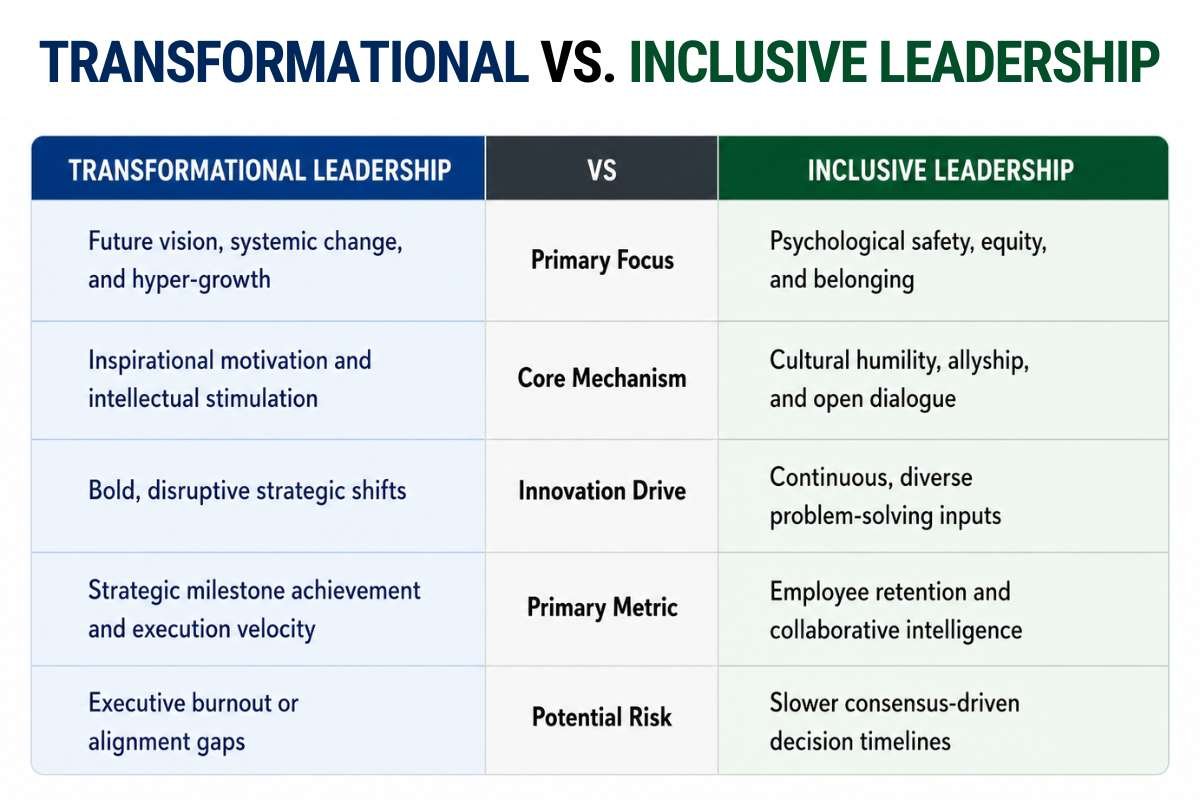
The core difference between the two styles lies in their primary objective and operational focus. A transformational leader alters the trajectory of the organization by inspiring employees to transcend self-interest for a grand corporate vision. An inclusive leader alters the culture of the organization by ensuring every individual feels safe, respected, valued, and empowered to contribute.
| Transformational Leadership | VS | Inclusive Leadership |
| Future vision, systemic change, and hyper-growth | Primary Focus | Psychological safety, equity, and belonging |
| Inspirational motivation and intellectual stimulation | Core Mechanism | Cultural humility, allyship, and open dialogue |
| Bold, disruptive strategic shifts | Innovation Drive | Continuous, diverse problem-solving inputs |
| Strategic milestone achievement and execution velocity | Primary Metric | Employee retention and collaborative intelligence |
| Executive burnout or alignment gaps | Potential Risk | Slower consensus-driven decision timelines |
Here’s the Detailed Breakdown: Differentiating the Core Engines
To master Transformational vs. Inclusive leadership, you must dissect the distinct behavioral mechanics that power each framework.
The Mechanics of Transformational Leadership
Sociologist James MacGregor Burns and researcher Bernard Bass established the foundation of transformational leadership around four core behaviors, often called the “Four Is”:
- Idealized Influence: The leader acts as a charismatic role model, winning trust through unwavering ethical standards.
- Inspirational Motivation: The leader articulates an exciting, clear vision that connects daily tasks to a larger corporate purpose.
- Intellectual Stimulation: The leader challenges standard assumptions, reframes problems, and encourages employees to take calculated risks.
- Individualized Consideration: The leader acts as a mentor, attending to the unique professional development needs of each follower.
A comprehensive review published via ResearchGate analyzing transformational leadership confirms that this style strongly correlates with employee engagement ($r \approx 0.47$). Furthermore, McKinsey data indicates that organizations leveraging transformational leadership claim two times higher worker satisfaction in hybrid work environments compared to companies using traditional top-down management.
The Mechanics of Inclusive Leadership

Inclusive leadership focuses heavily on the relational dynamics of diversity. Research published by the Center for Business and Economic Research (CBER) defines this approach as a collective process that simultaneously balances two contradictory human needs: belongingness and uniqueness.
Organizations achieve true inclusion when leaders implement three specific team norms:
- Promoting Expressions of Difference: Celebrating unique cultural backgrounds and unconventional ideas rather than forcing conformity.
- Fostering a Team-Coaching Climate: Guiding team members to support one another’s growth transparently.
- Codifying Fair Decision-Making: Eliminating systemic bias in promotions, hiring, and project assignments through objective data metrics.
According to data from Gartner, teams that feature high gender diversity combined with robust inclusive leadership perform 40% better than teams that possess diversity alone.
The Friction of Balancing Both Styles
Many corporate management blogs make a naive claim: “Simply use both styles simultaneously.” This advice ignores real operational friction. When you analyze Transformational vs. Inclusive leadership, you reveal an inherent structural paradox between execution speed and collaborative deliberation.
However, when you isolate these styles, you compromise your growth trajectory. A purely transformational executive drives innovation but leaves a trail of high attrition behind due to hyper-competitive pressure. Conversely, a purely inclusive executive builds an exceptionally loyal team that lacks the strategic drive to capture shifting market opportunities.
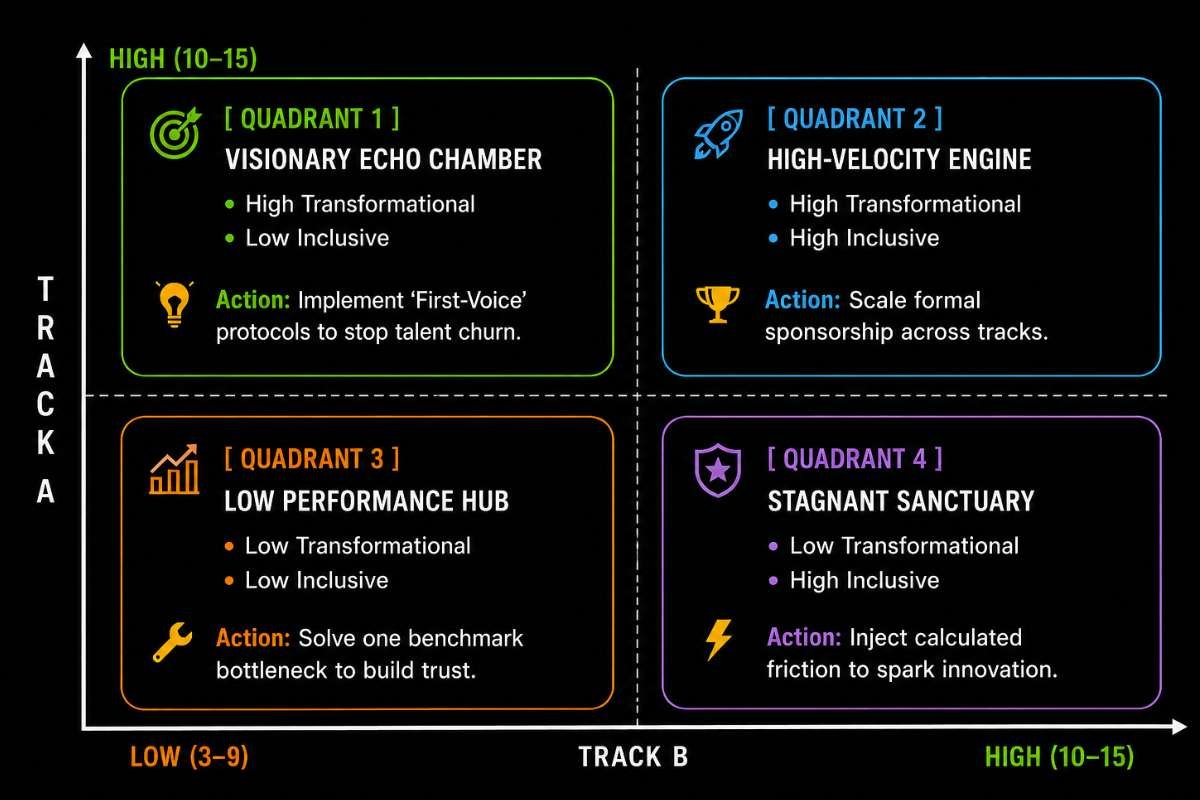
To solve this dilemma, we introduce the Leadership Velocity Matrix. This structural synthesis outlines how combining both systems unlocks unparalleled organizational performance.
- The Visionary Echo Chamber (High Transformation, Low Inclusion): The firm hits aggressive product milestones, but only elite internal circles hold decision-making authority. This alienation drives top-tier technical professionals out of the pipeline.
- The Stagnant Sanctuary (Low Transformation, High Inclusion): Employees experience exceptional psychological safety and enjoy their workplace culture. However, the business unit fails to innovate, causing market obsolescence within 24 months.
- The High-Velocity Engine (High Transformation, High Inclusion): This model represents the gold standard of modern enterprise execution. The executive introduces an ambitious market vision while explicitly relying on the collective intelligence of a diverse workforce to build the operational path.
This specific intersection provides a refreshing perspective on Transformational vs. Inclusive leadership, moving away from binary categorization. It treats inclusion as the essential fuel that powers long-term transformation.
Which Leadership Style is Better for Women Leaders?
Female executives frequently navigate a structural challenge known as the “double bind.” Corporate environments often penalize women for displaying traditional dominant management behaviors, yet label them as weak if they exhibit purely nurturing traits. When deciding between Transformational vs. Inclusive leadership, empirical data suggests a strategic synthesis offers the highest career velocity and organizational impact.
The American Psychological Association (APA) documented a landmark meta-analysis led by organizational psychologist Alice Eagly. The research verified that female leaders score significantly higher in transformational leadership metrics compared to their male counterparts. Women excel at epitomizing corporate values, articulating shared missions, and building virtual trust.
Simultaneously, Catalyst research on inclusive leadership norms shows that inclusive behaviors serve as a powerful trust cue. When a female executive leads outward with explicit allyship and inward with cultural humility, she creates an organizational trust signal that functions across both male- and female-dominated industries.
Therefore, the question is not which single style is better, but how female leaders combine them to shatter structural stereotypes. By blending both frameworks, a woman leader projects absolute authority through a transformational vision while completely neutralizing the double bind through an inclusive culture.
Read More: Why Inclusive Leadership for Remote Teams Matters Now More Than Ever?
How to Develop Both Leadership Styles?
Building a modern management toolkit requires a systematic development sequence. You cannot rely on instinct; you must practice specific behavioral interventions to master Transformational vs. Inclusive leadership.
The Hybrid Executive Development Sequence
Week 1-2: Audit Personal Bias and Communication Gaps:
Review your recent meeting histories. Track conversational turn-taking to ensure dominant voices do not crowd out remote or minority employees. Cultivate deep cultural humility by asking for anonymous feedback regarding your openness to dissenting viewpoints.
Week 3-4: Establish an Authority-Backed Core Vision:
Draft a transparent, outcome-oriented multi-year roadmap for your business unit. Eliminate corporate jargon. Clearly connect individual employee performance indicators to the long-term survival and growth of the firm.
Week 5-6: Implement Psychological Safety Guardrails:
Normalize failure as an intellectual data point. Introduce a structured “pre-mortem” phase into project launches where employees receive explicit permission to uncover hidden structural bottlenecks without fear of professional retaliation.
Week 7-8: Deconstruct Command-and-Control Oversight:
Transition your management style from strict task monitoring to digital autonomy. Delegate high-stakes operational choices to diverse project sub-committees, forcing your organization to leverage distributed collective intelligence.
The Advantage of the Integrated Approach (for Women)

- Neutralizing Unconscious Affinity Bias: When women executives deploy transformational behaviors, such as presenting high-density market data and articulating bold organizational shifts, they break archaic “think leader, think male” stereotypes. This clear projection of authority commands immediate commercial respect from institutional investors.
- Building Sustainable Talent Pipelines: Simultaneously, by championing inclusive frameworks, women leaders build exceptionally loyal, high-performing teams. They prioritize employee well-being and structured mentorship, which directly reduces voluntary turnover among mid-level operational managers.
The market data demonstrates that choosing one style over the other limits executive efficacy. The most successful strategy requires women leaders to use transformational tactics to command the boardroom, while using inclusive systems to empower their execution teams.
Case Study: Driving Transformation through Inclusive Infrastructure
A manufacturing corporation transitioning toward automated digital operations faced a 31% executive team turnover rate and severe frontline resistance. Management initially tried a purely transformational approach, delivering high-level speeches about “The Factory of the Future.” Frontline staff rejected the vision, viewing it as a thinly disguised threat to their job security.
The corporation rearranged its strategy by integrating inclusive principles into its transformational roadmap. They pulled frontline assembly workers into the product procurement committee, honoring their experiential diversity. They launched transparent upskilling bootcamps that guaranteed career transitions for workers displaced by automation.
According to data compiled by Brihan Consultants analyzing leadership diversity impacts, this inclusive pivot generated measurable business returns within 36 months:
- Product Innovation: A 27% improvement in regional product innovation metrics.
- Market Velocity: A 37% faster time-to-market acceleration for new product rollouts.
- Retention Assets: A 31% reduction in executive team turnover.
- Customer Satisfaction: A 24% enhancement in user experience ratings across previously underserved demographic segments.
Let’s Find Out where you tilt. Transformational vs. Inclusive Leadership
Instructions: Score yourself on each statement from 1 (Never) to 5 (Always).
[COLUMN 1: TRANSFORMATIONAL DRIVE]
TRACK A: Macro-Vision & Disruption
Q1: Meaning-Framing
When launching a new initiative, I spend more time communicating the macro-level “why” and future market impact than on the daily operational tasks.
Score: [ ]
Q2: Workflow Friction
I actively challenge my leadership team to audit and dismantle comfortable, legacy workflows, even if the transition causes short-term operational friction.
Score: [ ]
Q3: Strategic Sponsorship
I proactively identify high-potential employees and assign them high-stakes stretch roles that give them direct visibility before executive committees.
Score: [ ]
▶ TRACK A TOTAL SCORE: [ ] / 15
[COLUMN 2: INCLUSIVE DEPTH]
TRACK B: Psychological Safety & Voice
Q4: Voice Decentralization
I intentionally structure my meetings so that junior team members or quieter voices present their critiques before senior executives speak.
Score: [ ]
Q5: Active Verification
During tense operational debriefs, I repeat or summarize my team’s technical concerns verbatim to ensure true comprehension before I render a final decision.
Score: [ ]
Q6: Bias Mitigation
I rely strictly on objective, data-driven performance metrics rather than personal comfort or professional affinity when awarding high-visibility client accounts.
Score: [ ]
▶ TRACK B TOTAL SCORE: [ ] / 15
[BOTTOM ZONE: THE DIAGNOSTIC MATRIX]
Map your scores on the grid below to discover your quadrant and next strategic operational step:
The 2026 Baseline Metric: Elite enterprise executives score 10 or higher on both tracks, creating a sustainable cultural ecosystem where diverse internal intelligence directly powers rapid organizational growth.
Final Thoughts: The Senior Editor’s Perspective
Choosing between Transformational vs. Inclusive leadership presents a false dichotomy. Isolation breeds organizational failure. A transformational leader without inclusive traits creates a high-burnout cult of personality that breaks down under pressure. An inclusive leader without a transformational vision creates a highly comfortable, deeply bonded team that lacks the strategic direction to achieve market dominance.
True market leaders do not treat these styles as opposing philosophies. They treat them as complementary instruments. Use transformational mechanics to define your destination, and use inclusive infrastructure to ensure your entire workforce climbs the mountain with you.
Frequently Asked Questions (FAQ)
1. What defines the primary difference when comparing transformational vs. inclusive leadership?
Transformational leadership focuses on driving systemic organizational change through an inspiring future vision. Inclusive leadership focuses on cultivating a supportive workplace culture by ensuring all employees feel safe, unique, and fundamentally valued.
2. Can an executive practice transformational vs. inclusive leadership at the same time?
Yes. Elite executives use situational sequencing. They employ inclusive leadership to source diverse viewpoints and build psychological safety during strategy creation, then deploy transformational leadership to motivate rapid execution once the team establishes the final path.
3. Why do modern women leaders excel when combining transformational vs. inclusive leadership styles?
Combining both styles allows female executives to neutralize corporate gender stereotypes. Transformational behaviors establish clear strategic authority and vision, while inclusive behaviors build deep organizational trust and psychological safety across diverse teams.
4. How does inclusive leadership directly impact company profitability metrics?
Inclusive leadership unlocks the power of a diverse workforce. Studies show that diverse, highly inclusive teams solve complex corporate problems 63% faster than homogeneous groups and generate 34% higher innovation revenues by identifying emerging market opportunities ahead of competitors.
Thank You For Reading!
6-C Model of Inclusive Leadership Traits For Future Ready Workplaces