Sustainability is becoming a profit strategy, not just a purpose statement. Global energy investment is expected to reach $3.4 trillion in 2026, with about $2.2 trillion going toward clean-energy technologies, nearly twice the investment in fossil fuels.
At the same time, businesses face tighter regulations, energy volatility, supply-chain risks, resource constraints, and growing climate exposure. The opportunity is shifting from ESG branding to measurable business value.
A sustainable business in 2026 is increasingly built around a simple commercial equation: reduce costs + mitigate risk + meet compliance + satisfy customer demand.
The winning formula is straightforward. Businesses that can solve expensive operational problems while delivering environmental benefits have a stronger reason to win customers and retain them.
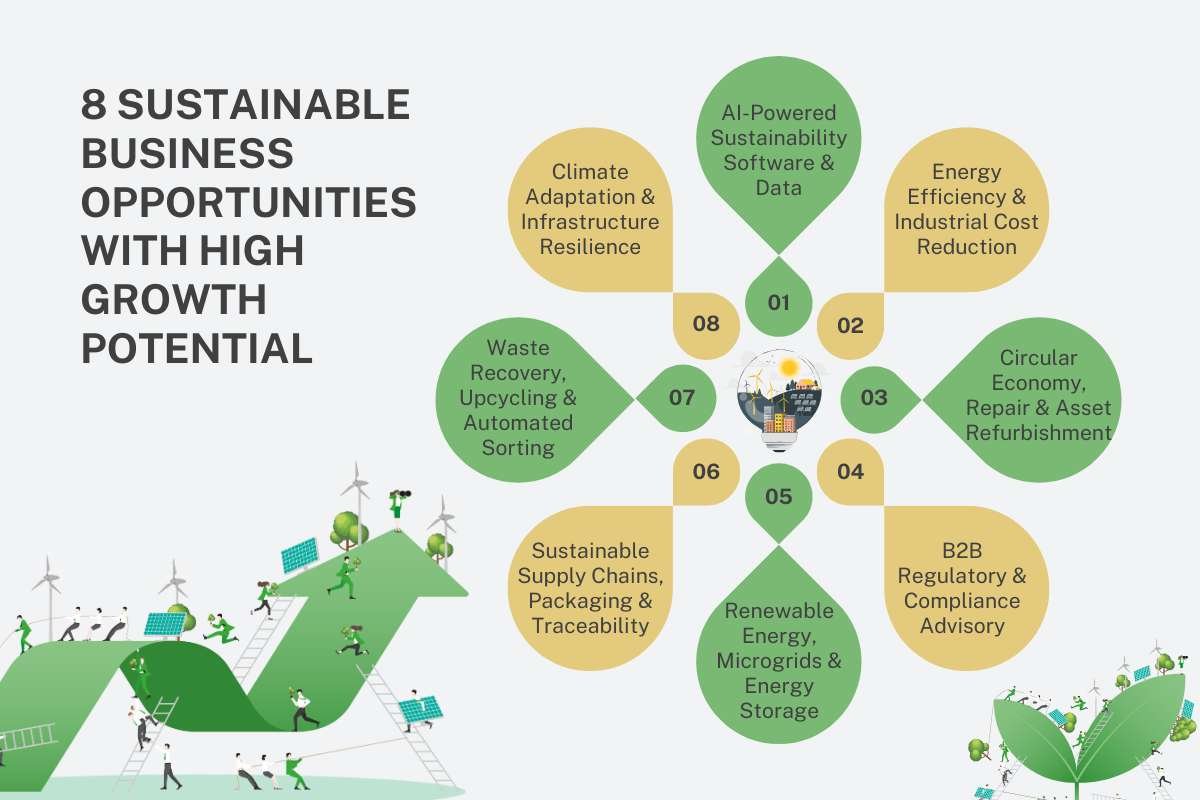
From AI-powered sustainability software and renewable energy to circular businesses, waste recovery, and climate adaptation, here are 8 sustainable business opportunities with strong growth potential in 2026.
What Makes a Sustainable Business Attractive in 2026?
The strongest opportunities solve problems businesses already have, and sustainability makes the solution more valuable.
That is what makes a sustainable business in 2026 commercially attractive. The best models do not rely on customers paying more simply because something is “green.” Instead, they connect sustainability with measurable financial outcomes.
Five forces are creating particularly strong opportunities.
1. Regulatory Pressure
Sustainability reporting is becoming more structured and data-driven. In the EU, companies within the Corporate Sustainability Reporting Directive framework must report sustainability-related risks, impacts, and opportunities. In July 2026, the European Commission also adopted revised reporting standards designed to simplify requirements while maintaining sustainability disclosures. This is increasing the importance of corporate sustainability reporting for businesses navigating changing disclosure requirements.
That creates demand for compliance software, reporting services, sustainability data management, supplier assessments, and advisory businesses. For companies responding to these pressures, developing a clear sustainability strategy for your company can help connect compliance requirements with broader operational and financial goals.
For entrepreneurs, this means regulatory complexity itself can become a business opportunity within sustainable business in 2026.
2. Energy Volatility
Energy efficiency is increasingly a financial decision rather than simply an environmental one. Global investment in energy-efficiency measures is expected to reach nearly $800 billion in 2025, more than 70% above 2015 levels.
Businesses that can reduce energy consumption therefore have a direct ROI story.
For a sustainable business in 2026, that connection between environmental impact and financial savings can become a powerful competitive advantage.
3. AI + IoT
AI and connected devices can turn sustainability data into operational decisions, from detecting energy waste and monitoring equipment to tracking emissions and optimising resource use.
That creates opportunities for automated sustainability platforms, smart-building systems, predictive maintenance, energy-management tools, and resource-optimisation software.
These technologies are also reshaping what a sustainable business in 2026 can deliver at scale, particularly when software replaces manual data collection and analysis.
4. Supply-Chain Disruption
Companies are under increasing pressure to understand suppliers, materials, packaging, logistics, and resource dependencies.
This is creating demand for traceability platforms, supplier-data systems, circular sourcing, sustainable packaging, and supply-chain optimisation.
The opportunity is particularly strong because businesses can use the same solution to address sustainability, procurement, compliance, and operational resilience.
5. Climate-Related Physical Risks
Climate risk is becoming a balance-sheet issue. S&P Global research cited by the World Economic Forum estimates that climate change could cost companies $1.2 trillion annually by the 2050s without adaptation, while only 35% of companies have context-specific climate adaptation plans.
That gap creates a growing market for resilience and adaptation solutions.
The growing focus on climate resilience is also increasing the importance of women in climate policy and environmental advocacy, particularly in shaping adaptation strategies, environmental regulations, and community-focused resilience initiatives.
For entrepreneurs, climate exposure is therefore becoming another commercial problem that sustainable business in 2026 can help solve.
8 Sustainable Business Opportunities With High Growth Potential
1. AI-Powered Sustainability Software & Data
- Problem: Sustainability data is often fragmented across spreadsheets, suppliers, energy systems, and internal databases.
- Opportunity: Build software that automates emissions tracking, sustainability data collection, reporting, supplier analysis, or resource optimisation.
- Customers: Enterprises, manufacturers, retailers, supply-chain companies, and sustainability teams.
- Revenue model: SaaS subscriptions, usage-based pricing, implementation fees, and enterprise contracts.
- Illustrative startup capital: $25K–$250K, depending on product complexity.
- Scalability: Very high.
- 2026 growth driver: Businesses need better sustainability data while AI is making data collection, analysis, and reporting increasingly automatable.
- Why it can be profitable: Software combines relatively low marginal delivery costs with recurring subscription revenue.
2. Energy Efficiency & Industrial Cost Reduction
- Problem: Inefficient equipment, HVAC, lighting, industrial processes, and buildings increase operating costs.
- Opportunity: Help businesses identify energy waste and reduce consumption through audits, monitoring, automation, equipment upgrades, and optimisation.
- Customers: Factories, warehouses, hotels, offices, retailers, and commercial property owners.
- Revenue model: Consulting fees, project contracts, performance-based savings, installation, and recurring monitoring.
- Illustrative startup capital: $25K–$250K.
- Scalability: High, particularly when software and remote monitoring are added.
- 2026 growth driver: Businesses need better sustainability data while AI is making data collection, analysis, and reporting increasingly automatable. This makes AI-powered software one of the most scalable opportunities within the sustainable business market in 2026.
- Why it can be profitable: The customer can often justify the purchase directly through lower energy bills and operating costs.
That direct ROI makes energy efficiency particularly attractive for a sustainable business in 2026 focused on B2B customers.
3. Circular Economy, Repair & Asset Refurbishment
- Problem: Products, equipment, electronics, and materials are often discarded before their economic value is exhausted.
- Opportunity: Build businesses around repair, refurbishment, resale, remanufacturing, or take-back programmes.
- These approaches are part of broader circular economy business models designed to keep products, components, and materials in use for longer.
- Customers: Manufacturers, retailers, electronics companies, automotive businesses, and consumers.
- Revenue model: Repair fees, resale margins, refurbishment contracts, subscriptions, and B2B take-back programmes.
- Illustrative startup capital: $25K–$250K+.
- Scalability: Medium to high.
- 2026 growth driver: Resource efficiency is becoming increasingly important as companies look to reduce material costs and waste.
- Why it can be profitable: The model can generate revenue from assets that would otherwise become waste.
4. B2B Regulatory & Compliance Advisory
- Problem: Businesses need help understanding sustainability requirements, reporting obligations, supplier disclosures, and climate-related risks.
- Opportunity: Provide specialised advisory services covering reporting, data collection, compliance, supplier assessments, and sustainability strategy.
- Customers: SMEs, enterprises, exporters, manufacturers, and supply-chain businesses.
- Revenue model: Consulting projects, retainers, compliance packages, and recurring advisory services.
- Illustrative startup capital: $0–$25K.
- Scalability: Medium, with greater scalability through templates, training, technology, and subscription services.
- 2026 growth driver: Sustainability regulation is becoming more structured even as reporting rules evolve. The EU’s 2026 revisions reduced mandatory ESRS data points by more than 60% and total data points by more than 70%, illustrating how quickly the compliance landscape is changing.
- Why it can be profitable: Expertise-based businesses require little upfront infrastructure and can generate recurring B2B retainers.
This demand also creates opportunities for professionals pursuing ESG careers for women, particularly in sustainability reporting, compliance, strategy, and advisory roles.
5. Renewable Energy, Microgrids & Energy Storage
- Problem: Businesses need reliable, affordable, and increasingly low-carbon electricity.
- Opportunity: Build or install solar systems, batteries, microgrids, energy-management systems, and related infrastructure.
- Customers: Factories, data centres, commercial buildings, campuses, retailers, and remote facilities.
- Revenue model: Equipment sales, installation, leasing, energy-as-a-service, maintenance, and long-term contracts.
- Illustrative startup capital: $250K+.
- Scalability: High, but capital-intensive.
- 2026 growth driver: Renewable deployment continues at record levels. In 2024, renewables added 585 GW, accounting for more than 92.5% of total global power-capacity expansion.
- Why it can be profitable: Large projects can produce substantial contract values and long-term service revenue.
The IEA also expects $2.2 trillion to be invested in clean-energy technologies in 2026.
This expanding investment is also creating demand for professionals who can evaluate, finance, and manage sustainable projects, strengthening opportunities in green finance careers for women.
That investment makes renewable energy one of the largest capital-intensive opportunities within the sustainable business market in 2026.
6. Sustainable Supply Chains, Packaging & Traceability
- Problem: Businesses need to reduce packaging waste, improve material efficiency, and demonstrate where products and materials originate.
- Opportunity: Build sustainable packaging products, traceability platforms, supplier-data systems, or material optimisation services.
- Customers: Retailers, FMCG companies, manufacturers, logistics providers, and exporters.
- Revenue model: Product sales, SaaS subscriptions, consulting fees, and enterprise contracts.
- Illustrative startup capital: $25K–$250K.
- Scalability: High, particularly for technology-enabled models.
- 2026 growth driver: Enterprise procurement is increasingly focused on measurable supplier performance, making traceability and sustainability data commercially valuable.
- Why it can be profitable: The same solution can address cost, compliance, procurement, and customer expectations simultaneously.
7. Waste Recovery, Upcycling & Automated Sorting
- Problem: Valuable materials are lost when waste is poorly sorted, processed, or sent to landfill.
- Opportunity: Recover materials from industrial, commercial, construction, electronic, and consumer waste and turn them into usable products or raw materials.
- Customers: Manufacturers, municipalities, recyclers, construction companies, and consumer brands.
- Revenue model: Material sales, processing fees, collection contracts, and B2B partnerships.
- Illustrative startup capital: $25K–$250K+.
- Scalability: Medium to high, depending on infrastructure.
- 2026 growth driver: Global municipal solid waste is projected to increase from 2.1 billion tonnes in 2023 to 3.8 billion tonnes by 2050. UNEP estimates the annual global cost of waste management could reach $640.3 billion by 2050 without urgent action.
- Why it can be profitable: Waste can become both a service revenue stream and a source of saleable materials.
8. Climate Adaptation & Infrastructure Resilience
- Problem: Heat, flooding, water stress, storms, and other climate risks can disrupt operations and damage assets.
- Opportunity: Help businesses assess exposure and invest in resilient buildings, drainage, cooling, water systems, backup power, and climate-risk monitoring.
- Customers: Real estate companies, manufacturers, infrastructure operators, municipalities, insurers, and large enterprises.
- Revenue model: Risk assessments, consulting, engineering projects, monitoring subscriptions, and resilience upgrades.
- Illustrative startup capital: $25K–$250K+.
- Scalability: Medium to high.
- 2026 growth driver: Climate-related business losses are rising while adaptation remains underdeveloped. S&P Global estimates potential corporate climate costs of $1.2 trillion annually by the 2050s without adaptation.
- Why it can be profitable: Businesses have a direct financial incentive to prevent downtime, asset damage, and operational disruption.
For entrepreneurs, this creates another high-value path into sustainable business in 2026, particularly in regions facing increasing physical climate risks.
Sustainable Business Opportunities Compared
These opportunities show how broad sustainable business in 2026 has become, spanning software, consulting, infrastructure, energy, waste management, and supply-chain solutions.
| Business Opportunity | Startup Capital* | Scalability | Revenue Potential | Best For |
| AI Sustainability Software | $25K–$250K | Very High | Very High | Tech entrepreneurs |
| Energy Efficiency | $25K–$250K | High | High | B2B service providers |
| Circular Economy & Refurbishment | $25K–$250K+ | Medium–High | High | Product-focused businesses |
| Compliance Advisory | $0–$25K | Medium | High | Sustainability professionals |
| Renewable Energy & Storage | $250K+ | High | Very High | Infrastructure entrepreneurs |
| Sustainable Supply Chains | $25K–$250K | High | High | B2B entrepreneurs |
| Waste Recovery & Sorting | $25K–$250K+ | Medium–High | High | Operations-focused businesses |
| Climate Adaptation | $25K–$250K+ | Medium–High | High | Infrastructure specialists |
*Startup capital figures are illustrative planning ranges, not industry-standard benchmarks.
The trade-off is straightforward: software and advisory models require less capital and can scale faster, while infrastructure and waste businesses require more upfront investment but can support larger contracts.
How to Build a Sustainable Business People Will Actually Pay For?

A sustainable idea is not automatically a viable business. Customers pay when the solution produces a clear economic outcome.
That principle is especially important when building a sustainable business in 2026. Sustainability may attract attention, but measurable business value drives purchasing decisions.
Weak vs. Strong Positioning
Weak: “We help companies become more sustainable.”
Strong: “We help manufacturers reduce energy costs by identifying operational waste.”
The second proposition connects sustainability to a measurable financial result. To prove that value, businesses also need clear sustainability KPIs that connect environmental performance with costs, efficiency, risk, and revenue.
Sell ROI, Not Sustainability Alone
Build the value proposition around four things:
- Cost reduction: Lower energy, material, waste, logistics, or operating costs.
- Risk reduction: Reduce exposure to climate, supply-chain, and resource risks.
- Compliance: Help customers meet reporting and regulatory requirements.
- Customer requirements: Help businesses satisfy sustainability expectations from enterprise buyers.
The strongest sustainable businesses sit where environmental impact and financial incentives overlap. This same value-driven approach is important when learning how to pitch sustainability initiatives, particularly when the audience is focused on financial returns, operational efficiency, or risk reduction.
3 Examples of Sustainability Creating Direct Business Value
1. Packaging → Lower Costs
Lightweight, reusable, or optimised packaging can reduce material use, storage requirements, and transportation costs while helping companies meet sustainability expectations.
The business opportunity could include packaging optimisation, sustainable materials, reusable systems, or packaging-as-a-service.
2. Building Systems → Lower Energy Bills
Smart HVAC, lighting, energy monitoring, and building-management systems can identify energy waste and optimize consumption.
For customers, the value is measurable through lower utility costs. For providers, revenue can come from installation, optimisation, maintenance, and recurring monitoring.
3. Sustainability SaaS → Lower Compliance Costs
Automated platforms can collect sustainability data, track emissions, assess suppliers, and simplify reporting.
The customer isn’t simply buying “ESG software.” They are buying less manual work, better data, lower reporting friction, and improved compliance readiness.
Which Sustainable Business Should You Start?
Your available capital can narrow the field quickly.
$0–$25K: Start With Expertise
Consider:
- B2B sustainability advisory
- Regulatory and compliance consulting
- Sustainability reporting
- Supplier assessments
- Energy-efficiency consulting
These models can start with expertise rather than expensive infrastructure. They also reflect the broader expansion of green jobs and sustainability roles, as companies increasingly need professionals who can manage compliance, reporting, energy efficiency, and sustainability strategy.
$25K–$250K: Build a Scalable Solution
Consider:
- AI sustainability SaaS
- Sustainable packaging
- Asset refurbishment
- Waste recovery
- Supply-chain traceability
- Climate-risk monitoring
These models require more operational investment but offer stronger potential for recurring revenue and scale. The approach can also vary by founder and business model, particularly when considering how women-led businesses approach sustainability differently, from prioritising stakeholder needs to building resilience and long-term value into growth strategies.
$250K+: Target Infrastructure
Consider:
- Renewable energy
- Battery storage
- Microgrids
- Automated waste processing
- Industrial energy infrastructure
- Climate-resilient infrastructure
These require significantly more capital but can generate larger contracts and longer customer relationships.
Best Sustainable Businesses by Goal
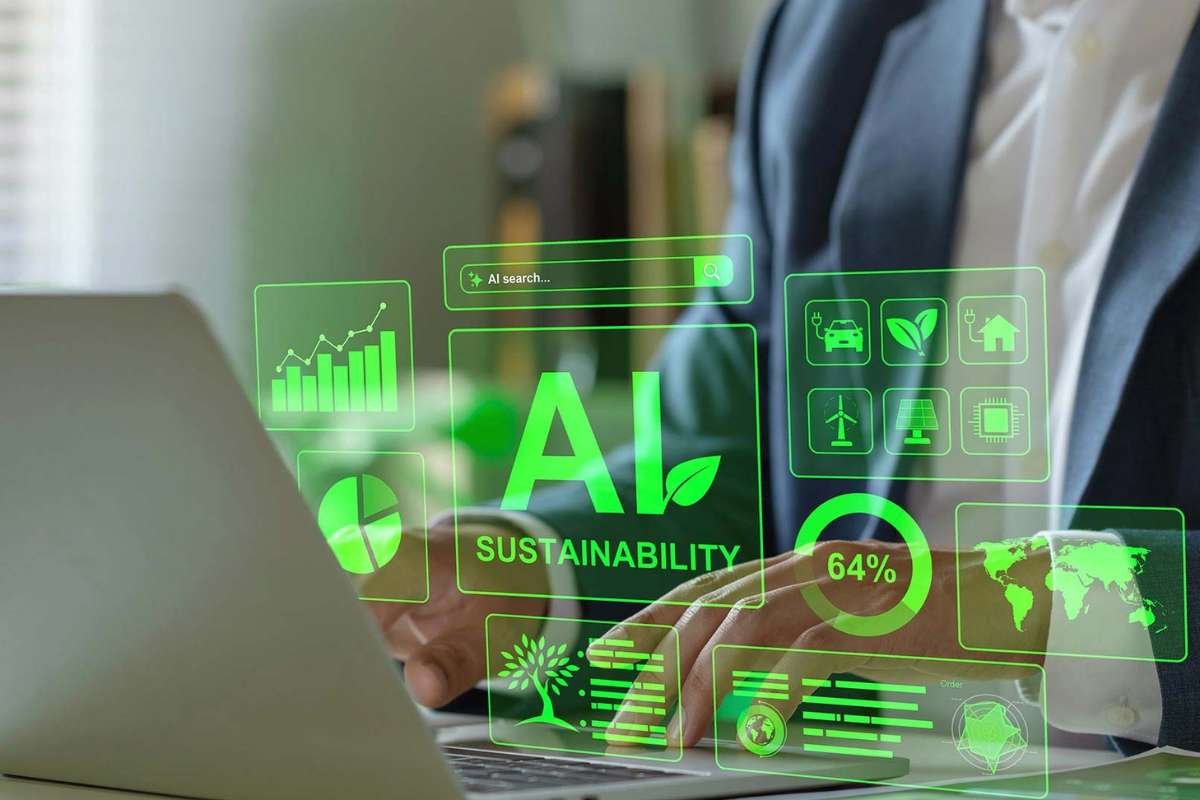
The following comparison can help narrow down the best sustainable business in 2026 based on your financial and growth objectives.
| Goal | Best Opportunity | Why |
| Cheapest to start | B2B Compliance Advisory | Low infrastructure requirements |
| Most scalable | AI Sustainability Software | High scalability and recurring SaaS revenue |
| Best recurring revenue | Sustainability SaaS / Energy Monitoring | Subscription and monitoring models |
| Best infrastructure opportunity | Renewable Energy & Storage | Large projects and long-term demand |
| Best B2B opportunity | Energy Efficiency / Supply-Chain Solutions | Direct ROI and enterprise demand |
If you have limited capital, start with expertise. If you want maximum scalability, look toward software and technology-enabled services. If you have substantial capital, infrastructure opportunities can offer larger long-term contracts.
Conclusion:
Sustainable business in 2026 is no longer about simply selling “green” products. It is about solving expensive business problems with sustainable solutions.
The market signals are strong: $2.2 trillion is expected to flow into clean-energy investment in 2026, energy-efficiency investment is approaching $800 billion, global waste could reach 3.8 billion tonnes by 2050, and climate risks could cost companies $1.2 trillion annually by the 2050s without adaptation.
That creates opportunities across software, energy, circularity, compliance, supply chains, waste, and infrastructure.
But the winning principle remains simple:
Don’t sell sustainability. Sell the business value sustainability creates.
If your solution cuts costs, reduces risk, simplifies compliance, improves resilience, or helps customers win business, sustainability becomes a commercial advantage and the foundation for a profitable sustainable business in 2026.
FAQs:
1. What is the most profitable sustainable business in 2026?
AI-powered sustainability software, renewable energy, energy efficiency, and climate adaptation have strong profit potential because they address measurable business needs and can support recurring or high-value revenue.
2. What is the cheapest sustainable business to start?
B2B sustainability and regulatory compliance consulting can be started with relatively little capital because they primarily require expertise rather than physical infrastructure or inventory.
3. Is a sustainable business in 2026 profitable?
Yes. Sustainable businesses can be highly profitable when they solve clear commercial problems such as reducing energy costs, improving resource efficiency, meeting regulations, or reducing climate and supply-chain risks.
4. Which sustainable business has the highest scalability?
AI-powered sustainability software has some of the strongest scalability potential because SaaS products can serve additional customers without proportionally increasing delivery costs.
5. How do I choose the right sustainable business to start?
Consider your available capital, expertise, target customers, revenue model, and scalability goals. Prioritise problems where customers already have a clear financial reason to pay for a solution.