
Sustainability has become a business imperative, not just an environmental goal. According to the World Economic Forum, environmental risks continue to rank among the most significant long-term threats to businesses, while Bloomberg Intelligence projects the global ESG market could surpass $40 trillion by 2030. As investors, regulators, customers, and employees demand greater accountability, organizations are under increasing pressure to prove that their sustainability initiatives deliver measurable results, not just good intentions.
That’s where sustainability KPIs come in. Setting goals like reducing emissions, improving diversity, or minimizing waste is only the first step. Without clear, measurable indicators, businesses can’t track progress, benchmark performance, or demonstrate real impact. Sustainability KPIs transform broad ESG commitments into actionable insights that drive smarter decisions, improve operational efficiency, strengthen stakeholder trust, and support long-term business resilience.
In this guide, you’ll learn what sustainability KPIs are, how they differ from sustainability metrics, the most important KPIs to track in 2026, practical ways to measure sustainability performance, and the reporting frameworks that help organizations turn sustainability into a measurable competitive advantage.
What are sustainability KPIs?
Sustainability KPIs (Key Performance Indicators) are quantifiable metrics that measure how effectively an organization is achieving its environmental, social, and governance (ESG) objectives. They provide a structured way to monitor progress, identify areas for improvement, and evaluate whether sustainability initiatives are delivering meaningful business outcomes.
Unlike broad sustainability goals, KPIs are specific, measurable, and tracked over time. They enable organizations to move beyond intentions and make informed decisions based on reliable data.
For example, a company may set a goal to become carbon neutral by 2040. While that defines the desired outcome, it doesn’t indicate whether the organization is making steady progress. A Sustainability KPI, such as reducing Scope 1 and Scope 2 greenhouse gas emissions by 8% year over year, provides a measurable benchmark that can be monitored and reported consistently.
| Sustainability Goal | Sustainability KPI |
| Achieve net-zero emissions by 2040 | Reduce Scope 1 and Scope 2 GHG emissions by 8% annually |
| Reduce freshwater consumption | Lower water intensity by 15% per unit of production |
| Build a more diverse workforce | Increase women in leadership roles to 40% by 2030 |
| Improve supply chain sustainability | Audit 100% of high-risk suppliers annually for ESG compliance |
Why do businesses need sustainability KPIs?
As sustainability becomes a strategic business priority, organizations need a consistent way to measure performance across operations, supply chains, and governance practices. Sustainability KPIs help businesses:
- Track progress against sustainability goals using measurable, time-bound indicators.
- Support regulatory compliance through standardized ESG reporting.
- Improve decision-making with actionable, data-driven insights.
- Strengthen investor and stakeholder confidence through transparent reporting.
- Increase operational efficiency by identifying opportunities to reduce energy use, waste, and resource consumption.
Simply put, sustainability KPIs provide the evidence organizations need to demonstrate that sustainability is creating measurable environmental, social, and business value, not simply remaining a corporate aspiration. As organizations expand their sustainability efforts, the demand for professionals in green jobs and sustainability roles continues to grow, with many of these positions focused on tracking, analyzing, and improving ESG performance.
Building meaningful sustainability KPIs starts with a well-defined corporate sustainability strategy that aligns environmental and social objectives with long-term business goals.
As sustainability becomes embedded across business functions, these KPIs also help define the skills and impact expected in emerging ESG careers for women, where professionals are increasingly responsible for tracking, analyzing, and improving organizational sustainability performance.
Why sustainability KPIs matter?
Organizations today are expected to demonstrate measurable progress, not just publish sustainability commitments. Sustainability KPIs provide the data needed to evaluate performance, improve operational efficiency, manage business risks, and communicate credible results to stakeholders.
As Peter Drucker famously observed: “What gets measured gets managed.”
Although originally applied to business management, this principle has become one of the foundations of corporate sustainability. Organizations cannot improve environmental or social performance without consistently measuring the metrics that matter.
They also help organizations answer critical business questions, such as:
- Are we reducing our carbon footprint year over year?
- Is our energy efficiency improving?
- Are our diversity and inclusion initiatives delivering results?
- Is our supply chain meeting ESG expectations?
- Are sustainability investments generating measurable business value?
Without clearly defined KPIs, these questions become difficult to answer.
According to John Elkington: “What you measure is what you get because what you measure is what people will pay attention to.”
His work on the Triple Bottom Line underscores that organizations achieve better environmental, social, and financial outcomes when they measure them with the same rigor as traditional business performance.
Organizations often prioritize different sustainability outcomes based on their leadership, values, and business strategy. This is especially evident in how women-led businesses approach sustainability differently, where long-term value creation, stakeholder impact, and responsible governance frequently shape the KPIs they choose to measure.
Benefits of sustainability KPIs

- Support better business decisions through measurable performance data.
- Improve operational efficiency by identifying opportunities to reduce energy, water, and material consumption.
- Strengthen risk management by monitoring environmental, social, and governance risks.
- Enhance transparency through consistent and comparable reporting.
- Demonstrate business value by linking sustainability initiatives to measurable outcomes.
Sustainability KPIs vs. Operating without them
| Business Area | Without Sustainability KPIs | With Sustainability KPIs |
| Performance Measurement | Progress is difficult to quantify | Measurable, standardized tracking |
| Reporting | Inconsistent and manual | Audit-ready and framework-aligned |
| Decision-Making | Based on estimates | Driven by reliable data |
| Resource Management | Inefficiencies go unnoticed | Continuous optimization opportunities |
| Stakeholder Trust | Limited transparency | Greater accountability and credibility |
| Business Value | Difficult to demonstrate ROI | Clear link between sustainability and performance |
Organizations that measure sustainability consistently are better equipped to identify opportunities, improve performance, and create long-term value.
Sustainability Metrics vs. Sustainability KPIs: what’s the difference?
The terms sustainability metrics and sustainability KPIs are often used interchangeably, but they serve different purposes.
A sustainability metric is any data point used to monitor environmental, social, or governance performance. It provides raw information about an organization’s activities, such as electricity consumption, water usage, or employee training hours.
A Sustainability KPI, on the other hand, is a strategic metric tied directly to a business objective. It measures progress against a defined target and helps organizations evaluate whether their sustainability initiatives are achieving the desired outcomes.
In simple terms, all KPIs are metrics, but not all metrics are KPIs.
Sustainability metrics vs. Sustainability KPIs
| Category | Sustainability Metric | Sustainability KPI |
| Purpose | Measures an activity or process | Measures progress toward a strategic objective |
| Focus | Raw operational data | Business performance and outcomes |
| Target-Based | Not always | Always linked to a measurable goal |
| Decision-Making | Supports monitoring | Drives strategic action |
| Example | Total electricity consumed (kWh) | Reduce electricity consumption per unit produced by 10% |
Practical Examples
| ESG Area | Sustainability Metric | Sustainability KPI |
| Environmental | Total water consumption | Water intensity per million dollars of revenue |
| Environmental | Total GHG emissions | Reduce Scope 1 and Scope 2 emissions by 8% annually |
| Social | Total training hours | Average sustainability training hours per employee |
| Social | Total women employees | Women in leadership positions (%) |
| Governance | Number of supplier audits | Percentage of suppliers meeting ESG compliance standards |
Tracking metrics tells organizations what happened, while KPIs explain whether they’re moving closer to their sustainability goals.
Sustainability KPIs across the ESG pillars
Every Sustainability KPI falls under one of the three pillars of Environmental, Social, and Governance (ESG). Together, these pillars provide a comprehensive framework for measuring an organization’s sustainability performance.
| ESG Pillar | What It Measures | Examples of Sustainability KPIs |
| Environmental (E) | Environmental impact and resource efficiency | Scope 1–3 emissions, carbon intensity, renewable energy share, water consumption, waste diversion |
| Social (S) | Workforce, communities, and social responsibility | Employee turnover, diversity, women in leadership, LTIFR, employee engagement |
| Governance (G) | Ethics, leadership, and compliance | Board diversity, supplier ESG compliance, cybersecurity incidents, ethics training |
Rather than focusing on just one pillar, organizations should build a balanced KPI framework that reflects their most material ESG priorities. For example, a manufacturing company may emphasize emissions and workplace safety, while a financial institution may prioritize financed emissions, governance oversight, and responsible lending.
The next step is identifying the sustainability KPIs that matter most. While organizations may track dozens of indicators, a core set of KPIs has emerged as the global benchmark for measuring sustainability performance across industries.
25 sustainability KPIs every organization should track in 2026
Choosing the right sustainability KPIs is more important than tracking the largest number of metrics. The most valuable KPIs are those that align with your organization’s sustainability objectives, industry requirements, and stakeholder expectations. They should also be measurable, actionable, and consistent with globally recognized reporting frameworks.
The following 25 sustainability KPIs represent some of the most widely used indicators across industries in 2026.
| # | Sustainability KPI | Category | Why It Matters | Common Frameworks |
| 1 | Scope 1 GHG Emissions | Environmental | Measures direct emissions from company-owned operations | GHG Protocol, GRI, CSRD |
| 2 | Scope 2 GHG Emissions | Environmental | Tracks indirect emissions from purchased energy | GHG Protocol, GRI, CSRD |
| 3 | Scope 3 Value Chain Emissions | Environmental | Captures emissions across the value chain | ISSB, CDP, CSRD |
| 4 | Carbon Intensity Ratio | Environmental | Measures emissions relative to business output | SASB, TCFD |
| 5 | Renewable Energy Share (%) | Environmental | Indicates the transition to clean energy | GRI, SASB |
| 6 | Energy Intensity Rate | Environmental | Tracks operational energy efficiency | GRI, CSRD |
| 7 | Water Consumption & Intensity | Environmental | Measures water efficiency and conservation | GRI, CDP |
| 8 | Waste Diversion Rate | Environmental | Evaluates recycling and landfill reduction efforts | GRI, SASB |
| 9 | Material Recycling & Reuse Rate | Environmental | Supports circular economy initiatives | GRI, CSRD |
| 10 | Air & Pollutant Emissions | Environmental | Monitors non-GHG environmental pollutants | GRI, SASB |
| 11 | Employee Turnover Rate | Social | Reflects workforce stability | GRI, CSRD |
| 12 | Employee Engagement Score | Social | Measures employee satisfaction and commitment | Internal Benchmarking |
| 13 | Diversity & Inclusion Ratio | Social | Tracks workforce diversity | GRI, CSRD |
| 14 | Women in Leadership (%) | Social | Evaluates leadership diversity | GRI, CSRD |
| 15 | Lost Time Injury Frequency Rate (LTIFR) | Social | Measures workplace safety performance | GRI, SASB |
| 16 | Safety & Compliance Training Hours | Social | Assesses workforce preparedness | GRI |
| 17 | Gender Pay Gap | Social | Measures pay equity | CSRD |
| 18 | Community Investment | Social | Tracks investment in community initiatives | GRI |
| 19 | Board Diversity & Independence | Governance | Evaluates governance effectiveness | GRI, SASB |
| 20 | ESG Executive Oversight | Governance | Measures leadership accountability | ISSB, CSRD |
| 21 | Ethics & Anti-Corruption Violations | Governance | Tracks ethical business conduct | GRI, SASB |
| 22 | Supplier ESG Audit Compliance | Governance | Evaluates responsible sourcing | CSRD |
| 23 | Data Privacy & Cybersecurity Incidents | Governance | Measures information security risks | SASB |
| 24 | Ethics Training Completion Rate | Governance | Strengthens compliance culture | GRI |
| 25 | Regulatory Non-Compliance Fines | Governance | Reflects legal and regulatory performance | GRI, CSRD |
While these KPIs provide a strong foundation, organizations don’t need to track every indicator. Instead, they should prioritize the KPIs that are most material to their operations, industry, and long-term sustainability strategy.
Key sustainability KPIs explained
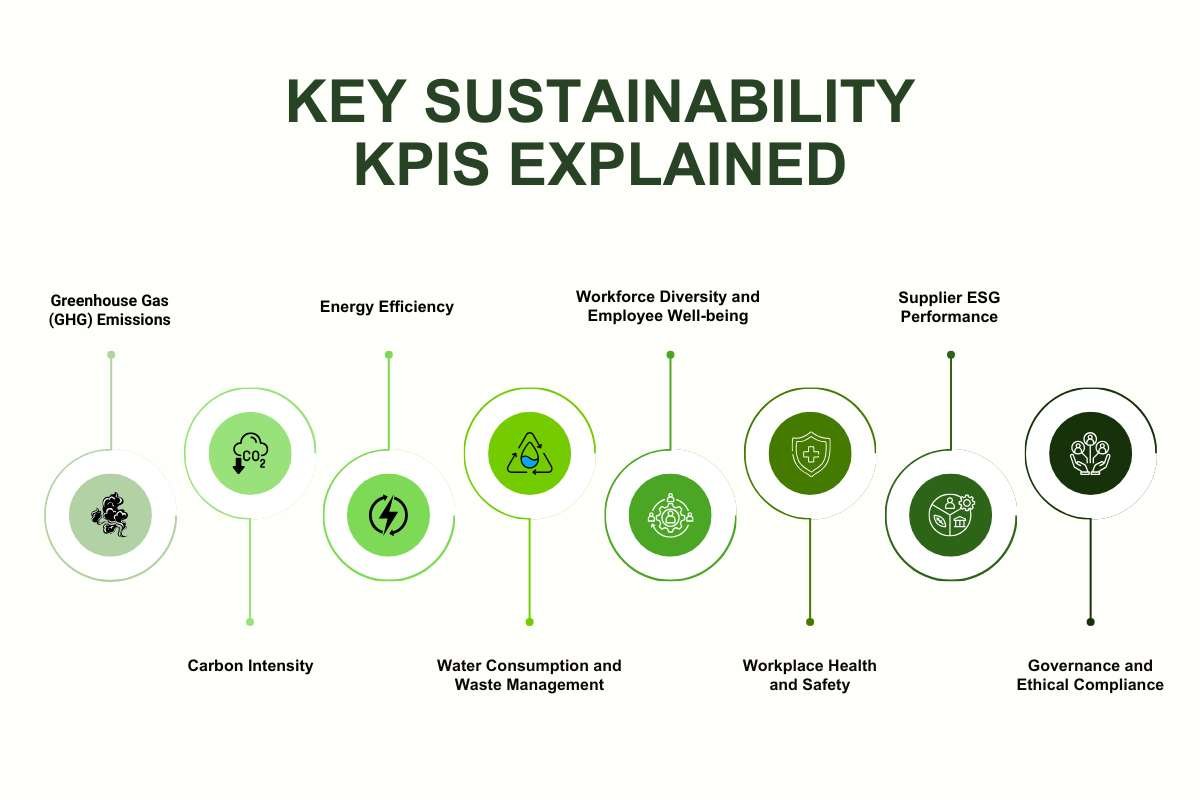
Some sustainability KPIs have a greater influence on business performance, regulatory compliance, and stakeholder confidence than others. Understanding these high-impact indicators helps organizations focus their efforts where they matter most.
1. Greenhouse Gas (GHG) Emissions
GHG emissions remain the cornerstone of sustainability reporting and climate action.
Organizations typically measure:
- Scope 1: Direct emissions from owned or controlled sources.
- Scope 2: Indirect emissions from purchased electricity, heating, or cooling.
- Scope 3: Indirect emissions across the value chain, including suppliers, transportation, business travel, and product use.
Why it matters: Measuring all three scopes provides a complete picture of an organization’s carbon footprint and helps identify opportunities for emissions reduction.
2. Carbon Intensity
Carbon intensity measures emissions relative to business activity, making it easier to compare sustainability performance as the organization grows.
Example:
Carbon Intensity = Total GHG Emissions ÷ Revenue (or Units Produced)
Why it matters: A company may increase production while reducing emissions per unit, demonstrating improved operational efficiency even if total emissions remain stable.
3. Energy Efficiency
Rather than focusing only on total energy consumption, organizations also monitor how efficiently energy is used.
Common indicators include:
- Energy intensity
- Renewable energy share
- Energy consumption per unit produced
Why it matters: Improved energy efficiency reduces operating costs while lowering environmental impact.
4. Water consumption and waste management
Water scarcity and waste reduction have become critical sustainability priorities across many industries.
Organizations commonly track:
- Total water consumption
- Water intensity
- Waste diversion rate
Why it matters: These KPIs improve resource efficiency, support circular economy business models, and reduce disposal costs by keeping materials in use for longer while minimizing waste throughout the product lifecycle.
5. Workforce diversity and employee well-being
Strong social performance contributes to employee engagement, innovation, and long-term organizational resilience.
Common social KPIs include:
- Diversity and inclusion ratio
- Women in leadership
- Employee turnover
Why it matters: These indicators help organizations create more inclusive workplaces while strengthening talent attraction and retention. They also support broader organizational efforts championed by women in climate policy and environmental advocacy, where diverse leadership drives stronger sustainability outcomes.
6. Workplace health and safety
Safety remains a core sustainability priority, particularly in industries such as manufacturing, construction, healthcare, and logistics.
The most widely used KPI is:
- Lost Time Injury Frequency Rate (LTIFR)
Organizations may also monitor:
- Safety training completion
- Recordable incident rates
- Near-miss reporting
Why it matters: Strong safety performance protects employees, improves productivity, and reduces operational disruptions.
7. Supplier ESG performance
An organization’s sustainability performance increasingly depends on its supply chain.
Key indicators include:
- Supplier ESG audit completion
- Responsible sourcing compliance
- Supplier code of conduct adherence
Why it matters: Monitoring supplier performance helps reduce operational, reputational, and regulatory risks.
8. Governance and ethical compliance
Good governance provides the foundation for credible sustainability performance.
Common governance KPIs include:
- Board diversity and independence
- Ethics training completion
- Anti-corruption violations
Why it matters: Strong governance improves transparency, strengthens stakeholder trust, and supports long-term business resilience. These governance metrics are also widely used in green finance careers for women, where ESG analysts, sustainable investment professionals, and climate finance specialists assess organizational performance and long-term risk.
How to measure sustainability performance?
Selecting sustainability KPIs is only the first step. Organizations also need a structured process for collecting reliable data, monitoring progress, and continuously improving performance. A simple five-step framework can help businesses build an effective sustainability measurement system.
Step 1: define sustainability goals and material issues
Start by identifying the sustainability priorities that matter most to your organization and stakeholders.
Examples include:
- Reducing carbon emissions
- Improving energy efficiency
- Increasing workforce diversity
Conducting a materiality assessment helps ensure that the KPIs you select address the issues with the greatest business impact.
Before selecting KPIs, organizations should establish a clear roadmap that aligns sustainability initiatives with business objectives. Our guide on sustainability strategy for your company explains how to build that foundation and identify the priorities that matter most.
Step 2: Select the right sustainability KPIs
Choose KPIs that are:
- Relevant to your business objectives
- Easy to measure consistently
- Supported by reliable data
Avoid tracking excessive metrics. A focused set of meaningful KPIs provides greater value than dozens of disconnected indicators.
Step 3: collect accurate and consistent data
Reliable reporting depends on high-quality data.
Organizations typically gather information from:
- Utility and energy systems
- HR platforms
- Procurement systems
Automating data collection wherever possible improves accuracy and reduces manual reporting effort.
Step 4: establish baselines and monitor progress
Measure current performance to establish a baseline, then set realistic improvement targets.
For example:
- Reduce Scope 1 emissions by 20% within five years.
- Increase renewable energy usage to 60% by 2030.
- Achieve 40% women in leadership roles.
Regular monitoring helps organizations identify trends, evaluate initiatives, and adjust strategies when needed.
Step 5: report, review, and improve
Sustainability measurement is an ongoing process.
Organizations should regularly:
- Review KPI performance
- Compare results against targets
- Communicate progress to stakeholders
By treating sustainability KPIs as strategic management tools rather than annual reporting requirements, organizations can drive continuous improvement while strengthening long-term business performance. Clear performance data also makes how to pitch sustainability initiatives far more effective by connecting sustainability efforts with measurable business outcomes.
The next step is understanding how globally recognized sustainability reporting frameworks standardize these KPIs, making disclosures more consistent, comparable, and credible across industries.
Sustainability reporting frameworks that use KPIs
Sustainability KPIs become significantly more valuable when they’re measured and reported using recognized reporting frameworks. These frameworks establish standardized methodologies that improve consistency, transparency, and comparability, making it easier for organizations to communicate sustainability performance to investors, regulators, customers, and other stakeholders.
Rather than viewing reporting frameworks as compliance requirements alone, businesses should use them as tools for benchmarking performance and strengthening sustainability strategies.
Organizations exploring different approaches to sustainability often compare voluntary certifications with disclosure frameworks. If you’re deciding between the two, our guide on B Corp Certification vs ESG Reporting explains how each approach supports business credibility, transparency, and long-term sustainability goals.
Comparison of leading sustainability reporting frameworks
| Framework | Primary Focus | Best For | Examples of KPIs |
| GRI (Global Reporting Initiative) | Broad sustainability impacts | Organizations across industries | Energy, emissions, waste, diversity, health & safety |
| ISSB (International Sustainability Standards Board) | Investor-focused sustainability disclosures | Public companies and investor reporting | Climate risks, governance, sustainability performance |
| CSRD (Corporate Sustainability Reporting Directive) | Mandatory ESG reporting in the EU | Eligible organizations operating in the EU | Emissions, workforce, governance, supply chain |
| CDP | Environmental disclosures | Climate- and resource-intensive businesses | Carbon emissions, water security, deforestation |
| SASB | Industry-specific sustainability issues | Financially material ESG reporting | Sector-specific environmental, social, and governance KPIs |
Which framework should you choose?

The right framework depends on your organization’s:
- Industry
- Geographic presence
- Regulatory obligations
Many organizations adopt more than one framework to meet different reporting requirements. Regardless of the framework you choose, the most important step is ensuring your sustainability KPIs are measured consistently using reliable, verifiable data.
If you’re preparing ESG disclosures, explore our comprehensive guide on corporate sustainability reporting to understand reporting requirements, materiality assessments, and disclosure best practices.
Sustainability KPIs across different industries
Although sustainability KPIs follow the same ESG principles, the indicators that matter most vary by industry. Selecting industry-specific KPIs allows organizations to focus on the sustainability issues that have the greatest operational, financial, and regulatory impact.
| Industry | Environmental KPI | Social KPI | Governance KPI |
| Manufacturing | Energy intensity, Scope 1 emissions, waste diversion | LTIFR, employee training | Supplier ESG audits |
| Retail & E-commerce | Packaging emissions, recycling rate | Employee turnover, fair wage compliance | Supply chain human rights audits |
| Technology | Renewable energy usage, data center efficiency | Workforce diversity, employee engagement | Cybersecurity incidents |
| Financial Services | Financed emissions | Fair lending practices | Board ESG oversight |
| Healthcare | Hazardous waste management | Staff retention, workplace safety | Clinical ethics compliance |
| Construction | Embodied carbon, construction waste | Worker safety | Contractor ESG compliance |
The objective isn’t to measure every available KPI but to prioritize those that address your organization’s most material sustainability challenges. A manufacturing company, for example, may focus on emissions and workplace safety, while a technology company may emphasize renewable energy adoption and cybersecurity governance.
Common mistakes companies make when choosing sustainability KPIs
Even organizations with well-defined sustainability strategies can struggle to generate meaningful insights if they select the wrong KPIs or fail to measure them consistently.
Avoid these common mistakes:
- Tracking Too Many Metrics: Measuring dozens of indicators often creates unnecessary complexity. Focus on the KPIs that directly support your business objectives and material ESG issues.
- Ignoring Scope 3 Emissions: For many organizations, the majority of their carbon footprint exists within the value chain. Excluding Scope 3 emissions can lead to an incomplete picture of environmental performance.
- Poor Data Quality: Manual spreadsheets, inconsistent methodologies, and fragmented data sources increase the risk of reporting errors.
- Lack of Accountability: Sustainability KPIs should have clearly defined owners. Assigning responsibility helps ensure regular monitoring and continuous improvement.
- Treating KPIs as Reporting Metrics Only: The purpose of sustainability KPIs extends beyond producing annual reports. They should be used to guide operational decisions, improve performance, and support long-term business strategy.
Best practices for building an effective sustainability KPI dashboard

A well-designed dashboard transforms sustainability KPIs into actionable insights by making performance easy to monitor, analyze, and communicate. Follow these best practices to build a dashboard that supports better decision-making.
1. Focus on material KPIs
Prioritize indicators that align with your organization’s sustainability goals rather than displaying every available metric.
Balance Leading and Lagging Indicators
| Leading Indicators | Lagging Indicators |
| Sustainability training completion | Annual carbon emissions |
| Supplier ESG audits completed | Waste diversion rate |
| Renewable energy projects initiated | Employee turnover rate |
| Employee engagement score | Regulatory non-compliance incidents |
Leading indicators help predict future performance, while lagging indicators measure results already achieved.
2. Apply the smart framework
Every Sustainability KPI should be:
- Specific
- Measurable
- Achievable
- Relevant
- Time-bound
This ensures KPIs remain meaningful, comparable, and aligned with business objectives.
3. Automate data collection
Integrating ESG data with HR, procurement, finance, and operational systems reduces manual work, improves reporting accuracy, and enables near real-time performance monitoring.
4. Maintain audit-ready data
Organizations should establish consistent calculation methods, document assumptions, validate data regularly, and maintain records that support third-party assurance when required.
Conclusion:
As sustainability becomes increasingly integrated into business strategy, organizations need more than ambitious goals; they need measurable evidence of progress. Sustainability KPIs provide that evidence by transforming ESG commitments into clear, actionable performance indicators.
Whether measuring carbon emissions, energy efficiency, workforce diversity, or governance practices, the right KPIs help organizations monitor progress, improve decision-making, strengthen stakeholder trust, and meet evolving reporting requirements.
The key is to focus on the metrics that matter most, align them with recognized reporting frameworks, and review them consistently. When supported by reliable data and effective reporting, sustainability KPIs become more than compliance metrics; they become strategic tools for building resilient, responsible, and future-ready businesses.
Frequently Asked Questions (FAQs)
1. What are Sustainability KPIs?
Sustainability KPIs are measurable indicators that track an organization’s environmental, social, and governance (ESG) performance. They help businesses evaluate progress toward sustainability goals, improve decision-making, and support transparent reporting.
2. What are the four main sustainability KPIs?
Although KPIs vary by organization, four of the most widely used include:
Greenhouse gas (GHG) emissions
Energy efficiency
Workforce diversity and employee well-being
Governance and ethical compliance
These KPIs provide a balanced view of environmental, social, and governance performance.
3. What’s the difference between sustainability metrics and sustainability KPIs?
A sustainability metric measures a specific activity, such as electricity consumption or water use. A Sustainability KPI is a strategic metric tied to a defined business objective, such as reducing electricity consumption by 10% over two years.
4. How do organizations measure sustainability performance?
Organizations typically:
Define sustainability goals.
Identify material ESG issues.
Select relevant sustainability KPIs.
Collect and analyze data.
Monitor, report, and continuously improve performance.
5. Which reporting frameworks use sustainability KPIs?
The most widely used sustainability reporting frameworks include:
GRI
ISSB
CSRD
CDP
SASB
These frameworks help standardize sustainability reporting and improve comparability across organizations
6. How many sustainability KPIs should a company track?
There is no fixed number. Organizations should prioritize KPIs that are material to their business, aligned with strategic objectives, measurable with reliable data, and useful for decision-making rather than simply tracking as many metrics as possible.
7. Why are sustainability KPIs important?
Sustainability KPIs help organizations measure progress, improve operational efficiency, manage ESG risks, strengthen stakeholder confidence, support regulatory compliance, and demonstrate the business value of sustainability initiatives.