
This article explores how women-led businesses approach sustainability differently by examining research-backed leadership patterns, ESG practices, and real-world examples. It highlights how purpose-driven decision-making, stakeholder engagement, transparency, circular innovation, and long-term thinking contribute to resilient and sustainable growth. Readers will also discover practical strategies that organizations of any size can adopt to strengthen their sustainability efforts and create lasting business value.
Sustainability is no longer just about meeting regulations; it’s becoming a key factor in how businesses grow, attract investment, and earn customer trust. As organizations adapt to this shift, how women-led businesses approach sustainability differently is gaining attention among business leaders, investors, and researchers alike. This broader change is reflected in corporate behavior: 96% of the world’s 250 largest companies now publish sustainability reports, according to KPMG’s 2024 Survey of Sustainability Reporting. At the same time, ESG considerations are playing a bigger role in business decisions, from supply chains to product development and talent retention.
Research from McKinsey has consistently found that companies with more diverse leadership are more likely to outperform financially, while studies from Harvard Business Review suggest that inclusive leadership is often linked to stronger stakeholder relationships and better long-term decision-making.
This isn’t about gender stereotypes. Instead, it reflects a leadership approach that often places greater emphasis on long-term value, responsible governance, and balancing the needs of customers, employees, communities, and investors.
In this article, we’ll examine how women-led businesses approach sustainability differently, explore the research behind these leadership patterns, and uncover practical lessons that organizations of all sizes can use to build stronger, more resilient sustainability strategies.
Do women-led businesses really approach sustainability differently?
There isn’t a simple yes-or-no answer. Sustainability isn’t determined by gender, but research consistently shows that companies with more diverse leadership often perform better on the building blocks of sustainable business innovation, governance, stakeholder trust, and long-term growth.
Here are some of the key findings:
- Companies in the top quartile for gender diversity on executive teams were 39% more likely to outperform financially than those in the bottom quartile. This suggests that diverse leadership is linked to stronger long-term business performance.
- Organizations with more diverse management teams generated 19% higher innovation revenue, highlighting how varied perspectives can fuel sustainable innovation and business growth.
- Companies with greater gender diversity on boards and leadership teams tend to have higher ESG ratings and fewer governance-related controversies, indicating stronger oversight and accountability.
These findings don’t suggest that every women-led company is automatically more sustainable. Rather, they highlight consistent leadership trends that explain how women-led businesses approach sustainability differently. Many women-led organizations tend to prioritize long-term growth, balance the interests of multiple stakeholders, and integrate sustainability directly into strategic decision-making instead of viewing it merely as a compliance obligation.
The core characteristics of women-led sustainable businesses:
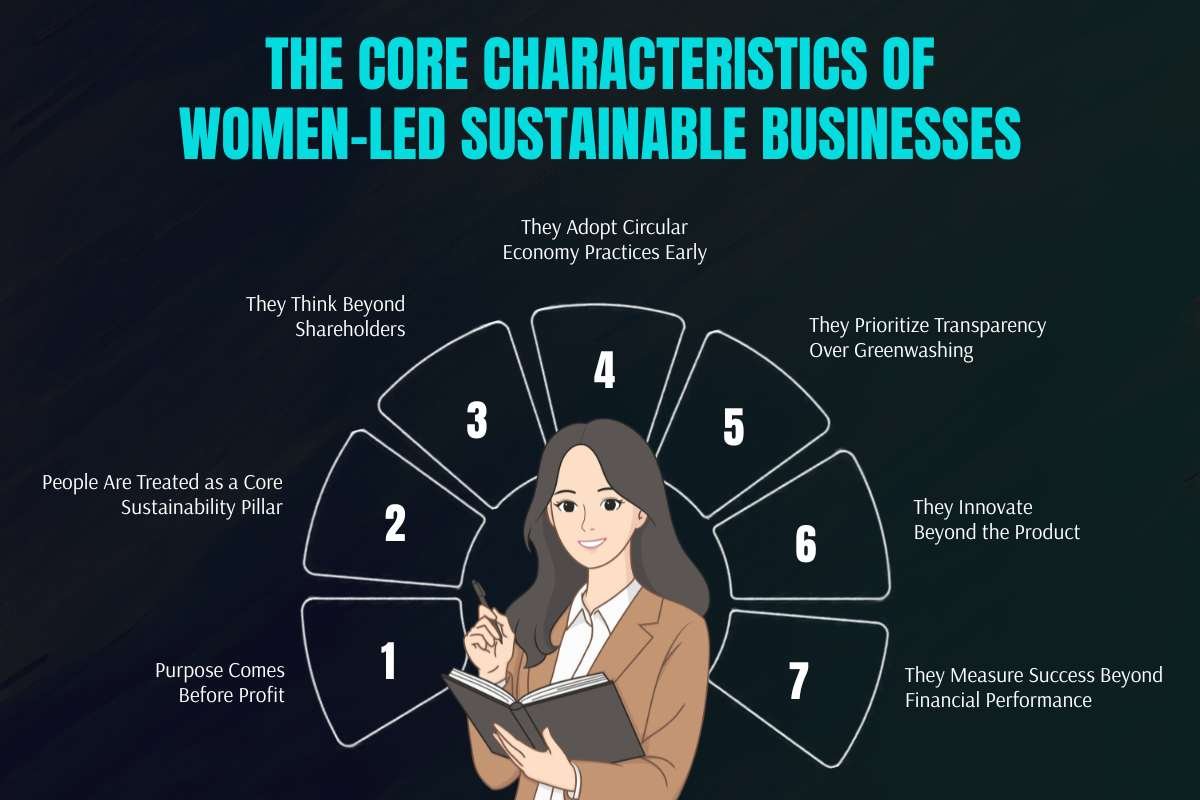
Many women-led businesses embed sustainability into their strategy through long-term thinking and stakeholder-focused leadership. These principles highlight the approaches that often set them apart.
1. Purpose comes before profit
One defining characteristic of how women-led businesses approach sustainability is that it is often built into the business from the start. Instead of treating it as a compliance requirement or CSR initiative, many purpose-driven companies use it to shape their products, operations, and long-term strategy.
This approach follows the Triple Bottom Line: People, Planet, and Profit, in which business success is measured not only by financial performance but also by social and environmental impact. This philosophy is a defining characteristic of many women driving sustainable business, where purpose shapes every business decision from product development to governance.
As sustainability expert John Elkington, who coined the Triple Bottom Line framework, has said: “The future winners will be those who embed sustainability into the core of their business, not bolt it on as an afterthought.” His perspective reinforces why purpose-driven companies are often better positioned for long-term resilience and growth.
What This Looks Like:
- Solving a social or environmental problem through the core business model.
- Prioritizing long-term value over short-term gains.
- Embedding sustainability into product design, sourcing, and operations.
EILEEN FISHER has made sustainability central to its business through responsible sourcing, circular fashion initiatives, and its Renew take-back program, which extends the life of garments and reduces waste.
Key takeaway: When purpose drives strategy, sustainability transforms from a reporting requirement into a genuine competitive advantage. This is one of the defining characteristics of how women-led businesses approach sustainability differently, allowing organizations to create lasting value for customers, communities, and investors alike.
2. People are treated as a core sustainability pillar
For many women-led sustainable businesses, sustainability goes beyond reducing emissions or minimizing waste. It also means creating workplaces where people can thrive.
This reflects the “People” pillar of the Triple Bottom Line. Alongside environmental goals, these businesses invest in employee well-being, inclusive workplaces, fair labor practices, and growth opportunities, recognizing that a resilient workforce is essential for long-term success.
Beyond building inclusive workplaces, many leaders are also influencing sustainability outside their organizations. The growing presence of women in climate policy and environmental advocacy is helping shape regulations, corporate accountability, and long-term environmental action.
What This Looks Like:
- Prioritizing employee well-being and psychological safety.
- Building diverse, equitable, and inclusive workplaces.
- Offering flexible work policies and fair career advancement opportunities.
Research supports this approach. According to Gallup’s State of the Global Workplace, organizations with highly engaged employees experience higher productivity, better retention, and stronger business performance, showing that investing in people is also a smart business strategy.
Key takeaway: Organizations that understand how women-led businesses approach sustainability differently recognize that sustainability is about more than protecting natural resources. Long-term success also depends on investing in the people who drive innovation, strengthen culture, and help businesses remain resilient through change.
3. They think beyond shareholders
Another distinguishing feature of many women-led sustainable businesses is their focus on creating value for everyone connected to the business, not just shareholders.
Instead of optimizing every decision for short-term profits, they often take a broader view, considering how their choices affect employees, customers, suppliers, local communities, and the environment. This stakeholder-first mindset helps build trust, reduce risks, and strengthen the business over time.
This philosophy is echoed by Rebecca Henderson, who argues that businesses create the greatest long-term value when they serve employees, customers, communities, and shareholders together rather than focusing solely on short-term financial returns. Her research supports the stakeholder-first approach that characterizes many women-led sustainable businesses.
Organizations often communicate these commitments through transparent corporate sustainability reporting, helping stakeholders understand how environmental, social, and governance initiatives contribute to long-term value creation.
What This Looks Like:
- Building long-term partnerships with suppliers.
- Making customer-centric and ethical business decisions.
- Supporting local communities alongside business growth.
Research supports this approach. According to the World Economic Forum, organizations that embrace stakeholder capitalism are better positioned to manage long-term risks and create sustainable value for all stakeholders.
Key takeaway: Understanding how women-led businesses approach sustainability differently reveals that long-term business success is often built on trust, collaboration, and shared value rather than quarterly financial performance alone.
4. They adopt circular economy practices early
Rather than managing waste after it’s created, many women-led sustainable businesses design it out of the process from the beginning. By embracing circular economy principles early, they reduce resource consumption, extend product life cycles, and minimize environmental impact.
Businesses interested in adopting these strategies can learn from proven circular economy business models, which focus on designing products and systems that minimize waste while maximizing resource efficiency.
This approach not only supports sustainability but also improves operational efficiency, lowers costs, and meets growing consumer demand for responsible products.
What This Looks Like:
- Designing products that are reusable, repairable, or recyclable.
- Choosing responsibly sourced materials and sustainable packaging.
- Reducing waste across the supply chain.
Blueland built its business around refillable cleaning products, helping customers reduce single-use plastic waste instead of relying on conventional disposable packaging. Sustainability isn’t an add-on; it’s the foundation of its product design.
Key takeaway: One reason how women-led businesses approach sustainability differently stands out: their ability to integrate circular thinking early. Businesses that embrace these principles are often better equipped to reduce costs, comply with evolving regulations, and strengthen long-term customer loyalty.
5. They prioritize transparency over greenwashing
As sustainability claims face greater scrutiny, many women-led sustainable businesses focus on backing their commitments with measurable results rather than marketing messages. Transparent reporting helps build credibility with customers, investors, and other stakeholders.
Instead of making broad environmental claims, these businesses track and disclose their progress through recognized ESG frameworks and regular sustainability reporting. As ESG adoption grows, businesses are also investing in professionals pursuing ESG careers for women, helping strengthen sustainability governance, reporting, and long-term compliance efforts.
What this looks like:
- Measuring and reporting carbon emissions and other ESG metrics.
- Monitoring supply chains for ethical and environmental compliance.
- Setting clear, measurable sustainability goals.
According to KPMG’s 2024 Survey of Sustainability Reporting, 96% of the world’s 250 largest companies now publish sustainability reports, highlighting that transparency has become a business expectation rather than a competitive advantage.
Key takeaway: A major lesson from how women-led businesses approach sustainability differently is that trust is earned through evidence. Businesses that openly measure, report, and communicate their sustainability performance are better positioned to strengthen stakeholder confidence and protect their long-term reputation.
6. They innovate beyond the product
For many women-led sustainable businesses, sustainability doesn’t stop at the product. It extends to how the business operates, from sourcing and procurement to hiring, logistics, and energy use.
Rather than making isolated changes, these companies look for opportunities to reduce their environmental impact across the entire value chain while creating lasting business value.
What this looks like:
- Sourcing materials from ethical and responsible suppliers.
- Adopting greener procurement and operational practices.
- Investing in renewable energy and resource-efficient processes.
This broader approach is becoming increasingly important. According to the World Economic Forum, businesses that integrate sustainability across their operations are better equipped to manage risks, adapt to changing regulations, and remain competitive in the long run.
Key takeaway: Understanding how women-led businesses approach sustainability differently shows that meaningful sustainability innovation goes beyond creating greener products. It involves building organizations where every department contributes to long-term environmental, social, and business impact.
7. They measure success beyond financial performance
Revenue and profit remain essential, but many women-led sustainable businesses also measure the impact they create. Tracking environmental, social, and governance (ESG) metrics helps them understand whether their sustainability efforts are delivering meaningful results, not just meeting targets.
Establishing meaningful sustainability KPIs ensures organizations can consistently monitor progress, improve accountability, and communicate measurable impact to stakeholders.
By measuring what matters, businesses can make better decisions, improve accountability, and identify new growth opportunities.
What This Looks Like:
- Tracking carbon emissions and waste reduction.
- Measuring employee engagement and retention.
- Monitoring supplier diversity and ethical sourcing.
These metrics provide a more complete picture of business health and resilience, helping organizations balance short-term performance with long-term value creation.
Key takeaway: A recurring lesson in how women-led businesses approach sustainability differently is that what gets measured gets managed. Looking beyond financial metrics enables organizations to strengthen sustainability strategies while creating lasting value for all stakeholders.
Traditional vs. Women-led sustainability focus
While every business is different, research shows that many women-led sustainable businesses tend to take a broader, longer-term approach to sustainability. Rather than focusing solely on short-term financial outcomes, they often balance business growth with social and environmental impact.
| Business Area | Traditional Focus | Women-Led Sustainability Focus |
| Growth | Quarterly revenue and short-term returns | Long-term resilience and sustainable growth |
| Primary Stakeholders | Shareholders | Employees, customers, suppliers, communities, and shareholders |
| Supply Chain | Cost and efficiency | Ethical sourcing, transparency, and resilience |
| Innovation | Product performance and market share | Sustainable products, circular design, and long-term impact |
| Success Metrics | Revenue and profit | People, Planet, Profit (Triple Bottom Line) |
It’s important to recognize that these represent leadership trends rather than fixed rules. Many traditionally led organizations are embracing similar sustainability practices, while not every women-led business follows the same model.
Nevertheless, understanding how women-led businesses approach sustainability differently highlights how organizations that prioritize stakeholder trust, responsible governance, and long-term value creation are often better positioned to innovate, adapt, and succeed in an increasingly sustainability-focused economy.
Real-world case studies: women driving sustainable innovation
Although these organizations operate in different industries, they share a common philosophy that reflects how women-led businesses approach sustainability differently. Rather than treating sustainability as an isolated initiative, they integrate it into product design, sourcing, operations, and community engagement, turning purpose into long-term business value.
1. Patagonia (CEO: Ryan Gellert; former CEO: Rose Marcario)
During Rose Marcario’s leadership, Patagonia accelerated its sustainability efforts by investing in regenerative agriculture, repairing and reselling used clothing through Worn Wear, and donating a portion of profits to environmental causes.
Key lesson: Extend product life instead of encouraging constant replacement.
2. EcoEnclose
Founded by Saloni Doshi, EcoEnclose helps e-commerce brands reduce packaging waste through recycled, recyclable, and responsibly sourced materials while maintaining supply chain transparency.
Key lesson: Sustainability can become a competitive advantage when embedded across the supply chain.
3. The Body Shop
Long recognized for its ethical sourcing and cruelty-free products, The Body Shop has championed fair trade partnerships, responsible ingredient sourcing, and refill initiatives, demonstrating that sustainability can strengthen both brand loyalty and business growth.
Key lesson: Responsible sourcing builds long-term trust with customers.
Despite operating in different industries, these companies share a similar approach: they integrate sustainability into product design, sourcing, operations, and community impact rather than treating it as a separate initiative. That’s what turns purpose into lasting business value.
Challenges women-led businesses face in scaling sustainability

While many women-led businesses are driving sustainable innovation, scaling these efforts isn’t always easy. Limited access to funding, stricter scrutiny, and the high cost of green transitions can slow growth even for businesses with strong sustainability models.
Key Challenges
- The funding gap: According to PitchBook, companies founded solely by women received just 2% of global venture capital funding in 2024. This makes it harder to invest in sustainable technologies, product innovation, and supply chain improvements.
- Access to green finance: Securing green loans and sustainability-linked financing often requires robust ESG reporting and compliance. This has also created new opportunities in green finance careers for women, supporting sustainable investment and ESG initiatives.
- Higher expectations for proof: Sustainability claims are under increasing scrutiny. Many women-led businesses must invest early in impact measurement, third-party certifications, and transparent reporting to build credibility with customers and investors.
The opportunity
Despite these challenges, how women-led businesses approach sustainability differently often demonstrates remarkable resilience. Many women entrepreneurs transform limited resources into strategic advantages by building lean, purpose-driven businesses focused on measurable impact. As demand for sustainable products and responsible business practices continues to grow, organizations that can demonstrate genuine progress, not simply promises, will be better positioned to attract customers, investors, and long-term partnerships.
How any business can build a more sustainable strategy?
The good news is that you don’t have to be a women-led business to apply these principles. The strategies behind many purpose-driven companies can be adapted by organizations of any size or industry.
A Practical Roadmap
- Make sustainability part of your business strategy. Set clear environmental and social goals from the outset instead of treating them as separate initiatives.
- Measure what matters. Track key metrics such as carbon emissions, waste reduction, employee engagement, and supplier performance to monitor progress and identify areas for improvement.
- Bring diverse perspectives into decision-making. Inclusive leadership helps businesses identify risks, uncover new opportunities, and make more balanced decisions.
- Think beyond shareholders. Build strong relationships with employees, customers, suppliers, and local communities to create long-term trust and resilience.
- Be transparent. Share your progress through regular sustainability reporting and measurable goals to build credibility with stakeholders.
The most successful sustainability strategies don’t emerge overnight. They evolve through consistent action, measurable progress, and an unwavering commitment to creating value for both business and society. These same principles are central to how women-led businesses approach sustainability differently, providing a practical roadmap for organizations seeking long-term success.
Why third-party certifications matter?
As consumers and investors become more skeptical of unverified sustainability claims, third-party certifications have become an important way for businesses to demonstrate credibility. They provide independent validation that a company’s environmental and social commitments are backed by measurable action, not just marketing.
Businesses often compare B Corp certification vs ESG reporting to determine which framework best aligns with their sustainability objectives, stakeholder expectations, and reporting obligations.
Some of the most widely recognized frameworks include:
| B Corp Certification | Evaluates a company’s overall social and environmental impact, governance, transparency, and accountability. |
| GRI (Global Reporting Initiative) | Helps organizations report their sustainability performance using globally recognized standards. |
| ISSB (International Sustainability Standards Board) | Provides a global baseline for investor-focused sustainability disclosures. |
| ISO 14001 | Sets the standard for effective environmental management systems and continuous improvement. |
Pursuing recognized sustainability certifications can further strengthen business credibility, improve transparency, and demonstrate a long-term commitment to responsible business practices.
Although obtaining these certifications requires time, investment, and organizational commitment, they strengthen stakeholder confidence, improve transparency, and help businesses differentiate themselves in an increasingly competitive marketplace. These practices also reinforce how women-led businesses approach sustainability differently, where measurable impact often takes precedence over broad sustainability claims.
The future of sustainable business leadership

Sustainability is no longer a trend; it’s becoming a core business expectation. As climate risks, evolving regulations, and stakeholder expectations continue to reshape markets, businesses will need to move beyond compliance and embed sustainability into every aspect of their operations.
Looking ahead, several trends are set to shape the next phase of sustainable business:
- Circular economy models will continue to replace the traditional “take-make-dispose” approach.
- AI-powered sustainability tools will help businesses track carbon emissions, optimize resource use, and improve ESG reporting.
- Regenerative business practices will gain momentum, focusing not just on reducing harm but on restoring ecosystems and communities.
- Impact investing will continue to grow, directing more capital toward businesses with strong environmental and social performance.
Research consistently shows that sustainability isn’t determined by gender alone. However, how women-led businesses approach sustainability differently highlights leadership qualities such as long-term thinking, stakeholder-focused decision-making, ethical governance, transparency, and responsible innovation that contribute to stronger sustainability outcomes.
As businesses navigate an increasingly ESG-driven economy, these principles offer a practical blueprint for building organizations that are not only more sustainable but also more resilient, innovative, and prepared for long-term success.
Conclusion:
The conversation around sustainability is no longer centered on whether businesses should act; it is focused on how they choose to act. As the evidence throughout this article demonstrates, how women-led businesses approach sustainability differently often reflects a leadership philosophy that embeds sustainability into strategy, governance, innovation, and stakeholder relationships instead of treating it as a separate initiative.
That doesn’t mean sustainable leadership is exclusive to women. Instead, it highlights a set of practices that any organization can adopt: leading with purpose, thinking beyond short-term profits, investing in people, embracing transparency, and measuring success through both business and societal impact.
As customer expectations, investor priorities, and ESG regulations continue to evolve, organizations that integrate these practices into their operations will be better positioned to adapt, strengthen stakeholder trust, and create lasting value.
Ultimately, how women-led businesses approach sustainability differently offers more than a leadership trend; it provides a practical roadmap for organizations seeking sustainable growth, stronger resilience, meaningful innovation, and long-term competitive advantage in a rapidly changing business landscape.
Frequently asked questions (FAQs)
1. How can companies integrate sustainability into their core business strategy?
Businesses can embed sustainability into their operations by setting measurable ESG goals, reducing environmental impact, improving governance, investing in employees, and making responsible decisions that balance long-term growth with social and environmental value.
2. Why are women-led businesses often associated with stronger sustainability practices?
Research suggests that companies with more diverse leadership teams often perform better in innovation, governance, ESG performance, and stakeholder engagement. Many women-led organizations also adopt a purpose-driven approach that balances profitability with long-term environmental and social impact.
3. Can small businesses adopt the same sustainability strategies as larger organizations?
Yes. Sustainable practices such as stakeholder engagement, ethical sourcing, circular economy initiatives, transparent reporting, and employee well-being can be implemented by startups, SMEs, and large enterprises alike. The scale may differ, but the core principles remain the same.
4. What challenges do businesses face when implementing sustainability initiatives?
Common challenges include limited funding, access to green financing, evolving ESG regulations, the cost of sustainable technologies, supply chain complexities, and measuring long-term environmental and social impact. Overcoming these barriers often requires strategic planning and continuous improvement.
5. Why is sustainability becoming a competitive advantage for modern businesses?
Organizations that prioritize sustainability often build stronger customer trust, attract investors, improve operational efficiency, reduce long-term risks, and strengthen brand reputation. Integrating responsible business practices also helps companies remain resilient in an evolving regulatory and market landscape.