This guide compares the leading sustainability certifications in 2026, including GRI, SASB/FSA, CFA and IEMA, by skills, cost, career relevance and earning potential. Learn which credential best fits your career path and how certification can complement practical experience and specialised sustainability skills.
Sustainability certifications are becoming a career differentiator as sustainability moves from a niche function into mainstream business. The World Economic Forum projects 8 million net jobs from climate adaptation and mitigation by 2030, while 63% of employers cite skills gaps as a major barrier to transformation.
As demand grows, professionals need expertise across sustainability reporting, ESG analysis, climate risk, sustainable finance, environmental management, and regulation. But the right credential depends on your career path.
GRI, SASB/FSA, the CFA Institute Sustainable Investing Certificate and IEMA each serve different goals, from sustainability reporting and ESG analysis to sustainable finance and environmental management.
So, which sustainability certifications are worth pursuing in 2026? This guide compares the leading credentials by cost, skills, career relevance, and earning potential to help you choose the right one.
Why are sustainability certifications becoming more valuable?
The sustainability job market is expanding beyond dedicated ESG departments. Sustainability responsibilities now appear across finance, operations, procurement, risk, compliance, reporting, strategy, and investment.
The World Economic Forum’s Future of Jobs Report 2025 projects 170 million new jobs and 92 million displaced jobs by 2030, reflecting the scale of change created by technological, demographic and environmental transitions.
As companies adapt, green jobs and sustainability roles are expanding across areas such as sustainability reporting, climate risk, sustainable finance, environmental management and corporate strategy.
This creates a challenge for employers: sustainability is broad, but many roles require highly specific technical capabilities.
A reporting manager needs different expertise from an ESG investment analyst. A climate-risk specialist needs a different skill set from an environmental management professional.
That is where sustainability certifications can add value. They can demonstrate structured knowledge in a defined area rather than simply showing an interest in sustainability.
This is also relevant to how women-led businesses approach sustainability differently, particularly where sustainability is integrated into business strategy, operations, resilience and long-term value creation.
However, certification should not be treated as a substitute for professional experience.
The strongest candidates typically combine a relevant credential with technical expertise, industry knowledge, and evidence that they can apply sustainability concepts to real business problems.
Certification vs. Experience: what matters more?
A certification validates structured knowledge, but it cannot replace practical experience, technical skills or industry knowledge. Its value depends on how closely it aligns with your target role.
For example, GRI focuses on sustainability reporting, while other credentials specialise in sustainable investing, financial analysis, or environmental management.
The strongest combination is:
Relevant certification + technical skills + industry knowledge + practical experience
The right sustainability certification also depends on your career path. A reporting professional may benefit from GRI, while a finance professional may gain more from a sustainable-investing credential.
Ultimately, the best certification is not the one with the biggest name or broadest syllabus; it is the one that fills a specific skills gap and supports your career goals.
Which sustainability certification is best?
There is no single sustainability certification that is best for everyone.
The right credential depends on where you want to apply sustainability expertise: reporting, investment analysis, sustainable finance, environmental management, or another specialised area.
The distinction becomes clearer when the leading options are compared side by side:
| Certification | Best for | Key strength |
| GRI Professional Certification | Sustainability and reporting professionals | Sustainability reporting and GRI Standards |
| SASB Standards / FSA Credential | ESG and investment professionals | Industry-specific, financially material sustainability information |
| CFA Institute Sustainable Investing Certificate | Finance and investment professionals | ESG integration and sustainable investing |
| IEMA qualifications | Environmental and sustainability practitioners | Environmental and sustainability competency |
These sustainability certifications differ not only in subject matter but also in how their knowledge is applied professionally.
The CFA Institute Sustainable Investing Certificate, for example, is designed around applying ESG factors to investment analysis and portfolio decisions. CFA Institute recommends around 100 hours of study, with one exam and six months of access to learning materials.
IEMA takes a broader professional-development approach, with qualifications and professional membership pathways designed around environmental and sustainability practice.
It is also important to distinguish SASB Standards from the FSA Credential. SASB Standards provide industry-specific guidance on financially material sustainability information, while the FSA Credential provides a structured way for professionals to demonstrate knowledge related to sustainability-related financial information.
The choice therefore comes down to professional fit rather than prestige.
Top sustainability certifications: GRI, SASB, CFA and IEMA
The value of a sustainability credential depends largely on what it helps professionals do in practice.
A reporting specialist, investment professional, and environmental practitioner may all work in sustainability, but their responsibilities can be completely different.
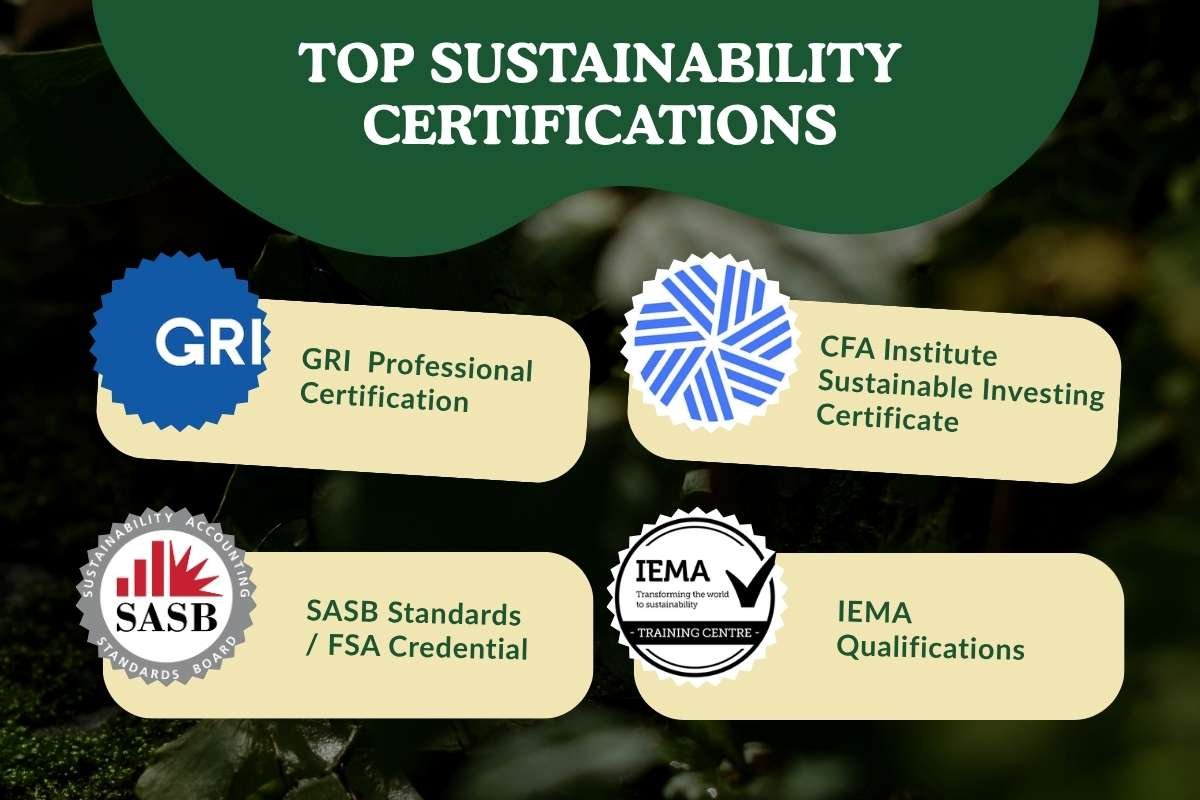
Among the leading sustainability certifications, GRI, SASB/FSA, the CFA Institute Sustainable Investing Certificate and IEMA stand out because they address distinct areas of professional sustainability practice.
Here is how the four credentials compare in terms of focus, learning outcomes, and career application.
1. GRI Professional Certification
| Best suited for | Sustainability reporting, ESG disclosure and corporate sustainability roles. |
| What it helps develop | Understanding of GRI Standards, reporting processes, impact identification and sustainability disclosures. |
| Career relevance | Strongest for professionals working directly with sustainability reports, material topics, stakeholder impacts and corporate disclosures. |
The GRI Professional Certification is particularly relevant to professionals responsible for corporate sustainability reporting, impact disclosure and sustainability communications. It is built around the GRI Standards, which provide a framework for organisations to report their impacts on the economy, environment and people.
Among sustainability certifications, GRI is therefore particularly aligned with professionals who need to understand how organisations identify, structure and communicate their sustainability impacts.
The credential can be useful for sustainability managers, reporting specialists, consultants and professionals whose work involves collecting, interpreting or communicating sustainability information.
For someone whose career goal involves corporate reporting, disclosure or sustainability communications, this makes GRI a more targeted option than a broader sustainability qualification.
2. SASB Standards / FSA Credential
| Best suited for | ESG analysts, investors, corporate finance professionals and sustainability professionals working with financially material information. |
| What it helps develop | Industry-specific sustainability analysis, financial materiality and the use of sustainability information in investment and business decisions. |
| Career relevance | Particularly useful where sustainability data needs to be connected to enterprise value, financial performance or investor decision-making. |
SASB takes a different approach by focusing on industry-specific sustainability information that can be financially material to investors. The SASB Standards are now maintained by the IFRS Foundation through the International Sustainability Standards Board (ISSB).
The related FSA Credential is designed to demonstrate knowledge of sustainability-related financial information and its application. This makes it particularly relevant to professionals working at the intersection of sustainability and financial markets.
For professionals evaluating sustainability certifications from a finance or investment perspective, the SASB/FSA pathway can provide a more financially oriented route than a reporting-focused qualification.
3. CFA Institute Sustainable Investing Certificate
| Best suited for | Investment professionals, analysts, wealth managers, risk professionals and others applying ESG considerations to financial decisions. |
| What it helps develop | ESG analysis, sustainable investment strategies and the integration of ESG considerations into investment processes. |
| Career relevance | Strongest for sustainable finance, ESG investment analysis, portfolio management and related financial roles. |
For professionals already working in finance or those targeting sustainable finance, the CFA Institute Sustainable Investing Certificate provides a more investment-focused pathway.
The curriculum covers ESG factors, engagement and stewardship, ESG integration, investment analysis, portfolio construction and client reporting. CFA Institute recommends 100+ hours of study, with candidates given six months to complete the programme and exam. The current standard registration fee is US$890, excluding applicable taxes.
This makes the CFA credential one of the more specialised sustainability certifications for professionals who want to connect sustainability considerations with investment decisions and financial analysis.
It can be particularly relevant for investment analysts, portfolio professionals, wealth managers and risk specialists who want to integrate sustainability considerations into existing financial expertise. For professionals considering green finance careers for women, the credential can also provide a structured foundation for combining financial expertise with sustainability and ESG analysis.
4. IEMA Qualifications
| Best suited for | Environmental practitioners, sustainability professionals and people building careers in environmental management. |
| What it helps develop | Environmental management knowledge, sustainability practice and professional competency. |
| Career relevance | Particularly valuable for roles where sustainability needs to be translated into operational policies, environmental performance and organisational practice. |
IEMA takes a broader environmental and sustainability management route. Rather than focusing narrowly on reporting or investment, its qualifications and professional membership pathway are designed for people developing careers in environmental and sustainability practice.
This makes IEMA particularly relevant to professionals involved in environmental management, sustainability strategy, compliance and organisational improvement.
For candidates looking for sustainability certifications with a stronger environmental-management orientation, IEMA can therefore offer a different career pathway from GRI, SASB/FSA or the CFA Institute credential.
The Key Difference
The simplest way to distinguish these credentials is by the problem they help professionals solve:
- GRI: How should an organisation report its sustainability impacts?
- SASB/FSA: Which sustainability issues could have financial relevance?
- CFA Institute: How can ESG factors inform investment decisions?
- IEMA: How can organisations improve environmental and sustainability performance?
This distinction is more useful than ranking one credential as universally “best.” The right choice among sustainability certifications depends on the type of sustainability work you want to perform and the direction in which you want your career to develop.
A professional moving into sustainability reporting may benefit from a reporting-focused credential, while someone entering sustainable finance may need stronger investment and financial-analysis capabilities.
The key is to treat sustainability certifications as career tools rather than standalone qualifications. Their value increases when the knowledge gained can be applied directly to workplace responsibilities and measurable business outcomes.
Can sustainability certifications lead to $100k careers?
A sustainability certification can strengthen a career profile, but the credential itself is rarely what determines salary. Compensation is more closely tied to the role, level of responsibility, industry, location, and the technical expertise a professional brings to the organisation.
The broader employment outlook is encouraging. The World Economic Forum projects that climate-change adaptation could create 5 million net jobs by 2030, while climate-change mitigation could add another 3 million. Sustainability specialists are also among the roles expected to benefit from the green transition.
However, reaching a six-figure salary generally requires more than sustainability knowledge. Professionals who combine sustainability expertise with finance, data, risk, technology, consulting, or regulatory knowledge can position themselves for higher-value roles.
Career paths with stronger earning potential:
Some sustainability-related career paths tend to offer greater earning potential as professionals gain experience and move into specialist or managerial positions. For professionals specifically considering ESG careers for women, these pathways can include sustainability consulting, ESG analysis, climate risk, sustainability strategy and reporting:
- Sustainability consulting combines sustainability expertise with strategy and client advisory skills.
- ESG and sustainable investment connect sustainability analysis with financial decision-making.
- Climate risk applies climate knowledge to financial, operational and enterprise risk.
- Sustainability strategy focuses on integrating sustainability into business objectives and operations.
- Sustainability reporting involves increasingly complex disclosure, data and assurance requirements.
For professionals specifically considering ESG careers for women, these pathways also show how sustainability expertise can translate into strategic and commercially valuable roles.
The strongest profiles tend to be T-shaped professionals: broad enough to understand sustainability, but deep enough in another commercially valuable discipline to solve specific business problems.
This matters because the World Economic Forum reports that nearly 40% of workers’ core skills are expected to change by 2030, while 63% of employers identify skills gaps as a major barrier to transformation.
A certification can therefore act as a career accelerator when it validates skills relevant to a target role.
For professionals aiming for $100K-plus positions, however, the bigger advantage comes from combining the credential with specialised skills, experience and measurable business impact.
Which sustainability skills are in high demand?
The sustainability job market is increasingly rewarding professionals who can apply sustainability knowledge to measurable business problems. The World Economic Forum expects climate adaptation and mitigation alone to contribute 8 million net jobs globally by 2030, with sustainability specialists among the roles benefiting from the green transition.
The skills employers need, however, extend well beyond general sustainability knowledge. This is where sustainability certifications can become more valuable when combined with specialised technical capabilities.
1. ESG Reporting and Disclosure
As sustainability information becomes more structured and decision-useful, professionals need to understand reporting frameworks, materiality, data collection, and disclosure requirements. This is particularly relevant for corporate sustainability and reporting roles.
A reporting-focused credential can help professionals build a foundation, but practical experience with sustainability data and disclosures remains equally important.
Organisations increasingly need professionals who can measure and manage greenhouse-gas emissions across their operations and value chains. Skills in emissions inventories, Scope 1, 2 and 3 accounting, and carbon-data management can therefore complement reporting expertise.
2. Carbon Accounting
Professionals who combine these technical capabilities with relevant sustainability certifications can develop a stronger profile for roles involving climate strategy, emissions management and sustainability reporting.
3. Climate Risk
Climate change increasingly intersects with financial and operational risk. Professionals who can assess physical and transition risks and translate them into business implications can work across risk management, finance, consulting and sustainability functions.
This is particularly relevant for professionals pursuing finance-oriented sustainability certifications, where understanding the connection between climate factors and financial performance can add significant value.
4. Sustainability Data and Analytics
Sustainability decisions depend on increasingly large volumes of environmental, social and operational data. Data analysis, measurement, assurance and the ability to turn sustainability KPIs into actionable insights are becoming valuable differentiators.
A credential can demonstrate foundational knowledge, but professionals who can actually analyse and interpret sustainability data are likely to be better positioned for data-intensive sustainability roles. These capabilities become even more valuable when professionals can connect technical sustainability knowledge with a broader sustainability strategy for your company and measurable business priorities.
5. Regulatory and Disclosure knowledge
Sustainability professionals increasingly need to understand how regulations and disclosure requirements affect companies. This makes regulatory literacy particularly useful for professionals working across reporting, compliance, risk and corporate sustainability. It is also relevant to women in climate policy and environmental advocacy, where understanding environmental regulations, climate frameworks and sustainability standards can support more effective policy and advocacy work.
For professionals choosing sustainability certifications, the relevance of regulatory knowledge should therefore be considered alongside the credential’s core syllabus.
Understanding how sustainability factors influence capital allocation, investment analysis and financial decisions is becoming important beyond dedicated ESG teams. This is where sustainability expertise combined with finance skills can create a particularly strong career proposition.
6. Sustainable Finance
For finance professionals, this can make investment-focused sustainability certifications more relevant than credentials primarily designed around environmental management or sustainability reporting.
7. Supply-Chain Sustainability
A company’s sustainability performance increasingly depends on activities beyond its direct operations. Supplier emissions, sourcing practices, resource use, and supply-chain risks therefore create demand for professionals who can work across procurement and sustainability.
Professionals with sustainability certifications can strengthen this foundation further by developing practical knowledge of supply-chain emissions, supplier assessment and sustainability risk.
8. Life-Cycle Assessment
Life-cycle assessment helps organisations evaluate environmental impacts across a product or service’s life cycle. It is particularly relevant to professionals working in product sustainability, manufacturing, circular economy business models and environmental management.
The broader trend is clear: sustainability skills are becoming increasingly multidisciplinary. The WEF estimates that nearly 40% of workers’ core skills will change by 2030, reinforcing the importance of combining sustainability expertise with data, finance, technology or operational capabilities.
That is also why the strongest sustainability certifications are not necessarily the ones with the broadest syllabus. Their value comes from how effectively they complement the specific skills and responsibilities required by a target career.
Is ESG falling out of favour?
The ESG conversation has become more complicated, but that does not mean sustainability-related work is disappearing.
In many organisations, terminology is changing while the underlying business requirements remain.
The World Economic Forum identifies the green transition as a major force reshaping employment and estimates that climate-change adaptation and mitigation could contribute 8 million net jobs globally by 2030.
What is changing is how companies frame and use sustainability.
Understanding the distinction between approaches such as B Corp certification vs ESG reporting helps clarify that sustainability certification, organisational impact, and formal disclosure serve different purposes.
Businesses are increasingly connecting sustainability with areas that directly affect performance, including:
- Regulatory compliance
- Financial and climate risk
- Capital allocation
- Operational resilience
- Supply-chain exposure
This shift is also visible in global reporting standards.
The IFRS Foundation’s ISSB has established IFRS S1 and IFRS S2 as a global baseline for investor-focused sustainability-related disclosures, while SASB Standards continue to provide industry-specific guidance within the ISSB framework.
This makes the distinction between “ESG as a label” and sustainability as a business capability increasingly important.
A professional who can analyse climate risk, prepare reliable sustainability disclosures, interpret environmental data or assess sustainability-related financial impacts remains valuable even when a company uses different terminology for the function.
For professionals considering sustainability certifications, the key question is therefore not whether “ESG” is trending as a term.
It is whether the credential develops skills that solve an ongoing business need.
How to choose the right sustainability certification?

With several credentials serving different functions, choosing a sustainability certification should start with the career outcome, not the certification’s popularity. The same credential can be highly relevant for one professional and have limited value for another.
A practical way to decide is to assess five factors:
1. Match the certification to your target role.
Start with the work you want to do.
- Sustainability reporting and disclosure → GRI
- Financially material sustainability information → SASB Standards/FSA
- Sustainable investing and finance → CFA Institute Sustainable Investing Certificate
- Environmental and sustainability management → IEMA
This role-first approach is more useful than choosing a credential simply because it appears frequently in ESG job listings.
2. Consider the skills you already have
Your existing background should influence the choice. A finance professional may be able to build on existing analytical and investment knowledge through a sustainable-investing credential, while an environmental professional may benefit more from a qualification that strengthens environmental management expertise.
The goal is to add a complementary skill, rather than collect credentials that duplicate what you already know.
3. Check the learning commitment.
Cost is only one part of the investment. Look at the programme’s study requirements, assessment format, learning period, and ongoing requirements.
For example, the CFA Institute Sustainable Investing Certificate currently lists 100 hours to complete, one exam and a six-month access period, while GRI’s professional certification programme includes multiple courses and an examination.
These differences matter when comparing sustainability certifications, particularly for professionals balancing certification study with full-time employment.
4. Evaluate whether the credential stays current.
Sustainability standards and disclosure expectations continue to evolve. A useful credential should therefore provide knowledge that can remain relevant as frameworks change.
GRI, for instance, updated its Professional Certification Programme in July 2025, while its certified professionals are required to complete annual continuing education for recertification.
5. Think about return on investment.
Finally, compare the cost and time required with the career opportunity it supports.
Ask:
- Does it qualify me for a role I actually want?
- Will it fill a genuine skills gap?
- Is it recognised in my target market?
- Can I apply the knowledge in my current or future role?
- Does it complement my existing experience?
The best sustainability certification is therefore not necessarily the most expensive or prestigious one. It is the credential that closes the most important skills gap between where you are now and the role you want next.
Conclusion:
A sustainability certification can strengthen a professional profile, but its real value comes from how well it aligns with a specific career path.
GRI is particularly relevant to sustainability reporting, SASB Standards/FSA to financially material sustainability information, the CFA Institute Sustainable Investing Certificate to sustainable finance, and IEMA to environmental and sustainability management. The choice should therefore be based on the skills you need to build, not simply the credential with the strongest name recognition.
The wider sustainability landscape is also becoming more structured. For example, GRI requires certified professionals to complete continuing education to maintain their certification, while emerging sustainability assurance standards such as ISSA 5000 are adding new technical requirements around the credibility and assurance of sustainability information.
For professionals building long-term careers in this space, the broader women driving sustainable business movement also highlights how sustainability expertise can translate into leadership, strategy, and measurable business impact.
Ultimately, the strongest career proposition is credential + specialised skills + practical experience. If you choose a certification that fills a genuine skills gap and supports the role you want next, it can be a meaningful investment in a long-term sustainability career.
FAQs
1. Which certification is best for sustainability?
There is no universal best certification. GRI is a strong fit for sustainability reporting, SASB Standards/FSA for financially material sustainability information, CFA Institute Sustainable Investing Certificate for sustainable finance, and IEMA for environmental and sustainability management.
2. Are sustainability certifications worth it?
They can be worthwhile when they address a specific skills gap or support a target role. Their value is strongest when combined with relevant work experience and technical or industry expertise.
3. Which sustainability certification is in high demand?
Demand varies by role and market. GRI is particularly relevant to sustainability reporting, while the CFA Institute Sustainable Investing Certificate is designed around ESG factors in investment decision-making.
4. Can sustainability jobs pay $100K?
Yes, some senior sustainability, consulting, climate-risk and sustainable-finance positions can reach or exceed $100,000, particularly in higher-paying markets. However, salary depends on experience, seniority, location, industry, and specialised skills, not certification alone.
5. Is ESG still a good career in 2026?
Yes, although the terminology and priorities are evolving. Sustainability-related expertise remains relevant across reporting, risk, financial compliance and business operations, making the underlying skills more important than the ESG label itself.