Compare B Corp certification vs ESG reporting to understand their key differences, benefits, costs, and ideal use cases. Learn how each approach supports sustainability, builds stakeholder trust, and helps businesses choose the right strategy or combine both for greater long-term impact.
A sustainability commitment is no longer measured only by the promises a company makes. Customers, employees, investors, and regulators increasingly want evidence of how businesses create environmental and social impact.
This shift has made sustainability verification and reporting essential parts of modern business strategy. However, companies often face a critical decision: Should they pursue B Corp certification, invest in ESG reporting, or consider both?
The debate around B Corp certification vs ESG reporting has become increasingly important because both approaches communicate sustainability efforts, but they send different signals.
B Corp certification focuses on proving that a company meets verified standards for social and environmental performance. It evaluates how a business impacts its employees, communities, customers, and the planet.
ESG reporting, on the other hand, focuses on measuring and disclosing sustainability-related data, helping investors and stakeholders understand a company’s environmental risks, social practices, and governance structures.
The choice depends on several factors:
| Cost | What resources can a company invest in sustainability measurement? |
| Credibility | Does the business need third-party validation or transparent reporting? |
| Audience | Is the primary focus customers, investors, regulators, or employees? |
| Business goals | Is the company building a purpose-driven brand or improving corporate transparency? |
For example, a sustainable consumer brand may benefit from B Corp certification because customers can easily recognize the certification as a trust signal. Meanwhile, a publicly listed company may prioritize ESG reporting because investors need measurable sustainability data to evaluate long-term risks.
Understanding the difference between B Corp certification and ESG reporting allows businesses to choose a sustainability approach that aligns with their growth strategy.
Why businesses are comparing B Corp certification and ESG reporting?
Sustainability has evolved from being a corporate responsibility initiative into a key business consideration.
According to KPMG’s sustainability reporting research, sustainability disclosures have become increasingly common among large companies, with global organizations recognizing the importance of communicating environmental, social, and governance performance.
At the same time, voluntary certifications such as B Corp have grown in popularity as companies look for ways to demonstrate that their sustainability commitments are independently verified.
The growing interest in B Corp certification vs ESG reporting comes from the fact that businesses need different tools for different sustainability challenges.
The difference is largely about measurement versus validation.
- ESG reporting answers: How is the company performing on sustainability-related metrics?
- B Corp certification answers: Has the company met independently verified standards for responsible business practices?
While ESG reporting provides structured sustainability information, B Corp certification provides external validation that a company meets specific impact standards.
This distinction explains why many businesses evaluate B Corp certification vs ESG reporting before developing their sustainability strategy. A company focused on customer trust may prioritize certification, while an organization focused on investor communication may prioritize reporting.
Before choosing either approach, it’s important to build a clear sustainability strategy for your company that aligns sustainability goals with business priorities, stakeholder expectations, and long-term growth objectives.
However, these approaches are not mutually exclusive. Increasingly, businesses are recognizing that combining B Corp certification and ESG reporting can create a stronger sustainability narrative by connecting verified impact with measurable performance.
What is B Corp certification?
B Corp certification is a voluntary certification awarded to companies that meet high standards of social and environmental performance, transparency, and accountability.
Developed by B Lab, the certification evaluates businesses through the B Impact Assessment, a framework that measures a company’s impact across five key areas:
| Assessment Area | What It Measures |
| Governance | Business transparency, accountability, and ethical decision-making |
| Workers | Employee benefits, workplace culture, and employee wellbeing |
| Community | Social impact, diversity, and community contribution |
| Environment | Carbon emissions, resource management, and environmental practices |
| Customers | Product impact, customer responsibility, and value creation |
Companies must achieve a minimum verified score to become certified B Corporations.
Unlike traditional sustainability claims, B Corp certification involves an external evaluation process, making it a visible credibility marker for businesses.
When comparing B Corp certification vs ESG reporting, one of the biggest differences is that B Corp certification evaluates the broader purpose and impact of a company, while ESG reporting primarily focuses on measuring and communicating sustainability performance.
This makes B Corp certification especially valuable for businesses that want to demonstrate that sustainability is embedded into their operational model rather than treated as a separate initiative.
Why companies choose B Corp certification?
Businesses typically pursue B Corp certification when they want to demonstrate that sustainability is integrated into their overall operating model rather than treated as a separate initiative.
1. Building consumer trust through verification
One of the biggest advantages of B Corp certification is its ability to communicate sustainability efforts directly to customers.
For many consumers, sustainability claims can be difficult to evaluate because companies often use different reporting methods and definitions. A third-party certification provides a clearer signal that a company has undergone external assessment.
This is one reason why the discussion around B Corp certification vs ESG reporting is especially important for consumer-facing brands. While ESG reporting provides detailed sustainability data, B Corp certification offers a simpler and more recognizable trust signal for customers.
Research from IBM found that many consumers consider sustainability when making purchasing decisions, with a significant number willing to change buying behaviour based on environmental and social considerations.
For consumer-focused companies, certification can therefore become a competitive differentiator.
2. Real-life example: Patagonia’s stakeholder-focused business model
Patagonia is one of the most recognized examples of a company using sustainability as part of its core business identity.
The company became a certified B Corporation and has built its reputation around environmental responsibility, supply chain transparency, and stakeholder-focused decision-making.
Patagonia’s approach demonstrates how B Corp certification can support companies that want to communicate a broader purpose beyond financial performance.
Rather than using sustainability only as a marketing message, the company has integrated environmental commitments into areas such as product design, repair programs, responsible sourcing, and business decisions.
Many organizations strengthen these initiatives by adopting circular economy business models, which prioritize product longevity, resource efficiency, reuse, and waste reduction across the value chain.
This example highlights an important distinction in the B Corp certification vs ESG reporting discussion. Patagonia’s certification communicates that the company has met independently verified standards for responsible business practices, while ESG reporting would provide stakeholders with measurable data about areas such as emissions, resource use, and governance performance.
For purpose-driven brands, combining B Corp certification with transparent sustainability reporting can strengthen both customer trust and stakeholder confidence.
3. Strengthening brand differentiation
For companies operating in competitive consumer markets, sustainability certification can help create stronger brand positioning.
Companies such as Ben & Jerry’s have used social and environmental commitments as part of their brand identity, demonstrating how purpose-driven practices can influence customer relationships.
While certification alone does not guarantee consumer loyalty, verified sustainability efforts can help businesses build stronger connections with audiences who prioritize responsible consumption.
This is where B Corp certification vs ESG reporting becomes an important strategic consideration. Companies that rely heavily on consumer trust may find certification more valuable, whereas businesses communicating primarily with investors may gain greater benefits from detailed ESG disclosures.
B Corp certification: what it signals
B Corp certification primarily signals:
| To Customers | The company has undergone external evaluation. Sustainability commitments are backed by measurable standards |
| To Employees | The company values purpose alongside profit. Workplace and community impact are important priorities |
| To Investors | The company has developed stakeholder-focused practices. Sustainability is integrated into business operations. |
However, B Corp certification is not designed to replace detailed sustainability disclosures required by investors or regulators.
This creates one of the clearest differences in the B Corp certification vs ESG reporting comparison.
B Corp certification answers whether a company follows verified impact standards, while ESG reporting explains how the company is performing against measurable sustainability indicators.
What is ESG reporting?
While B Corp certification focuses on verifying a company’s overall impact, ESG reporting focuses on measuring and disclosing sustainability performance through structured data.
Businesses new to ESG disclosures may also benefit from understanding the fundamentals of corporate sustainability reporting, including the major reporting frameworks, disclosure requirements, and best practices used across industries.
ESG stands for:
- Environmental: How a company manages climate impact, emissions, energy consumption, waste, and resource use.
- Social: How it manages employees, workplace practices, diversity, communities, and human rights.
- Governance: How it manages leadership structures, ethics, compliance, risk management, and accountability.
Unlike B Corp certification, ESG reporting is not a certification or sustainability badge. Instead, it is a reporting framework that helps businesses communicate sustainability-related risks, opportunities, and performance to stakeholders.
The difference between B Corp certification and ESG reporting becomes clearer when looking at their primary purpose:
- B Corp certification validates a company’s commitment to responsible business practices.
- ESG reporting communicates measurable sustainability performance and business risks.
For investors, ESG reporting provides a clearer understanding of how sustainability factors may influence long-term financial performance.
Why ESG reporting has become important for businesses?
The growing importance of ESG reporting is closely linked to increased investor demand for transparency.
Investors are no longer looking only at financial statements; they are also assessing factors such as climate risks, resource dependency, employee practices, and governance structures.
This growing focus on sustainable investment is also driving demand for professionals in green finance careers for women, where ESG analysis and responsible investment have become increasingly important skills.
According to the International Sustainability Standards Board (ISSB), sustainability-related financial disclosures are designed to provide investors with consistent information about sustainability risks and opportunities that could affect a company’s financial outlook.
As reporting requirements continue to expand globally, demand is also increasing for professionals with expertise in sustainability reporting, creating new opportunities in ESG careers for women across consulting, finance, compliance, and corporate sustainability teams.
The introduction of standards such as IFRS S1 (General Requirements for Disclosure of Sustainability-related Financial Information) and IFRS S2 (Climate-related Disclosures) reflects the growing demand for comparable sustainability information across markets.
This shift highlights why companies compare B Corp certification vs ESG reporting before choosing a sustainability approach.
While B Corp certification can strengthen brand credibility, ESG reporting helps companies communicate sustainability performance through measurable data that investors and regulators can evaluate.
What companies include in ESG reports?
A company’s ESG report typically includes measurable indicators related to sustainability performance.
These indicators form the foundation of effective sustainability KPIs, enabling businesses to track progress, benchmark performance, and communicate measurable outcomes to investors, regulators, and other stakeholders.
Examples include:
| ESG Category | Common Reporting Metrics |
| Environmental | Carbon emissions, renewable energy usage, water consumption, waste reduction |
| Social | Employee safety, diversity metrics, training programs, labour practices |
| Governance | Board diversity, ethics policies, compliance systems, executive accountability |
Companies may use globally recognized frameworks such as:
- Global Reporting Initiative (GRI)
- International Sustainability Standards Board (ISSB)
- Carbon Disclosure Project (CDP)
When evaluating B Corp certification vs ESG reporting, businesses should understand that ESG frameworks are designed to improve transparency and comparability, while B Corp certification focuses on verifying broader impact commitments.
Real-life example: Microsoft’s ESG reporting approach
Microsoft provides an example of how large corporations use ESG reporting to communicate sustainability progress.
The company publishes sustainability reports covering areas such as carbon reduction, renewable energy, water conservation, waste reduction, and responsible technology development.
Microsoft has also committed to becoming carbon negative, water positive, and zero waste by 2030, with progress tracked through publicly available sustainability disclosures.
For large organizations operating across multiple markets, ESG reporting provides investors and stakeholders with measurable information about progress, challenges, and future targets.
This illustrates why ESG reporting is particularly important for companies where sustainability performance is closely connected to business risk and investor expectations.
The Microsoft example also reinforces the difference between B Corp certification and ESG reporting. While B Corp certification demonstrates that a company meets verified responsibility standards, ESG reporting enables large organizations to track complex sustainability goals across global operations.
B Corp certification vs ESG reporting: key differences
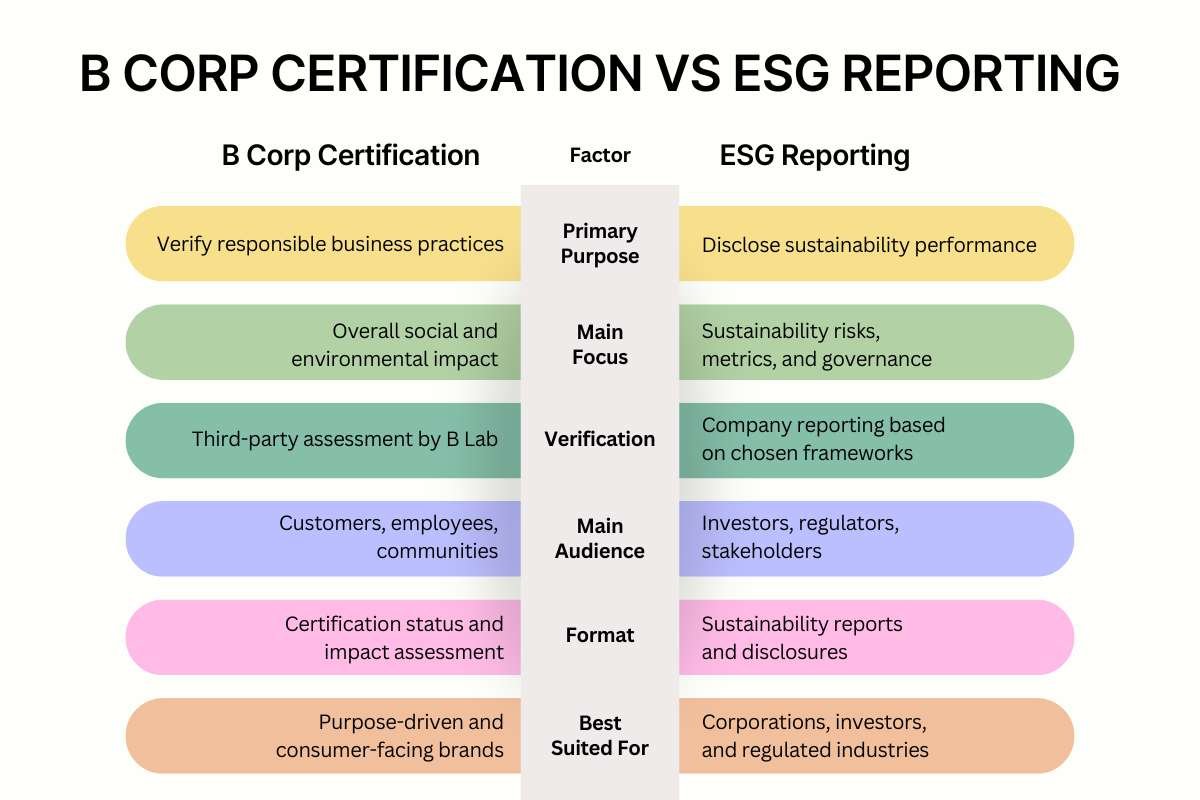
Although both approaches support sustainability goals, they differ in purpose, process, and audience.
| Factor | B Corp Certification | ESG Reporting |
| Primary Purpose | Verify responsible business practices | Disclose sustainability performance |
| Main Focus | Overall social and environmental impact | Sustainability risks, metrics, and governance |
| Verification | Third-party assessment by B Lab | Company reporting based on chosen frameworks |
| Main Audience | Customers, employees, communities | Investors, regulators, stakeholders |
| Format | Certification status and impact assessment | Sustainability reports and disclosures |
| Best Suited For | Purpose-driven and consumer-facing brands | Corporations, investors, and regulated industries |
The comparison of B Corp certification vs ESG reporting shows that both approaches address different sustainability needs.
B Corp certification focuses on demonstrating that a company operates responsibly, while ESG reporting focuses on showing measurable sustainability progress.
For many businesses, the strongest sustainability strategy may involve using both approaches together.
Cost comparison: B Corp certification vs ESG reporting
Cost is one of the most important considerations when evaluating B Corp certification vs ESG reporting. While both approaches require investment, the nature of those costs differs depending on a company’s size, sustainability maturity, and reporting requirements.
Cost of B Corp Certification
The cost of becoming a certified B Corporation depends on factors such as:
- Company size
- Revenue
- Assessment requirements
While the certification process requires investment, businesses often view it as a long-term brand and credibility investment.
Costs may include:
- Assessment fees
- Certification fees
- Documentation preparation
For smaller businesses, the biggest investment is often not the certification fee itself but the time required to improve sustainability practices.
Cost of ESG reporting
ESG reporting costs vary significantly depending on company size and reporting complexity.
Expenses may include:
- Sustainability data collection systems
- ESG software platforms
- External consultants
- Reporting teams
- Third-party assurance
Large companies may invest significantly in ESG reporting because investors and regulators increasingly expect detailed sustainability information.
For example, multinational companies often maintain dedicated sustainability teams to collect emissions data, monitor supply chains, and prepare annual ESG disclosures.
This is another area where B Corp certification vs ESG reporting differs. Certification focuses on verifying business practices, whereas ESG reporting requires ongoing systems to collect, analyze, and disclose sustainability data.
Which has better value: B Corp certification or ESG reporting?
The answer depends on what the company wants to achieve.
| Business Objective | Better Choice |
| Build consumer trust | B Corp Certification |
| Create a sustainability-focused brand identity | B Corp Certification |
| Attract impact-driven customers | B Corp Certification |
| Communicate with investors | ESG Reporting |
| Improve regulatory readiness | ESG Reporting |
| Measure sustainability performance | ESG Reporting |
| Strengthen overall sustainability strategy | Both |
A direct-to-consumer brand selling sustainable products may receive more immediate value from B Corp certification because customers recognize the certification as a trust signal.
A publicly traded company managing investor expectations may receive greater value from ESG reporting because investors require measurable sustainability information.
What each approach signals to investors and customers
The biggest difference between B Corp certification vs ESG reporting is the message each sends.
1. B Corp certification signals:
| To customers | “This company has been independently evaluated for its impact.” |
| To employees | “This company prioritizes purpose and stakeholder impact.” |
| To investors | “This company has built responsible business practices into its operating model.” |
2. ESG reporting signals:
| To investors | “This company understands sustainability-related risks.” |
| To regulators | “The company has systems to monitor and disclose sustainability information.” |
| To stakeholders | “The company is accountable for measurable sustainability goals.” |
Why companies may choose both?
Increasingly, businesses are realizing that B Corp certification and ESG reporting are not competing approaches.
They solve different sustainability challenges.
A company can use:
B Corp certification to demonstrate commitment + ESG reporting to demonstrate measurable progress
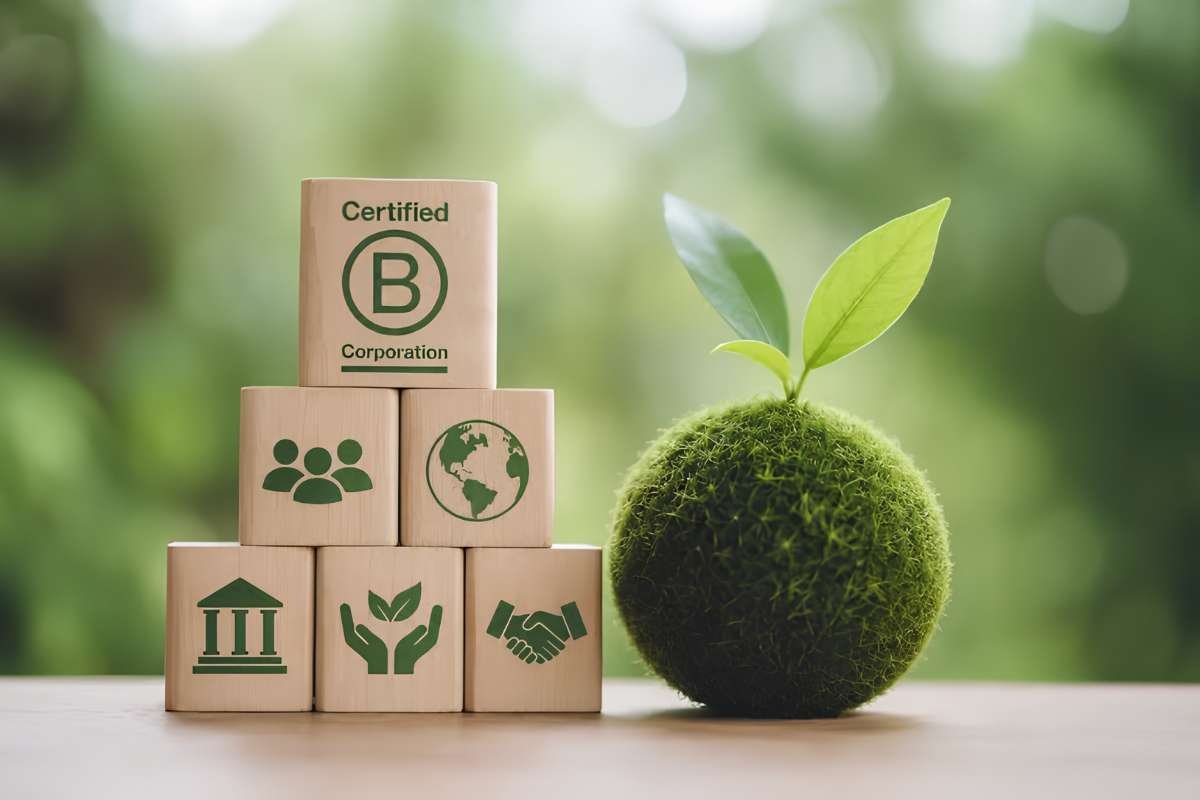
For example:
A consumer brand may use B Corp certification to strengthen customer trust while publishing ESG reports to provide detailed sustainability information to investors and business partners.
Together, they create a stronger sustainability framework by combining credibility with transparency.
What makes more sense for your business: B Corp certification or ESG reporting?
The decision between B Corp certification vs ESG reporting depends on what a company wants to achieve through its sustainability strategy.
There is no universal solution because businesses have different priorities. A startup building a purpose-driven consumer brand may need external validation to gain customer trust, while a global corporation may require structured sustainability reporting to meet investor and regulatory expectations.
The right choice depends on four key factors:
- Cost
- Credibility
- Target audience
- What the company wants to signal to investors and customers
1. Cost: which approach requires greater investment?
Cost is often the first consideration, especially for small and growing businesses.
B Corp Certification Cost Considerations
B Corp certification can be more accessible for smaller businesses compared to developing a comprehensive ESG reporting system. However, companies must invest time and resources into improving their impact performance.
Costs may involve:
- Completing the B Impact Assessment
- Improving sustainability practices
- Collecting impact-related information
- Maintaining certification standards
For companies already operating with strong sustainability practices, certification may require fewer changes.
ESG Reporting Cost Considerations
ESG reporting can require larger investments, especially for companies that need detailed sustainability data collection and reporting systems.
Costs may include:
- ESG data management platforms
- Sustainability teams
- External consultants
- Reporting assurance processes
- Supply chain assessments
Large companies often invest heavily because ESG information is increasingly connected to investor decision-making.
Which makes more sense?
| Business Situation | Better Option |
| Small business building brand trust | B Corp Certification |
| Consumer-focused sustainability brand | B Corp Certification |
| Public company seeking investor confidence | ESG Reporting |
| Large organization managing global operations | ESG Reporting |
| Mature sustainability strategy | Both |
2. Credibility: which creates stronger trust?
Credibility is one of the biggest differences between B Corp certification and ESG reporting.
B Corp Certification: Credibility Through Verification
B Corp certification provides external validation because companies must complete a third-party assessment process.
This can help businesses avoid vague sustainability claims and demonstrate that their practices meet defined standards.
For customers, the certification badge provides a simple and recognizable sustainability signal.
For example, companies such as Patagonia have built strong brand recognition by connecting business decisions with environmental responsibility and stakeholder impact.
ESG reporting: credibility through transparency
ESG reporting builds credibility by providing measurable information.
Investors are often more interested in data such as:
- Carbon emissions reduction
- Energy consumption
- Diversity metrics
- Governance structures
- Sustainability risks
For large organizations, transparent reporting allows investors to evaluate whether sustainability commitments are supported by measurable progress.
3. Audience: who are you trying to reach?
The intended audience is another major consideration in B Corp certification vs ESG reporting.
If Customers Are the Priority → B Corp Certification May Make More Sense.
Consumers often respond better to simple sustainability signals.
A certification communicates: “This company has been independently evaluated for its social and environmental impact.”
This can be valuable for:
- Sustainable fashion brands
- Ethical food companies
- Consumer products businesses
If investors are the priority → ESG reporting may make more sense.
Investors require detailed information to evaluate sustainability-related risks and opportunities.
ESG reporting communicates: “This company measures, tracks, and manages sustainability performance.”
This is particularly important for:
- Public companies
- Large corporations
- Businesses seeking institutional investment
B Corp certification vs ESG reporting: what each signals
| Stakeholder | B Corp Certification Signals | ESG Reporting Signals |
| Customers | Responsible business practices and verified impact | Transparency about sustainability performance |
| Investors | Long-term commitment to stakeholder value | Measurable sustainability risks and opportunities |
| Employees | Purpose-driven workplace culture | Structured sustainability governance |
| Regulators | Voluntary commitment to impact standards | Formal sustainability disclosures |
Should businesses do both B Corp certification and ESG reporting?

For many companies, combining both approaches creates the strongest sustainability strategy.
B Corp certification and ESG reporting are not alternatives; they address different needs.
A company using both can communicate:
- Verified impact through B Corp certification
- Measured performance through ESG reporting
For example, a consumer brand may use B Corp certification to strengthen customer relationships while using ESG reporting to provide transparency to investors and partners.
This combination creates a more complete sustainability approach because it connects purpose with measurable outcomes.
The future of corporate sustainability: moving beyond claims
The future of sustainability will be defined by accountability.
Businesses are increasingly expected to move beyond statements such as:
- “We support sustainability”
- “We care about the environment”
- “We are committed to social responsibility”
Instead, stakeholders want evidence:
- What impact has been created?
- How is progress measured?
- Who verifies the claims?
This is why both certification and reporting are becoming increasingly valuable.
According to the World Economic Forum, businesses will need stronger sustainability practices and transparent reporting systems as environmental and social challenges increasingly affect economic decision-making.
Companies that combine measurable performance with credible communication are likely to build stronger stakeholder relationships in the long term.
Conclusion:
The comparison between B Corp certification vs ESG reporting is not about choosing one approach over the other. It is about understanding which solution aligns with a company’s goals, audience, and stage of growth.
B Corp certification is ideal for businesses that want to demonstrate verified social and environmental impact, strengthen customer trust, and build a purpose-driven identity.
ESG reporting is better suited for companies that need structured sustainability disclosures, investor transparency, and measurable performance tracking.
For businesses deciding between the two, the key questions are:
- Do we need customer trust or investor transparency?
- Do we need certification or reporting?
- What sustainability message do we want to communicate?
For many modern businesses, the strongest approach may be combining both, using B Corp certification to demonstrate commitment and ESG reporting to prove measurable progress.
Sustainability is no longer only about doing good; it is about proving impact, building trust, and creating long-term business value.
Businesses looking to embed sustainability across every function should also understand the broader principles of women driving sustainable business, where leadership, innovation, and accountability work together to create lasting organizational impact.
FAQs
1. What is the difference between B Corp certification and ESG reporting?
B Corp certification verifies a company’s social and environmental impact through a third-party assessment, while ESG reporting measures and communicates sustainability performance through structured disclosures.
2. Is B Corp certification better than ESG reporting?
Neither approach is universally better. B Corp certification is often more valuable for customer trust and brand differentiation, while ESG reporting is more useful for investors, regulators, and corporate transparency.
3. Do investors care about B Corp certification?
Investors may view B Corp certification positively as a sign of stakeholder-focused business practices, but they generally rely more on ESG data and disclosures when evaluating sustainability risks.
4. Is ESG reporting only for large companies?
While large companies commonly use ESG reporting, smaller businesses are increasingly adopting sustainability reporting to improve transparency and prepare for future stakeholder expectations.
5. Can a company have both B Corp certification and ESG reporting?
Yes. Many businesses combine both approaches to demonstrate verified impact while maintaining transparent sustainability reporting for investors and stakeholders.