
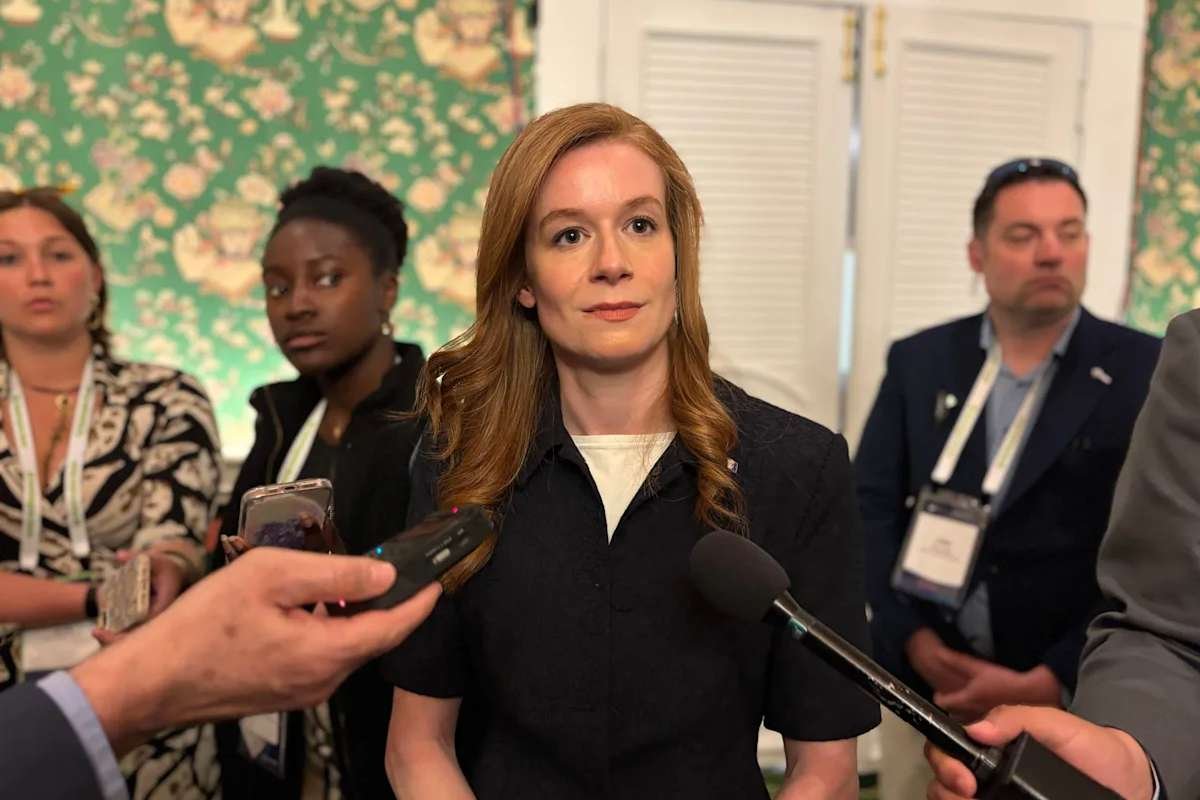
Michigan State Senator Mallory McMorrow has suspended her campaign for the Democratic nomination for the U.S. Senate, significantly reshaping one of the most closely watched races of the 2026 election cycle. Her withdrawal narrows the Democratic field to U.S. Representative Haley Stevens and former public health official Abdul El-Sayed, who will now compete for the opportunity to succeed retiring Senator Gary Peters.
McMorrow announced her decision after acknowledging that her campaign no longer had a viable path to securing the nomination. While ending her bid, she thanked volunteers, donors, and supporters who had backed her campaign, emphasizing that her focus remains on ensuring Democrats retain the Michigan Senate seat in the general election.
Her exit comes at a critical moment in the race, with the Democratic primary entering its final stretch. Michigan has long been considered one of the country’s most important battleground states, and the open Senate seat has drawn significant national attention. Political strategists view the contest as one that could influence the balance of power in the U.S. Senate, making the state’s Democratic primary one of the most consequential races of the election year.
McMorrow’s departure also marks the end of a campaign that sought to appeal to both moderate and progressive Democrats. Throughout her candidacy, she presented herself as a leader capable of bridging ideological divides within the party, but as the race evolved, support increasingly consolidated around the remaining frontrunners.
Stevens and El-Sayed Now Face Off in a Two-Way Contest
With McMorrow no longer in the race, the Democratic primary has effectively become a direct contest between Haley Stevens and Abdul El-Sayed, two candidates offering distinctly different visions for the party’s future.
Stevens, who represents Michigan in the U.S. House of Representatives, has built her campaign around economic growth, manufacturing, job creation, and strengthening the state’s industrial economy. Positioning herself as a pragmatic, center-left Democrat, she has secured support from several prominent party leaders and established a strong fundraising network that has helped her remain one of the best-funded candidates in the race.
El-Sayed, a physician and former public health official, has campaigned on a progressive platform focused on expanding healthcare access, tackling economic inequality, addressing climate change, and reducing corporate influence in politics. His campaign has gained momentum in recent months, particularly among younger and progressive voters, aided by endorsements from nationally recognized progressive leaders.
The narrowing of the field is expected to intensify competition between the two remaining candidates. Political analysts believe both campaigns will now seek to attract McMorrow’s supporters, many of whom viewed her as a consensus candidate capable of appealing across ideological lines. Her departure may also simplify the race for undecided voters by presenting a clearer choice between the Democratic Party’s moderate and progressive wings.
With only two major candidates remaining, campaign messaging is expected to become sharper as both sides attempt to consolidate support before voters head to the polls.
National Spotlight Remains on Michigan Senate Race
McMorrow first gained national prominence in 2022 after delivering a widely shared speech in the Michigan Legislature defending LGBTQ+ rights and rejecting political attacks directed at her. The speech transformed her into one of the Democratic Party’s emerging national figures and significantly raised her political profile beyond Michigan.
That visibility helped generate early enthusiasm for her Senate campaign, with many observers viewing her as a rising star capable of building a broad coalition of voters. However, as the primary unfolded, polling indicated that the race increasingly became a contest between Stevens and El-Sayed, making McMorrow’s path to victory considerably more difficult.
Although she did not endorse either remaining candidate while announcing her withdrawal, political observers expect her supporters could play an important role in determining the outcome of the Democratic primary. Both campaigns are likely to intensify outreach efforts in the coming weeks as they compete for undecided voters and former McMorrow backers.
The eventual Democratic nominee will face Republican Mike Rogers in November in what is expected to be one of the most competitive Senate elections in the country. With control of the U.S. Senate potentially hinging on a handful of closely contested races, Michigan is expected to remain under intense national scrutiny throughout the remainder of the election season.
As the Democratic field narrows, the race now enters a decisive phase, with Stevens and El-Sayed carrying the party’s competing visions into a contest that could have implications far beyond Michigan’s borders. The outcome will not only determine who represents the state in the Senate but may also shape the broader political landscape in Washington following the 2026 midterm elections.