
This article explores how CIO women leaders are changing workplace culture through inclusive leadership. It covers their leadership journeys, real examples, practical lessons, and how empathy, collaboration, and innovation help organizations succeed.
What if your company’s next big idea is already sitting in the room, but someone is too afraid to speak?
Great organizations are not built only by smart technology. They grow when leaders create a culture where people feel heard, trusted, and valued.
The inclusive leadership lessons from CIO women leaders reveal how women technology leaders are changing modern workplaces. Their leadership proves that success is not about having the loudest voice; it is about bringing different voices together.
Inspired by leadership journeys like Prachi Singh’s trust-driven approach and Deepti Sharma’s people-first mindset, CIO leaders are showing that strong foundations create lasting impact.
Technology may power transformation, but people make it successful.
Leaders like Padmasree Warrior have shown how technical expertise combined with empathy can shape stronger teams and smarter innovation.
Today’s CIOs are not just managing systems. They are guiding people through change, digital growth, and the future of work.
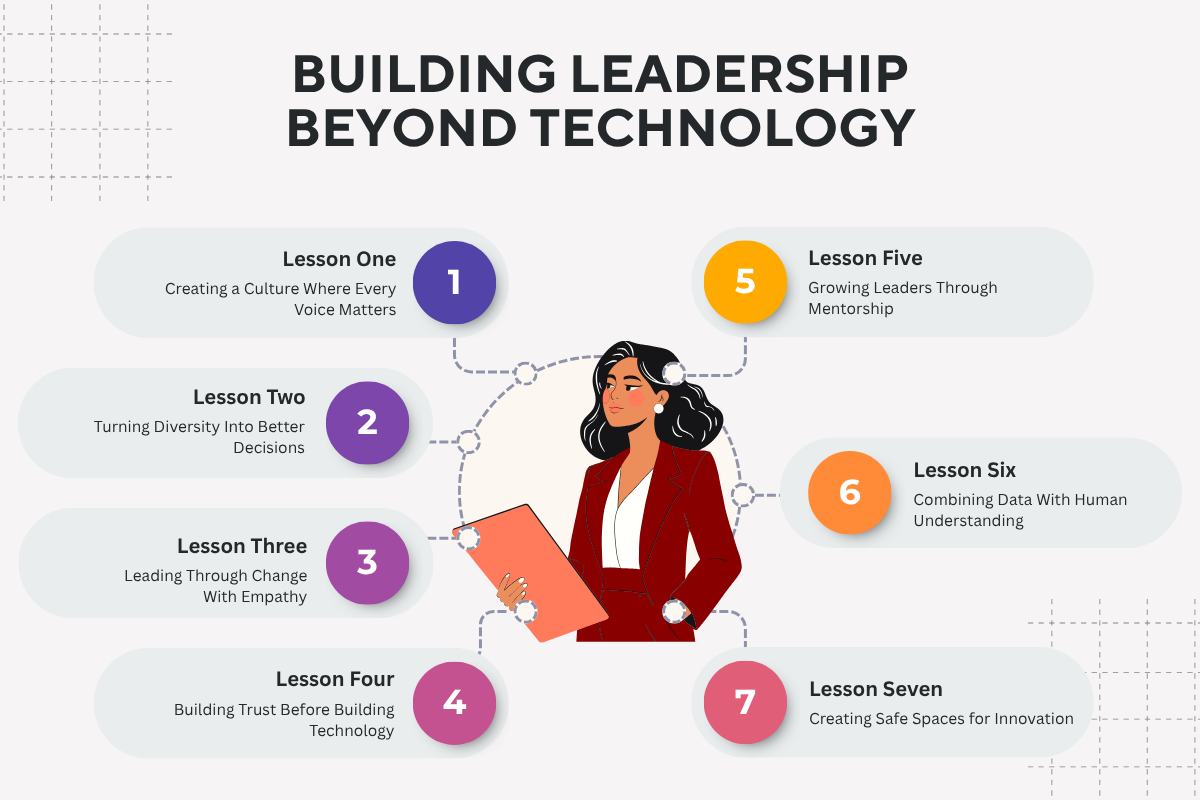
Building leadership beyond technology
For many years, the CIO role was mainly connected with infrastructure, software, and technical operations. Today, that role has expanded.
A CIO influences company culture. They decide how teams collaborate, how employees adapt to change, and how technology supports business goals.
The inclusive leadership lessons from CIO women leaders highlight that leadership success depends on balancing innovation with understanding.
A great CIO does not only ask: “Which technology should we use?”
They also ask:
“Who will use it?”
“How will it affect people?”
“What support will employees need?”
These questions create better decisions.
Ginni Rometty demonstrated this type of leadership during her time at IBM. She focused on workforce transformation and preparing employees for changing digital skills. Her leadership emphasized that businesses must evolve while helping people evolve, too.
This approach connects closely with the idea that growth should not leave people behind.
Lesson one: Creating a culture where every voice matters
A company does not become innovative because it hires talented people. It becomes innovative when those people feel comfortable sharing ideas.
Many employees stay silent during discussions because they fear their opinions may be ignored. Inclusive leaders notice this gap.
These lessons show that great leaders actively create opportunities for participation.
A CIO can encourage inclusion through simple actions:
- Asking quieter employees for their opinions
- Giving credit for ideas
- Creating respectful discussions
- Encouraging different approaches
These habits help teams think more creatively.
A useful example comes from Reshma Saujani, who worked to increase access to technology education for girls through Girls Who Code. Her work focused on creating opportunities for people who were traditionally underrepresented in technology.
Her leadership reflects a larger lesson: inclusion starts when access becomes possible.
Lesson two: turning diversity into better decisions
Different experiences create different ways of solving problems.
A developer may focus on technical efficiency. A customer team may focus on user needs. A business team may focus on growth.
A strong leader connects these viewpoints.
The inclusive leadership lessons from CIO women leaders explain that diverse perspectives are not a challenge to manage. They are a resource to use.
For example, when creating a digital product, a team with different backgrounds may notice problems that one group could miss.
They may ask:
Does this work for all users?
Is this process simple enough?
Are we creating barriers without realizing it?
These questions improve outcomes.
According to research from McKinsey & Company, organizations with greater diversity in leadership have shown stronger performance compared with less diverse organizations.
This proves that inclusion can support both people and business growth.
Read More: 6-C Model of Inclusive Leadership Traits
Lesson three: leading through change with empathy
Change is unavoidable in technology.
New tools arrive. Processes change. Employees must learn continuously.
However, change becomes difficult when people feel ignored.
The inclusive leadership lessons s show that empathy helps leaders guide teams through uncertainty.
A CIO who explains change clearly creates confidence.
A CIO who listens to concerns creates trust.
A CIO who supports learning creates resilience.
This is similar to Deepti Sharma’s leadership philosophy from the provided example in the introduction, where transformation came from understanding people first.
The lesson applies across industries: people accept change more easily when they feel valued.
Lesson four: building trust before building technology
Technology projects often fail not because the tools are wrong, but because people do not trust the change.
A new system may be powerful, but employees need confidence before they fully adopt it. They want to understand why the change is happening and how it will improve their work.
The inclusive leadership lessons from CIO women leaders show that trust is the foundation behind every successful digital transformation.
A strong CIO communicates clearly. They involve employees early. They explain decisions instead of simply announcing them.
This approach creates ownership.
When people feel included in the process, they become active participants instead of passive users.
A strong example is Anne Wojcicki, whose work in consumer biotechnology has focused on connecting technology with people’s everyday needs. Her leadership journey reflects the importance of balancing innovation with responsibility and trust.
The lesson is clear: technology creates possibilities, but trust creates adoption.
Lesson five: growing leaders through mentorship
Successful leaders understand that their impact should continue even when they are not in the room.
This happens when leaders develop other leaders.
Mentorship helps employees gain confidence. It gives them opportunities to take responsibility and build skills.
The lessons reveal that inclusive leaders do not protect knowledge. They share it.
A CIO who mentors employees helps create a stronger leadership pipeline.
They encourage team members to:
- Take ownership of projects
- Share new ideas
- Develop decision-making skills
- Learn from challenges
This leadership style creates long-term organizational strength.
Frances Allen is a historic example of how women have shaped technology through expertise and innovation. Her contributions to computer science influenced generations of professionals, and she became the first woman to receive the ACM A.M. Turing Award.
Her career represents the power of knowledge, curiosity, and continuous growth.
Lesson six: combining data with human understanding
Modern CIOs work with massive amounts of information.
Data helps leaders understand performance, customer behavior, and business trends. But numbers alone cannot explain everything.
The inclusive leadership lessons from CIO women leaders show that effective leaders combine technology with human thinking.
For example, if employees are not using a new platform, the problem may not be the platform itself.
The real questions could be:
Were employees trained properly?
Was the purpose explained?
Does the tool solve their actual needs?
Inclusive leaders look beyond the numbers. They understand that every data point represents real people.
Lesson seven: creating safe spaces for innovation
Innovation requires experimentation. However, people hesitate to experiment when they fear criticism for mistakes.
A strong workplace allows employees to test ideas, learn, and improve. Inclusive leadership explains that psychological safety helps teams become more creative.
A CIO who creates a safe environment encourages employees to speak honestly.
This can help organizations identify:
- Security risks
- Process problems
- Customer concerns
- Improvement opportunities
Small conversations can prevent major problems. This leadership approach is especially valuable in technology because digital decisions often affect the entire organization.
How are CIO women leaders changing the future of work?

The workplace is changing faster than ever.
Artificial intelligence, automation, remote collaboration, and digital transformation are reshaping how companies operate.
In this environment, leaders need more than technical skills.
They need emotional intelligence.
They need curiosity.
They need the ability to connect different teams.
The inclusive leadership lessons from CIO women leaders show that future leaders must understand both technology and people.
Women CIOs are contributing to this shift by bringing new perspectives into decision-making roles. Their leadership demonstrates that successful organizations are not built only through advanced tools. They are built through strong relationships.
Practical lessons organizations can apply
Companies do not need complicated programs to become more inclusive. Small leadership habits can create meaningful change.
Leaders can:
- Listen actively before responding
- Encourage different opinions
- Recognize contributions publicly
- Support employee learning
- Create fair opportunities
- Ask for feedback regularly
The lessons from CIO women leaders prove that inclusion is created through consistent daily actions.
Leadership is not only visible during big decisions. It appears in everyday conversations.
A leader who asks one extra question may discover a better idea.
A leader who supports one employee may create the next great innovator.
Why does inclusive CIO leadership matter for business growth?

Companies today compete through ideas. The ability to adapt quickly often determines success.
Teams with different experiences can identify opportunities faster and solve problems more effectively.
The inclusive leadership lessons from CIO women leaders demonstrate that inclusive leadership is not just a cultural initiative. It is a growth strategy.
When employees feel respected, they contribute more.
When teams communicate openly, innovation improves.
When leaders build trust, transformation becomes easier.
The future belongs to organizations that understand people and technology together.
The bigger leadership message
The stories of successful leaders show one important pattern.
Great leadership is not about controlling every decision. It is about creating conditions where good decisions can happen.
As the examples of Prachi Singh and Deepti Sharma shared earlier, meaningful leadership comes from purpose, trust, and people-focused thinking.
A leader builds systems that continue working even when circumstances change.
The inclusive leadership lessons remind us that leadership is not measured only by titles or achievements. It is measured by the people who become stronger because of that leadership.
Conclusion:
The next big idea in any organization may not come from the loudest voice in the room. It may come from someone who simply needs the right leader to listen.
The inclusive leadership lessons from CIO women leaders show that modern leadership is not only about technology, strategies, or digital growth. It is about creating workplaces where people feel confident to contribute, challenge ideas, and grow.
Women CIO leaders are proving that empathy and innovation can work together. Like strong foundations behind successful organizations, inclusive leadership builds trust, improves teamwork, and prepares businesses for the future.
Technology will continue to change, but leaders who value people will always create the strongest impact.
FAQs
1. What are the main lessons from women CIO leaders?
The biggest lessons include building trust, encouraging collaboration, supporting employee growth, and creating workplaces where different perspectives are valued.
2. How does inclusive leadership help technology teams?
Inclusive leadership helps technology teams by improving communication, encouraging innovation, and helping employees share ideas without hesitation.
3. Why are women CIO leaders important in modern organizations?
Women CIO leaders bring valuable experiences and perspectives that strengthen decision-making and help organizations create more balanced workplace cultures.
4. Can inclusive leadership improve innovation?
Yes. When employees with different backgrounds and experiences contribute ideas, organizations can discover better solutions and identify challenges earlier.
5. How can companies create more inclusive leadership?
Companies can focus on mentorship, open communication, equal opportunities, employee development, and leadership practices that encourage participation.
Thank You For Reading!
See More
Inclusive Leadership Toolkit for Management