

In 2025, at a global level, women held 28.3% of board seats at large.
Stepping into executive authority as a woman business owner means surrounding yourself with brilliant minds who actively challenge your assumptions and open doors to new capital. However, mistaking informal mentorship for formal corporate governance can lead to confusing legal overlap and fragmented decision-making across your leadership team.
Understanding Advisory Board vs Corporate Board structures gives entrepreneurs a clear blueprint for scaling with confidence. While an advisory board provides non-binding, strategic counsel tailored to specific expansion goals, a corporate board holds ultimate decision-making power, statutory liability, and financial oversight.
Establishing clear boundaries between external counsel and formal governance safeguards your company’s long-term financial health. When you purposefully structure your leadership support systems, you create an environment where strategic advice accelerates innovation without compromising organizational agility.
What is a corporate board?
A corporate board is a formal group that oversees a company. Board members help guide the company and protect the interests of its shareholders. They do not handle the company’s daily work. Instead, they focus on major business matters and long-term plans.
Understanding the Advisory Board vs Corporate Board distinction is especially important when a growing company moves toward formal governance.
The board reviews company strategy and oversees senior leaders, including the CEO. It may also approve major deals, large investments, mergers, and changes in top leadership. Board members also review risks, financial results, and other issues that could affect the company.
Corporate boards also have legal duties. These duties can vary based on the company and the country where it operates. In many cases, board members must act in the company’s best interests and meet their duties to shareholders.
When people talk about the roles and responsibilities of women on corporate boards, they usually mean women who hold seats and function as part of these formal boards. This is why corporate board diversity is a key part of the wider discussion about women in business leadership.
What is an advisory board?
An advisory board is a group of people who give advice to a company’s leaders. Unlike a corporate board, it does not have formal power to make company decisions. Its members share their knowledge, experience, and ideas to help leaders make better choices.
Advisory board members can offer advice on areas such as growth, finance, technology, hiring, or market strategy. The company can choose advisors based on the skills and experience it needs. Their role can also change as the company grows.
Many women entrepreneurs create advisory boards for their own companies. These boards can give founders access to advice they may not have within their teams. Women can also serve on advisory boards for other companies. There are board readiness programs for women that can help them build business and governance experience while expanding their professional networks.
Advisory board vs corporate board: key differences
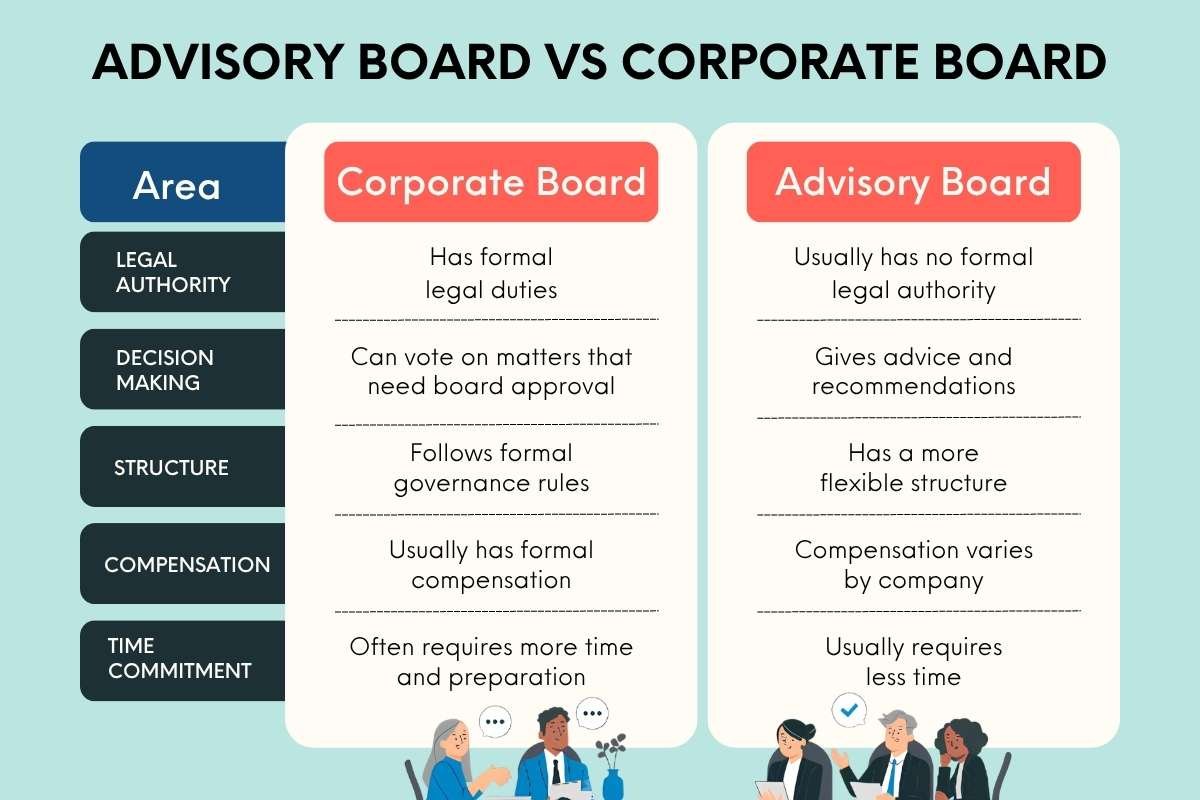
Advisory Board vs Corporate Board structures may both support company leaders, but they serve different purposes. A corporate board has formal duties, legal responsibilities, and authority over certain company decisions. An advisory board mainly gives advice based on the knowledge and experience of its members. The differences also affect how each board is formed, how members are paid, and how much time they need to give.
| Area | Corporate Board | Advisory Board |
| Legal authority | Has formal legal duties | Usually has no formal legal authority |
| Decision making | Can vote on matters that need board approval | Gives advice and recommendations |
| Structure | Follows formal governance rules | Has a more flexible structure |
| Compensation | Usually has formal compensation | Compensation varies by company |
| Time commitment | Often requires more time and preparation | Usually requires less time |
1. Legal authority and liability
Corporate board members have formal duties to the company and its shareholders. These duties may include acting in the company’s best interests and reviewing major business decisions. Directors can also face legal liability if they fail to meet their duties.
Advisory board members usually do not have the same legal duties as corporate directors. They give advice based on their skills and experience. Company leaders can use that advice when making decisions, but advisors usually do not have the power to approve or reject those decisions.
The exact duties can vary by company type and local law. Companies should also define the role of an advisory board clearly.
This difference in legal responsibility is a central part of understanding Advisory Board vs Corporate Board roles.
2. Decision-making power
Corporate boards have formal decision-making power. Board members can vote on matters that require board approval. These may include major transactions, executive appointments, or other important company actions.
Advisory boards do not usually have this power. Members review issues, share ideas, and offer recommendations. The company’s leaders then decide whether to act on that advice.
This creates one of the clearest differences between the two. Corporate directors take part in formal decisions, while advisors provide input without the final vote.
This difference in authority is one of the defining features of Advisory Board vs Corporate Board structures.
3. Composition and formality
Corporate boards usually follow a set structure. Companies may have rules for appointing directors, holding meetings, recording decisions, and handling conflicts of interest. Directors may also need to meet legal or company requirements.
Advisory boards offer more flexibility. A company can select advisors based on the skills and experience it needs. It can also change the group as its needs change. This makes advisory boards easier to form and adjust.
The level of structure is another important factor when comparing an Advisory Board vs Corporate Board.
4. Compensation and time commitment
Corporate board roles often come with formal compensation. Directors may receive fees for board service, meetings, or committee work. They also need to prepare for meetings and review company information.
Advisory roles often require less time, although this depends on the company and the role. Advisors may meet a few times each year or join discussions when their expertise is needed. This can make advisory roles easier to fit alongside other work or leadership duties.
Compensation and time requirements can also differ significantly in an Advisory Board vs Corporate Board arrangement.
The key difference is authority and responsibility. Corporate boards have formal duties and can make binding decisions. Advisory boards focus on advice and expertise. Understanding this difference helps companies choose the right board structure and helps professionals understand what each role requires.
Building your own advisory board

Knowing the differences between an Advisory Board vs Corporate Board can help founders decide which type of support fits their current stage.
For entrepreneurs, an advisory board can provide access to expert advice without changing who controls the company. Founders can choose people who have skills they need and set clear limits for the role. This can help a growing business get outside guidance while the founder keeps control over key decisions.
Step 1: identify the gaps
Start by listing the areas where you need outside advice. A startup may need help with sales, finance, technology, hiring, or market entry. Focus on skills that your current team does not have.
Step 2: choose the right advisors
Look for people with useful experience in those areas. An advisor does not need to be a famous industry leader. Practical knowledge and a good understanding of your business can matter more.
Step 3: set clear roles
Decide what each advisor will do before they join. Explain what you expect from them, how often you will meet, and which topics they will advise on. This keeps the relationship clear.
Step 4: set the terms
Put the main terms in writing. Explain the length of the role, payment if any, confidentiality rules, and how either side can end the arrangement. An advisory role does not normally give the advisor formal control over company decisions.
Step 5: use the advice
Meet with your advisors and bring specific questions to each discussion. Consider their recommendations, then make the final decisions as the founder.
Step 6: review the board
Your business needs will change as it grows. Review your advisory board from time to time and add or replace advisors when you need different skills.
An advisory board can support early growth while the founder keeps formal control. A corporate board is different. As a company grows, it may form a formal board to meet legal requirements, strengthen governance, or support outside investment.
For women entrepreneurs, forming a corporate board can mark a major change in how a company is governed. The board brings formal oversight to the business and gives directors defined duties. If your company is growing, these steps can help you prepare for that transition.
Building your own corporate board

For women entrepreneurs, forming a corporate board can mark a major change in how a company is governed. The board brings formal oversight to the business and gives directors defined duties. If your company is growing, these steps can help you prepare for that transition.
Step 1: know when you need a board
Start by looking at where your company stands. You may need a formal board because of legal requirements, outside investment, or the growing size of the business. Understand the reason before you begin the process.
Step 2: define what you need
Think about the skills your company needs at the board level. Ask yourself what board directors actually doc. You may need experience in finance, law, technology, operations, or your industry. Write down these needs before looking for directors.
Step 3: choose directors carefully
Look for people who bring relevant experience and can offer a useful view of your business. Consider their skills, track record, and ability to challenge ideas in a constructive way. A board should add knowledge that supports the company’s needs.
Step 4: understand your responsibilities
As a founder, you should understand how your role may change once a corporate board is in place. Directors have formal duties, and some major decisions may require board approval. Learn the rules that apply to your company before appointing directors.
Step 5: set clear governance rules
Set rules for meetings, voting, conflicts of interest, and board records. Give directors the information they need before meetings. Clear processes can make board discussions more focused and useful.
Step 6: prepare for outside investment
If you plan to seek outside investment, understand what investors may expect from your board. New investors may seek board seats or other governance rights. Review these terms carefully before agreeing to them.
Step 7: review the board as you grow
Your company’s needs will change over time. Review the skills and experience on your board as the business grows. You may need new directors when you enter new markets, raise more capital, or take on new business challenges.
Women on corporate boards can bring formal oversight to a growing company while adding new skills and experience to its leadership structure. It also differs from an advisory board because directors have defined duties and formal authority.
Conclusion:
Scaling a women-owned business into a market leader requires surrounding yourself with brilliant minds without sacrificing the independence you worked so hard to build. Choosing the right support system isn’t just a legal formality; it is a strategic decision that determines how quickly you can access capital, navigate high-stakes decisions, and expand your market reach.
Whether you need agile mentors to sharpen your growth strategy or formal directors to guide an institutional funding round, alignment is everything. Understanding how an advisory board vs corporate board serves your long-term vision ensures you maintain control over your company’s culture while building the executive authority needed to dominate your industry.
FAQs
1. What is the main legal difference between an advisory board vs corporate board?
Corporate board members carry legal fiduciary duty and voting power over company decisions, whereas advisory board members offer non-binding strategic guidance with zero legal liability.
2. Do women-owned startups need a corporate board before seeking venture capital?
Most early-stage startups begin with an advisory board for flexible mentorship and only establish a formal corporate board when required by investors during equity funding rounds.
3. How are advisory board members typically compensated in female-founded businesses?
Advisory board members are usually compensated with small equity grants ranging from 0.1% to 1%, or a modest meeting stipend, rather than full director salaries.
4. Can an advisory board member transition to a formal corporate board seat later on?
Yes, founders often use advisory board positions to test strategic alignment and industry expertise before nominating a trusted advisor to an official director seat.
5. How often should an advisory board meet compared to a corporate board?
Advisory boards typically meet monthly or quarterly depending on current scaling goals, while corporate boards follow a strict, mandatory schedule dictated by corporate bylaws.