

For a woman executive, taking a board seat can be an important step toward building governance experience and expanding her leadership perspective. But adding a board role to an already demanding executive position also creates a practical challenge: time.
Balancing a board seat with a full-time executive role starts with understanding that the two positions require different kinds of leadership. An executive runs the business, while a board director provides oversight, challenges management, and contributes to major strategic decisions.
Women are also entering boardrooms in greater numbers. MSCI reported that women held 28.3% of board seats globally in 2025, up from 27.3% in 2024. This makes board service an increasingly relevant part of the leadership journey for women executives.
Can you balance a board seat with a full-time executive role?
Yes. Many board directors continue to hold executive positions elsewhere. However, whether you can accept a particular board role depends on your employment agreement, company policies, potential conflicts of interest, and the nature of the board position.
Board diversity requirements can also vary by country and company type. For example, EU rules applying from June 30, 2026 require large listed companies to have at least 40% of non-executive board positions held by the underrepresented sex, or 33% of all director positions where countries apply the broader option.
A non-executive or independent board role is different from joining another company’s management team. Your responsibility is primarily governance and oversight rather than running its daily operations. For a broader look at these requirements, see board diversity mandates around the world in 2026.
Before accepting a seat, review:
- Your employer’s outside-directorship policy
- Potential competitors or business conflicts
- Confidentiality obligations
- Expected board and committee meetings
- Travel requirements
- Additional work between meetings
- Director liability and insurance coverage
How much time does a board seat really require?
A board seat is not necessarily a full-time job, but it is also not simply a few meetings a year.
Directors may need to prepare for meetings, review financial and strategic materials, participate in committees, and respond to significant issues between meetings. Understanding the roles and responsibilities of women on corporate boards can also help executives distinguish governance work from the operational responsibilities they manage in their full-time roles. The workload can increase during a major transaction, leadership change, regulatory issue, or crisis.
Spencer Stuart’s 2024 Director Pulse Survey found that 70% of respondents said the average total time spent on board obligations had increased slightly or significantly. Nearly one-third said board work required more time than expected.
For an executive with an already demanding schedule, understanding the actual workload is essential to balancing a board seat with a full-time executive role.
How to balance a board seat with a full-time executive role?
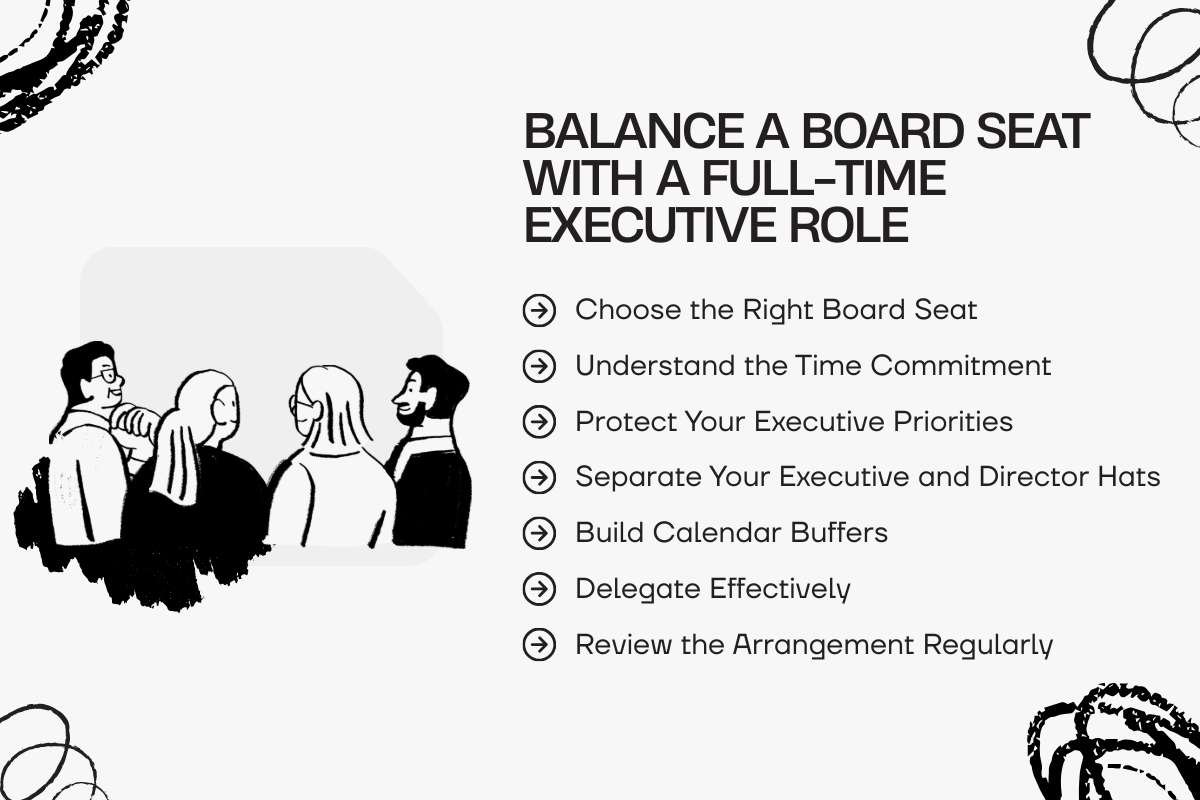
1. Choose the right board seat
Not every board role will fit your career or schedule. If you are still looking for opportunities, knowing how to find open board positions as a woman professional can help you focus your search on roles that match your expertise, availability, and career goals.
Look beyond the company’s reputation when considering a board seat with a full-time executive role. Consider its meeting calendar, committee structure, travel requirements, governance culture, and expectations between meetings.
For executives who are building governance experience, non-profit board experience can also provide exposure to board meetings, committees, oversight, and strategic decision-making. It can also help you understand how to get your first board seat as a woman and what boards typically expect from new directors.
2. Understand the time commitment
Ask direct questions before signing.
How many meetings are held each year? How long do they last? How frequently do committees meet? Are directors expected to attend events or visit company locations? How much preparation is expected?
Do not assume that the published meeting schedule represents the entire commitment when balancing a board seat with a full-time executive role.
3. Protect your executive priorities
Your full-time executive role remains your primary operating responsibility. Knowing how to balance a board seat with a full-time executive role means protecting enough time and attention for your core executive responsibilities.
Block board meetings and preparation time well in advance, while protecting periods for your executive team’s strategic work and unexpected business demands.
Avoid scheduling board obligations so tightly that every change in your executive calendar creates a conflict.
4. Separate your executive and director hats
One of the most important skills is knowing which role you are performing. Understanding what board directors actually do can make this distinction clearer, particularly for executives who are accustomed to making operational decisions.
As a CEO or senior executive, you may make operational decisions. As a director, your role is to oversee management, contribute to strategy, and exercise independent judgment.
A board member generally should not step into management’s daily responsibilities simply because they have executive experience.
5. Build calendar buffers
Reserve time for:
- Reading board papers
- Preparing questions
- Committee work
- Follow-up discussions
- Travel
- Unexpected board matters
This kind of planning is central to balancing a board seat with a full-time executive role, particularly when both positions involve unpredictable demands. Leaving some space between commitments can make balancing a board seat with a full-time executive role easier to manage.
6. Delegate effectively
Balancing leadership roles often requires more deliberate delegation.
As an executive, identify responsibilities that can be owned by capable members of your leadership team. This creates room to focus on decisions that genuinely require your involvement.
Similarly, understand your board committee responsibilities and avoid taking on additional work simply because you are willing to help.
7. Review the arrangement regularly
The right balance can change as your executive role evolves.
A new CEO appointment, acquisition, international expansion, or major transformation can increase your workload. At the same time, a board may enter a period of higher activity.
Review your commitments periodically and assess whether both roles remain sustainable.
What should board members not do?
Understanding what not to do is just as important as understanding board responsibilities.
A director should generally avoid:
- Managing employees directly
- Giving operational instructions to management
- Bypassing the CEO unnecessarily
- Using confidential board information for personal benefit
- Allowing personal interests to influence decisions
- Taking on more board work than they can properly support
The board’s role is oversight, not day-to-day management.
Boards may also hold executive sessions without management present to discuss sensitive matters such as CEO performance, succession, conflicts, or board effectiveness. The exact rules depend on the organization’s governance documents and applicable requirements.
What are the risks of holding a board seat alongside a full-time role?

Board service comes with responsibilities that should not be treated casually, especially when balancing a board seat with a full-time executive role.
- Conflict of interest: Your employer and the company whose board you join could have overlapping customers, suppliers, markets, or strategic interests.
- Confidentiality: You may have access to sensitive information in both roles. Keeping information properly separated is essential.
- Time pressure: A board role can become significantly more demanding during a crisis, acquisition, or leadership transition.
- Reputation and liability: Directors have fiduciary and governance responsibilities. Poor oversight can create legal, financial, and reputational consequences depending on the circumstances.
- Overcommitment: Holding multiple board seats while managing a demanding executive position can affect your ability to prepare and participate effectively.
How board service can support a woman executive’s career?
A well-chosen board role can broaden an executive’s perspective beyond her own organization.
Understanding the skills most valued in board directors can also help an executive identify which existing strengths to highlight when evaluating board opportunities.
Board service can provide exposure to:
- Corporate governance
- Risk oversight
- CEO succession
- Capital allocation
- Audit and financial oversight
- Technology and cybersecurity risks
- Long-term strategy
- Stakeholder expectations
For women executives, this experience can add another dimension to an existing leadership career. The goal should not simply be to add another title, but to develop meaningful governance experience while continuing to perform strongly in the executive role. As your governance experience grows, knowing how to build a board profile that gets you noticed can help you present that experience more effectively for future opportunities. Knowing how to balance a board seat with a full-time executive role also means evaluating whether the opportunity fits your existing responsibilities before saying yes.
Before accepting a board seat: a quick checklist

Before saying yes, ask:
- Time: How many hours will the role realistically require?
- Employer: Does your current employer permit outside board service?
- Conflicts: Could the two organizations have competing interests?
- Responsibilities: What committees and additional duties will you have?
- Insurance: Does the company provide appropriate directors and officers liability coverage?
- Compensation: What is the director fee, including any committee or chair responsibilities?
- Culture: Does the board encourage constructive challenge and independent judgment?
- Exit: Under what circumstances can you or the company end the appointment?
If you are unsure whether you are ready for the responsibilities involved, board readiness programs for women can provide structured preparation in areas such as governance, fiduciary duties, and boardroom expectations.
Conclusion:
Learning how to balance a board seat with a full-time executive role is ultimately about boundaries, preparation, and choosing the right opportunity.
For women executives, a board seat can add valuable governance experience without requiring them to step away from their executive careers. As the conversation around women on corporate boards continues to grow, these opportunities can become an important part of a broader leadership journey. But the role needs to fit realistically alongside existing responsibilities.
The strongest arrangement is one where an executive can give her full attention to her company while bringing thoughtful, independent, and well-prepared oversight to the boardroom.
FAQs
1. Can a CEO also serve on another company’s board?
Yes, a CEO can serve on another company’s board, provided the role does not violate employment terms, corporate policies, legal requirements, or create an unmanaged conflict of interest.
2. Is being on a board a full-time job?
Usually not. However, board service requires meeting preparation, committee work, and ongoing oversight. The time commitment can increase significantly during periods of major corporate activity.
3. Can a board member tell the CEO what to do?
Individual directors generally do not manage the company directly. The board collectively oversees management, while the CEO is responsible for day-to-day operations.
4. What are the biggest challenges of holding a board seat while working full-time?
The main challenges include time management, competing priorities, conflicts of interest, confidentiality, and maintaining clear boundaries between executive and director responsibilities.
5. Should you take a board seat while holding a demanding executive position?
The decision depends on the specific board’s workload, your executive responsibilities, employer policies, potential conflicts, and your ability to give both roles adequate attention.