

Understanding independent vs executive directors is essential because a board seat brings influence, responsibility, and accountability, but directors do not all have the same role.
Executive directors are involved in running the business, while independent directors focus on oversight and objective decision-making. Both play important roles, but their responsibilities, relationship with management, and influence can vary.
With women holding 28.3% of global board seats in 2025, understanding these roles can help women assess where their skills and experience fit within the boardroom.
Independent board director vs. executive directors at a glance
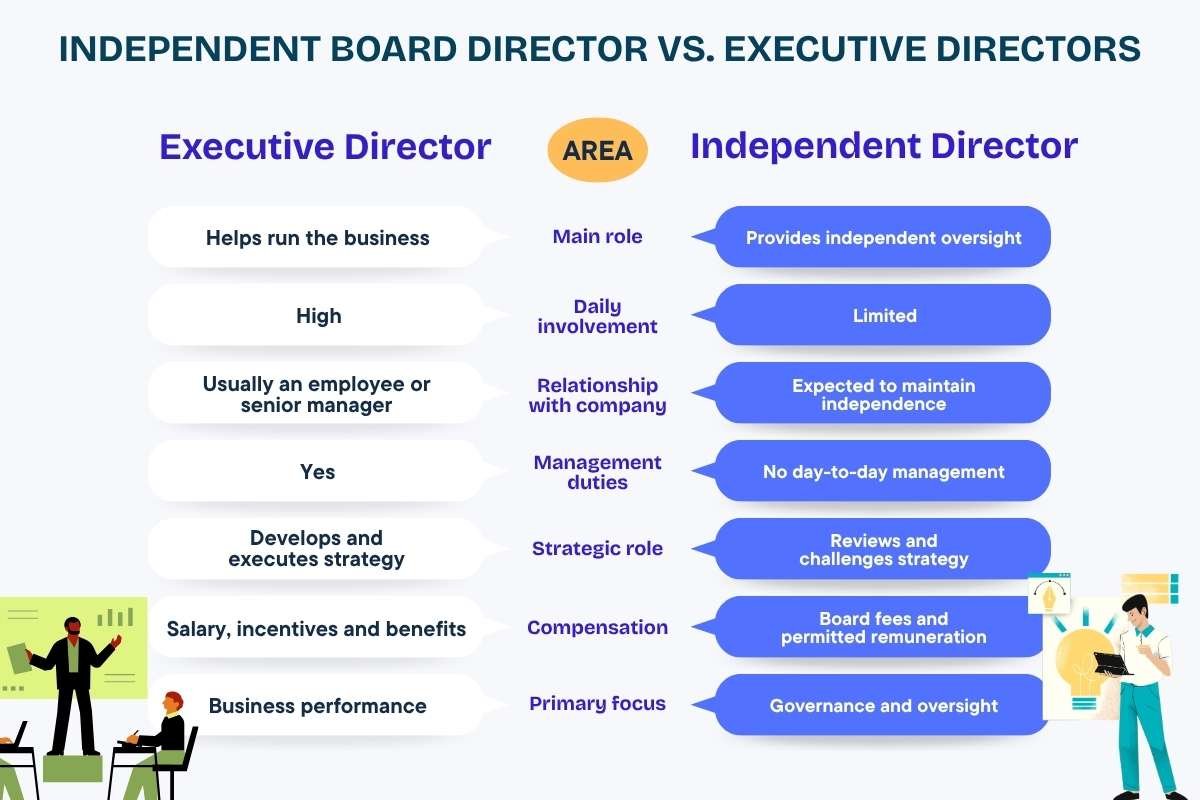
| Area | Executive Director | Independent Director |
| Main role | Helps run the business | Provides independent oversight |
| Daily involvement | High | Limited |
| Relationship with company | Usually an employee or senior manager | Expected to maintain independence |
| Management duties | Yes | No day-to-day management |
| Strategic role | Develops and executes strategy | Reviews and challenges strategy |
| Compensation | Salary, incentives and benefits | Board fees and permitted remuneration |
| Primary focus | Business performance | Governance and oversight |
The central difference between independent board directors and executive directors is simple:
Executive directors help manage the company, while independent directors oversee management and provide objective judgment.
What is an executive director? Key differences in independent vs. executive directors
An executive director is a board member who also holds a senior management role, such as CEO, managing director, or full-time director. Their responsibilities may include:
- Business strategy and execution
- Financial performance
- Operations and employee management
- Resource allocation and risk management
- Business growth and reporting to the board
For women in senior leadership, becoming an executive director can be a natural progression. However, the role combines day-to-day management with board-level governance responsibilities.
What is an independent director? Understanding independent vs. executive directors
Understanding Independent vs. Executive Directors helps explain how board members contribute to strategic decision-making.Unlike executive directors, they do not manage daily operations. Instead, they oversee management, evaluate key decisions, and bring independent expertise in areas such as:
- Finance and law
- Technology and risk
- Sustainability
- Human resources
- Operations and industry strategy
The skills most valued in board directors can vary by company and industry, but boards generally need expertise that supports strategy, oversight, risk management, and long-term decision-making.
For women considering this pathway, how to get your first board seat as a woman also involves building relevant expertise, understanding governance expectations, and demonstrating the value they can bring to a board.
Understanding Independent vs. Executive Directors is therefore important for women who are deciding whether their experience is better suited to an executive leadership path or an independent board role.
Independent vs. executive directors: key differences
1. Daily involvement
Executive directors are closely involved in everyday business activities. They may manage teams, approve operational plans, and oversee performance.
Independent directors generally do not participate in daily management. They review management decisions and assess whether they serve the company’s interests.
This difference is one of the clearest ways to understand Independent vs. Executive Directors. One role is closely connected to execution, while the other is primarily focused on oversight.
2. Relationship with management
Executive directors are normally part of the management structure.
Independent directors are expected to maintain sufficient distance from management so they can question decisions objectively.
Independence does not mean being disconnected from the business. Effective independent directors need a strong understanding of the company, its industry, and its risks.
3. Decision-making
Both types of directors participate in board decisions.
An executive director brings the perspective of someone responsible for executing a strategy. An independent director examines that strategy from an oversight perspective and can challenge its assumptions and risks.
Both perspectives strengthen board discussions.
4. Compensation
Executive directors generally receive employment-related compensation, which may include salary, bonuses, incentives and benefits.
Independent directors generally receive board fees, meeting fees or other permitted remuneration.
The amount varies by company, market and responsibility. For women considering a board position, compensation should also be considered alongside time commitment, legal responsibility and reputational exposure.
5. Accountability
Both roles carry legal and fiduciary responsibilities.
Executive directors may be accountable for decisions involving business operations and strategy execution.
Independent directors are responsible for fulfilling their oversight duties, reviewing information, identifying risks, and exercising appropriate judgment.
A non-executive role does not mean limited responsibility. This is an important consideration when evaluating Independent vs. Executive Directors as potential career paths.
What do independent directors actually do?

Independent directors focus on oversight rather than day-to-day management. Understanding what board directors actually do helps women considering board careers see where their expertise can add value.
Their responsibilities may include:
- Reviewing strategy and financial reporting
- Assessing major risks
- Overseeing senior management
- Reviewing executive compensation
- Serving on audit, risk, nomination, or remuneration committees
Committee roles can also give directors opportunities to apply their expertise. For example, a finance leader may contribute to an audit committee, while a technology leader may oversee cybersecurity and digital risks.
The goal is not simply to hold a board seat, but to contribute meaningfully to board-level decisions.
What do executive directors actually do?
Executive directors are closely involved in leading and managing the business. Their responsibilities can include:
- Developing business plans and executing strategy
- Managing revenue, profitability, and resources
- Leading employees and overseeing operations
- Managing business risks
- Reporting performance to the board
For women in senior management, an executive director role can build experience in both business leadership and corporate governance. This experience can also provide a foundation for moving into independent board roles later in their careers.
Why independent directors matter for women on boards?
Women on corporate boards are often discussed in terms of representation, but the type of board role also matters. Independent directorship can provide women with a pathway into corporate governance without requiring them to become CEOs or managing directors.
MSCI reported that women held 28.3% of global board seats in 2025, while 48.7% of companies had reached at least 30% female board representation.
For women considering board opportunities, understanding the roles and responsibilities as women on corporate boards can help them assess how their expertise in areas such as finance, technology, law, sustainability, or risk can contribute to board oversight and decision-making.
In India, the requirement for an independent woman director among the top 1,000 listed entities also makes governance expertise and board readiness particularly relevant for women professionals.
How many independent directors should a board have?
There is no single number that applies to every company. Requirements vary according to the country, company type, listing status, and board structure. These differences are also reflected in board diversity mandates around the world in 2026, with jurisdictions using different quotas, targets, and disclosure requirements for women on boards.
The purpose is to ensure that boards have enough independent voices for effective oversight.
Women pursuing board appointments should therefore understand both professional eligibility and the board-composition rules applicable to the company.
Who cannot be an independent director?

A person may not qualify as independent if their relationship with the company or its management compromises objective judgment.
Depending on the jurisdiction, restrictions may relate to:
- Current or recent employment
- Material financial relationships
- Significant business dealings
- Close relationships with senior management
- Connections with promoters or major shareholders
In India, the Companies Act sets specific independence criteria covering areas such as financial relationships, promoters, key managerial personnel, and relatives.
For women considering positions in family-owned companies, understanding how ownership and family relationships affect independence is particularly important.
These eligibility requirements are an essential part of the Independent vs. Executive Directors comparison because an executive’s existing relationship with a company may affect whether that person can later qualify as an independent director.
What are the rules for independent directors?
Independent directors must follow the laws and governance requirements applicable to their company.
Common requirements include:
- Meeting independence criteria
- Disclosing conflicts of interest
- Acting in the company’s best interests
- Protecting confidential information
- Participating in board and committee meetings
In India, independent directors may generally serve a term of up to five years and may be reappointed for another term of up to five years through the required shareholder approval, subject to applicable law.
SEBI’s framework also provides for independent directors to meet separately from other directors and management at least once a year.
For women entering their first board role, understanding these obligations is essential. The position may not involve daily management, but it carries substantial responsibility.
What are the disadvantages of independent directors?
Independent directorship can offer valuable opportunities, but the role also comes with challenges:
- Limited operational involvement: Independent directors do not manage daily operations and depend on management for information.
- Information gaps: They may not have the same real-time understanding of the business as executives.
- Legal and reputational exposure: Independent directors can face consequences if they fail to fulfill their oversight responsibilities.
- Time commitment: Board work can involve preparation, committee meetings, strategy discussions, and crisis management.
- Difficult conversations: Independent directors may need to challenge CEOs, founders, or senior executives when necessary.
For women entering boardrooms, strong preparation, relevant expertise, and a clear understanding of governance responsibilities can help them contribute effectively.
What does this difference mean for women building a board career?

Understanding Independent vs. Executive Directors can help women identify the right career path.
An executive director role may suit a woman who wants to remain closely involved in operations, strategy, and business leadership.
An independent director role may suit a woman whose value comes from specialized expertise, governance knowledge, and strategic judgment.
The pathways can also overlap. A woman may build executive experience before moving into independent directorship. Experience as a CEO, CFO, technology leader, lawyer, or senior business professional can provide a strong foundation for board work. For women looking to move into board governance, building a board profile that gets them noticed means clearly connecting their leadership experience and specialist expertise to what boards need.
For women who are still building corporate board experience, non-profit board experience can provide exposure to governance, committee work, oversight, and fiduciary responsibilities.
Board readiness programs for women can also help professionals strengthen their understanding of governance and prepare for the expectations that come with board service.
The objective is to find a board role where their experience can contribute meaningfully.
Conclusion:
The difference between independent board directors and executive directors largely comes down to management involvement and oversight. Executive directors help run the company, while independent directors provide oversight and maintain appropriate independence. Both roles carry legal and fiduciary responsibilities, with independent directors often contributing through committees covering areas such as audit, risk, and executive succession.
Women can pursue independent directorship through expertise in finance, technology, law, sustainability, risk, and other fields. Understanding board composition and independence requirements is essential before accepting a board role. For women planning a board career, knowing these differences can help them assess opportunities and build relevant leadership and governance experience.
FAQs:
1. What is the main difference between an independent and executive director?
An executive director is involved in managing the company, while an independent director provides board-level oversight without participating in daily management.
2. Can an executive director become an independent director?
Yes, potentially. Applicable laws may require a cooling-off period or other conditions before someone qualifies as independent.
3. Who cannot be an independent director?
People with certain employment, financial, business, or family relationships with a company may not qualify, depending on applicable independence rules.
4. Do independent directors get paid?
Yes. Independent directors generally receive board fees and other permitted remuneration. Compensation varies by company and jurisdiction.
5. Can women become independent directors without being CEOs?
Yes. Women with experience in areas such as finance, law, technology, risk, operations, and sustainability can pursue independent board positions, subject to applicable requirements.