
The best ESG careers for women in 2026 include sustainability manager, ESG analyst, carbon accountant, climate risk consultant, CSR manager, and sustainable finance specialist. These roles offer strong career growth, competitive salaries, and increasing demand across industries. This guide explains the top opportunities, essential skills, certifications, salary trends, and practical steps to build a successful career in ESG and sustainability.
What if the next generation of business leaders is measured not only by profits created, but by the positive impact they leave behind?
As companies accelerate climate commitments, adopt responsible business practices, and face growing investor pressure, ESG has moved from a compliance function to a core business priority. This shift is creating unprecedented opportunities, making ESG careers for women one of the fastest-growing and most impactful career paths in today’s business landscape. The global push toward a greener economy could create millions of new jobs, with growing demand for professionals skilled in sustainability, climate risk, responsible investing, and ethical governance.
For women, this shift creates a powerful career opportunity. ESG roles increasingly value skills such as collaboration, communication, stakeholder management, and purpose-driven leadership capabilities that are essential for solving complex business and sustainability challenges.
From finance and consulting to technology, healthcare, and manufacturing, ESG is opening doors for professionals from diverse backgrounds. This guide explores the top ESG careers for women in 2026, including roles, skills, certifications, salary trends, and practical steps to build a future-ready sustainability career.
What Are ESG Careers and Why Are They Growing So Fast?
ESG careers are professional roles focused on helping organizations improve their Environmental, Social, and Governance (ESG) performance. These professionals work at the intersection of business, sustainability, compliance, and strategy to ensure companies create long-term value while managing environmental risks, social responsibilities, and corporate governance.
Unlike traditional business roles that primarily measure financial performance, ESG careers focus on how businesses operate responsibly, meet evolving regulations, and respond to growing investor and consumer expectations.
| ESG Pillar | What It Covers | Examples |
| Environmental | A company’s impact on nature and climate | Carbon emissions, renewable energy, waste management |
| Social | How a company treats people and communities | Employee wellbeing, diversity, human rights |
| Governance | How responsibly a company is managed | Ethics, compliance, transparency |
ESG professionals help businesses achieve measurable sustainability goals. Depending on the role, they may reduce carbon emissions, develop ESG strategies, prepare sustainability reports, ensure compliance with evolving regulations, improve workplace policies, manage climate risks, or help investors assess the long-term value of sustainable businesses.
As governments tighten regulations and investors increasingly prioritize responsible companies, ESG careers have evolved from niche sustainability roles into some of the fastest-growing opportunities across finance, consulting, technology, manufacturing, healthcare, and consumer industries.
How Has ESG Evolved From Compliance to Business Strategy?
As ESG becomes embedded in long-term decision-making, businesses are increasingly investing in a comprehensive sustainability strategy for their company, making ESG professionals valuable contributors beyond compliance and reporting.
A few years ago, sustainability was often treated as a reporting exercise. Companies focused on publishing annual sustainability reports and meeting regulatory requirements. Today, ESG careers for women have moved much closer to business decision-making.
Organizations are using ESG strategies to:
- Identify future risks
- Improve operational efficiency
- Attract investors
- Strengthen brand trust
- Build resilient supply chains
For example, companies are increasingly investing in corporate sustainability reporting because investors and regulators want reliable information about environmental and social performance. This change has transformed ESG from a niche function into a strategic business area.
Top ESG Careers for Women in 2026
ESG offers career paths for beginners, experienced professionals, and people switching careers. Most In-Demand ESG Roles
| Role | What You Do | Industries |
| ESG Analyst | Analyze sustainability data and ESG performance | Finance, Consulting |
| Sustainability Consultant | Help companies develop ESG strategies | Consulting |
| ESG Reporting Specialist | Prepare sustainability disclosures | Corporate |
| Corporate Sustainability Manager | Lead sustainability programs | All sectors |
| Climate Risk Analyst | Assess climate-related financial risks | Banking |
| CSR Manager | Manage social impact initiatives | Corporate |
| ESG Investment Analyst | Evaluate sustainable investments | Finance |
| Supply Chain Sustainability Manager | Improve supplier sustainability | Manufacturing |
| Carbon Accounting Specialist | Measure and report emissions | Energy |
| ESG Compliance Officer | Manage ESG regulations | Corporate |
Professionals looking for broader sustainability opportunities can also explore Green Jobs and Sustainability Roles, which include careers in renewable energy, environmental consulting, policy, and sustainable development.
Why ESG Careers Are Growing Faster Than Ever
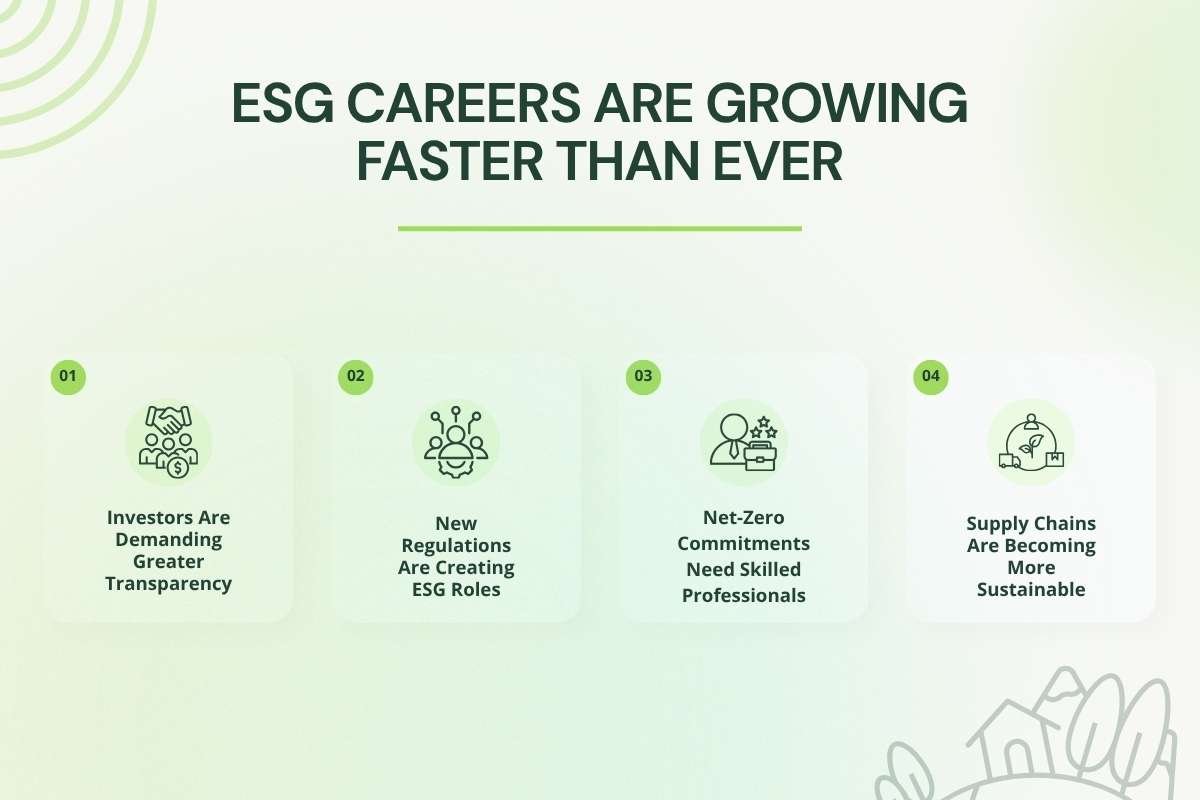
The growth of ESG careers for women is being driven by a combination of business needs, investor expectations, and regulatory changes.
1. Investors Are Demanding Greater Transparency
Sustainability is becoming an important factor in investment decisions. Asset managers, banks, and institutional investors increasingly evaluate companies based on:
- Climate risks
- Governance standards
- Environmental impact
According to the Global Sustainable Investment Alliance, sustainable investment assets reached $30.3 trillion globally in 2022, showing the growing importance of responsible investing. This has increased demand for professionals who understand ESG analysis, sustainable finance, and impact measurement.
2. New Regulations Are Creating ESG Roles
Governments and regulators are introducing stronger sustainability disclosure requirements. Companies now need professionals who can manage:
- ESG reporting frameworks
- Sustainability disclosures
- Climate-related information
Frameworks that have created demand for specialists who can collect, analyze, and communicate sustainability data :
- Global Reporting Initiative (GRI)
- International Sustainability Standards Board (ISSB)
- Corporate Sustainability Reporting Directive (CSRD)
- Task Force on Climate-related Financial Disclosures (TCFD)
3. Net-Zero Commitments Need Skilled Professionals
Thousands of companies have announced climate targets. However, setting a goal is easier than achieving it. Organizations need experts who can help with:
- Carbon accounting
- Emissions reduction plans
- Renewable energy strategies
- Climate risk assessments
This is creating opportunities for professionals with technical, analytical, and strategic skills.
4. Supply Chains Are Becoming More Sustainable
Companies are under increasing pressure to understand where their products come from and how they are made.
Consumers and regulators want businesses to address:
- Labor practices
- Environmental impact
- Supplier responsibility
- Resource efficiency
This has increased demand for sustainability professionals in manufacturing, retail, and supply chain management.
Industries Creating ESG Career Opportunities
One of the biggest advantages of ESG careers for women is that they are not limited to one industry. Almost every major sector now needs sustainability professionals, creating opportunities across finance, consulting, healthcare, manufacturing, and technology.
| Industry | ESG Career Opportunities |
| Banking & Finance | ESG investing, climate risk, sustainable finance |
| Consulting | ESG strategy, sustainability advisory |
| Manufacturing | Sustainable production, responsible sourcing |
| Energy | Renewable energy, carbon management |
| FMCG | Sustainable packaging, ethical supply chains |
| Technology | ESG data management, green technology |
| Healthcare | Sustainable healthcare operations |
| Startups | Impact strategy, responsible growth |
This demand reflects the broader transformation of sustainable business in 2026, where organizations are integrating environmental and social goals into every stage of business operations.
The rise of Sustainable Business in 2026 reflects how companies are integrating sustainability into everyday business decisions rather than treating it as a separate initiative.
Why ESG Creates Strong Opportunities for Women?
ESG careers for women are redefining business leadership by creating opportunities where purpose, strategic thinking, and long-term value creation are just as important as financial performance. The field requires professionals who can think beyond short-term results and understand how decisions affect employees, communities, investors, and the environment. These qualities create strong opportunities for women leaders.
Women and Sustainability Leadership: Why the Connection Matters
Research increasingly suggests that greater participation of women in leadership can strengthen sustainability outcomes.
A study published in the Business Strategy and the Environment journal, analyzing thousands of companies, found that higher female representation in leadership positions was associated with stronger ESG performance.
Why? Because ESG requires leadership qualities such as:
1. Collaborative Decision-Making
Sustainability challenges rarely belong to one department. An ESG leader may need to coordinate between:
- Finance teams managing investments
- Operations teams improving efficiency
- HR teams addressing employee wellbeing
- Legal teams managing compliance
The ability to bring different groups together is essential.
2. Strong Stakeholder Management
Companies today interact with more stakeholders than ever before. ESG professionals must communicate with:
- Investors
- Employees
- Customers
- Communities
- Regulators
Strong communication and relationship-building skills are critical.
3. Focus on Ethics and Governance
Governance is one of the three foundations of ESG. Organizations need leaders who prioritize:
- Transparency
- Accountability
- Responsible decision-making
Women’s growing representation in boardrooms and leadership roles is contributing to stronger conversations around responsible business practices.
4. Purpose-Driven Career Opportunities
Many professionals today want careers where their work creates visible impact. ESG provides that opportunity.
A sustainability professional can contribute to:
- Reducing emissions
- Improving workplace equality
- Building ethical supply chains
- Supporting responsible investments
Women entrepreneurs and business leaders are also adopting unique sustainability approaches, as discussed in how women-led businesses approach sustainability differently. Their work shows that sustainability is not just an environmental issue; it is a business leadership opportunity.
Green Finance Careers for Women
Professionals interested in specialized green finance careers for women can explore opportunities in ESG investing, sustainable finance, impact investing, and climate finance. Green finance is emerging as one of the fastest-growing areas within ESG and has become one of the most promising ESG careers for women who want to combine financial expertise with sustainability goals. As businesses and investors increasingly focus on climate risks, responsible investing, and sustainable growth, professionals are needed to direct capital toward projects that create both financial returns and positive environmental impact.
Women with backgrounds in finance, economics, business, and investment can build careers across areas such as ESG investing, sustainable finance, impact investing, green bonds, and climate finance. These roles require a mix of financial analysis, risk assessment, sustainability knowledge, and an understanding of how businesses can transition toward a low-carbon future.
Skills Needed to Build a Successful ESG Career
To succeed in ESG careers for women, professionals need more than sustainability knowledge. The field demands analytical thinking, business acumen, communication skills, and the ability to influence strategic decisions. The role requires a combination of analytical ability, business understanding, communication skills, and the ability to influence decisions. The best ESG professionals are those who can understand complex sustainability challenges and translate them into practical business solutions.
Technical Skills That Matter in ESG

1. ESG Reporting Frameworks
Companies need professionals who understand how sustainability performance is measured and communicated.
Key frameworks include:
- Global Reporting Initiative (GRI)
- International Sustainability Standards Board (ISSB)
- Sustainability Accounting Standards Board (SASB)
- Corporate Sustainability Reporting Directive (CSRD)
- Task Force on Climate-related Financial Disclosures (TCFD)
Professionals who understand these frameworks are increasingly valuable because businesses need accurate and transparent sustainability reporting.
2. Carbon Accounting
As companies work toward net-zero goals, measuring greenhouse gas emissions has become a critical skill. Carbon accounting professionals help organizations:
- Measure carbon footprints
- Track emissions
- Identify reduction opportunities
- Prepare climate disclosures
Many organizations are also adopting circular economy business models to reduce resource consumption, minimize waste, and lower carbon emissions, creating additional career opportunities for ESG professionals.
Industries such as energy, manufacturing, logistics, and technology are actively hiring professionals with these capabilities.
3. Sustainability Data Analysis
Modern ESG decisions depend heavily on reliable data. Professionals need to analyze:
- Emission data
- Energy consumption
- Diversity metrics
- Supply chain performance
- Sustainability indicators
Skills in tools that can improve employability such as:
- Excel
- Power BI
- ESG software platforms
- Data visualization tools
4. Climate Risk Analysis
Climate change is becoming a business risk. Companies need professionals who can assess:
- Physical climate risks
- Regulatory risks
- Transition risks
- Financial impacts of climate change
This skill is particularly valuable in banking, insurance, consulting, and investment sectors.
Beyond collecting sustainability data, professionals are increasingly expected to track meaningful sustainability KPIs that measure environmental performance, social impact, governance outcomes, and progress toward corporate sustainability goals.
Soft Skills That Help Women Succeed in ESG
While technical knowledge opens doors, leadership skills help professionals grow.
1. Communication
ESG professionals often explain sustainability issues to people who may not have technical backgrounds. Strong communication helps in:
- Presenting ESG strategies
- Preparing reports
- Engaging stakeholders
2. Stakeholder Management
ESG involves working with multiple groups with different priorities. For example:
- Finance teams focus on returns
- Operations teams focus on efficiency
- Sustainability teams focus on impact
An effective ESG professional helps these groups work toward shared goals.
3. Critical Thinking
Sustainability challenges rarely have simple solutions. Professionals must evaluate:
- Business impact
- Environmental consequences
- Social outcomes
- Regulatory requirements
Project Management
ESG initiatives often involve multiple teams, deadlines, and measurable targets. Project management skills help professionals successfully implement sustainability programs.
Best Degrees and Educational Backgrounds for ESG Careers
One of the biggest advantages of ESG careers for women is that they welcome professionals from diverse academic backgrounds, making career transitions easier than in many traditional industries. Relevant degrees include:
- Business Administration
- Commerce
- Finance
- Environmental Science
- Engineering
- Economics
- Public Policy
- Law
- Social Sciences
- MBA
While formal education builds foundational knowledge, many employers also value professional credentials. Understanding the difference between ESG certification vs ESG reporting can help professionals choose learning paths that best align with their career goals.
However, a sustainability degree is not mandatory. A finance graduate can enter ESG investing. A lawyer can move into ESG compliance. An HR professional can work in social sustainability. An operations manager can transition into sustainable supply chain roles. The key is combining existing expertise with ESG knowledge.
How Women Can Enter ESG: A Practical Career Roadmap
Building an ESG career does not require starting from scratch. A structured approach can help professionals transition smoothly.
Step 1: Understand ESG Fundamentals
Start by learning:
- ESG principles
- Sustainability concepts
- Climate change basics
- Corporate responsibility
Understand how businesses measure environmental and social impact.
Step 2: Choose an ESG Specialization
ESG is a broad field. Choosing a focus area helps build expertise. Popular pathways include:
| Environmental Sustainability | Climate action, Carbon reduction, Renewable energy, Resource efficiency |
| Social Sustainability | Diversity and inclusion, Employee wellbeing, Human rights, Community development |
| Governance | Ethics, Compliance, Risk management, Corporate accountability |
| ESG Reporting | Sustainability disclosuresESG metricsRegulatory reporting |
| Sustainable Finance | ESG investingGreen bondsClimate finance |
| ESG Consulting | Strategy developmentSustainability transformationAdvisory services |
Professionals who enjoy community engagement and social development may compare social impact careers vs corporate sustainability roles before choosing a specialization that matches their interests and long-term aspirations.
Step 3: Build Practical ESG Experience
Employers value practical knowledge.
You can build experience through:
- Sustainability projects
- ESG research reports
- Volunteer initiatives
- Climate-related case studies
- Sustainability audits
For example, a finance professional could analyze a company’s ESG performance. A marketing professional could create a sustainability communication strategy.
Step 4: Earn Relevant ESG Certifications
Certifications can help professionals demonstrate credibility, especially when transitioning into ESG from another field.
Best ESG Certifications for Women
Choosing the right sustainability certifications can strengthen your credibility and help demonstrate practical ESG expertise to employers across industries.
| Certification | Best For | Suitable For |
| GRI Professional Certification | ESG Reporting | Corporate professionals |
| CFA ESG Certificate | Sustainable Finance | Finance professionals |
| SASB Fundamentals | ESG Reporting | Analysts |
| ISSB Courses | Sustainability Disclosure | Reporting professionals |
| IEMA Sustainability Courses | Sustainability Fundamentals | Career switchers |
| CSR & Sustainability Programs | Business Professionals | Professionals entering ESG |
Which ESG Certification Should You Choose First?

The right certification depends on your career background. Professionals interested in reporting-focused careers may also find it useful to understand the differences between B Corp certification vs ESG reporting, as these serve different purposes within responsible business and sustainability.
| For Fresh Graduates | ESG fundamentals, GRI certification, Sustainability courses |
| For Finance Professionals | CFA ESG Certificate, sustainable finance programs, ESG investing courses |
| For Reporting Professionals | GRISASBISSB |
ESG Reporting: A Career Skill With Growing Demand
As sustainability reporting becomes more important, ESG reporting specialists are becoming essential members of corporate teams.
Companies need professionals who can answer questions such as:
- How much carbon does the company emit?
- What progress has been made toward sustainability goals?
- How diverse is the workforce?
- What climate risks could affect the business?
This has increased demand for professionals skilled in ESG Reporting.
Where Do ESG Reporting Professionals Work?
Career opportunities exist across:
| Corporations | Large companies hire ESG specialists to manage sustainability disclosures and internal reporting. |
| Consulting Firms | Consultants help organizations improve ESG strategies and comply with reporting standards. |
| Financial Institutions | Banks and investment firms need ESG experts to evaluate companies and manage sustainable investments. |
| Sustainability Advisory Firms | These organizations support businesses with ESG measurement and strategy. |
Professionals interested in this area can explore opportunities in corporate sustainability reporting, one of the fastest-growing sustainability career paths.
Salary Expectations in ESG Careers
ESG salaries vary depending on experience, industry, location, and specialization. As demand continues to rise globally, ESG careers for women also offer competitive salary growth across entry-level, mid-level, and leadership positions.
| Experience Level | Typical Roles | Salary Potential |
| Entry-Level | ESG Analyst, Sustainability Associate | Growing |
| Mid-Level | ESG Consultant, Reporting Specialist | Strong |
| Senior-Level | Sustainability Manager | High |
| Leadership | ESG Director, Chief Sustainability Officer | Very High |
Challenges Women May Face in ESG Careers and How to Overcome Them
Although ESG is a growing field, women may still encounter challenges while building leadership careers.
1. Limited Representation in Senior Positions
While women’s participation in sustainability roles is increasing, executive-level representation remains a challenge across many industries.
How to overcome:
- Seek mentorship opportunities
- Build leadership experience
- Take ownership of ESG projects
- Develop business skills alongside sustainability knowledge
2. Technical Skill Gaps
Some women hesitate to enter ESG because they feel they lack environmental or technical expertise.
However, many ESG skills can be learned.
How to overcome:
Start with:
- ESG courses
- Sustainability certifications
- Data analysis training
- Industry research
A strong willingness to learn can often matter as much as an existing technical background.
3. Career Transition Challenges
Professionals switching careers may worry that they are starting over.
The reality is different.
Many existing skills transfer directly into ESG.
Examples:
| Previous Career | ESG Opportunity |
| HR | Social sustainability |
| Finance | ESG investing |
| Marketing | Sustainability communication |
| Legal | ESG compliance |
| Operations | Sustainable processes |
| Analytics | ESG data management |
| Supply Chain | Responsible sourcing |
4. Networking Barriers
Many ESG opportunities come through professional networks.
How to overcome:
Engage with:
- Sustainability communities
- ESG conferences
- Professional associations
- Industry discussions
Building relationships can open doors to opportunities that are not always publicly advertised.
The Future of ESG Careers: Emerging Roles to Watch

As sustainability becomes more integrated into business strategy, ESG careers for women are expanding into new specializations such as climate data science, nature risk analysis, and circular economy consulting.
1. Nature Risk Analyst
Companies are beginning to assess their impact on biodiversity and ecosystems.
Nature risk analysts help organizations understand:
- Biodiversity risks
- Ecosystem impact
- Natural resource dependencies
2. Carbon Market Specialist
As carbon markets grow, specialists are needed to manage:
- Carbon credits
- Emission trading systems
- Climate finance opportunities
3. Circular Economy Consultant
Businesses are moving away from waste-heavy models.
Circular economy professionals help companies redesign products and processes to:
- Reduce waste
- Reuse resources
- Improve efficiency
As more organizations redesign products and supply chains around circular economy business models, demand is expected to grow for professionals who can combine sustainability strategy with operational transformation.
4. Sustainable Supply Chain Manager
Companies increasingly need experts who can build responsible supply chains.
Responsibilities include:
- Supplier assessments
- Ethical sourcing
- Sustainable procurement
5. Climate Data Scientist
As ESG becomes more data-driven, professionals who can analyze climate and sustainability data will be highly valuable.
6. ESG AI Specialist
Technology is increasingly being used for:
- ESG data collection
- Sustainability reporting
- Climate modelling
Professionals who understand both ESG and technology will have new career opportunities.
Women Leading the Future of Sustainability
Across industries, women are playing an increasingly important role in sustainability leadership.
From corporate executives to climate advocates and policymakers, women are influencing how businesses respond to environmental and social challenges.
Examples include leaders working in:
- Renewable energy
- Sustainable finance
- Climate policy
- Corporate sustainability
- Environmental advocacy.
Their work demonstrates that sustainability leadership is not limited to environmental roles; it exists across business, government, and society.
Those interested in learning from these journeys can explore women sustainability leaders changing the rules of business and the growing influence of women in climate policy and environmental advocacy
Conclusion:
ESG is becoming one of the most important career areas as companies rethink how they grow, operate, and create value.
The opportunities extend far beyond traditional sustainability jobs.
ESG careers for women span finance, consulting, technology, corporate strategy, reporting, policy, and supply chain management, offering multiple pathways to build a meaningful and future-ready career.
ESG careers for women span finance, consulting, technology, reporting, policy, and supply chain management, offering multiple pathways to build meaningful, future-ready careers. Together, these roles contribute to the broader movement of women driving sustainable business, where sustainability is becoming a defining element of modern leadership and long-term business success.
FAQs
1. Are ESG careers a good option for women in 2026?
Yes. ESG careers for women are expected to grow as businesses increase their focus on sustainability, responsible governance, climate action, and social impact. Companies across industries are hiring professionals with skills in ESG reporting, sustainable finance, climate risk, and corporate sustainability, making it a promising and future-ready career path.
2. What qualifications are needed to start a career in ESG?
There is no single qualification required to enter ESG. Professionals from backgrounds such as business, finance, environmental science, engineering, law, economics, public policy, and social sciences can transition into ESG roles. Earning certifications like GRI Professional Certification, the CFA Sustainable Investing Certificate, or IEMA sustainability courses can further strengthen your profile.
3. Which industries offer the best ESG career opportunities for women?
ESG professionals are in demand across a wide range of industries, including banking and finance, consulting, manufacturing, renewable energy, technology, healthcare, consumer goods, and supply chain management. As sustainability becomes a business priority, opportunities continue to expand across both the private and public sectors.
4. What skills are most important for success in ESG careers?
Successful ESG professionals combine technical expertise with strong business and leadership skills. Key competencies include sustainability reporting, carbon accounting, ESG data analysis, climate risk assessment, stakeholder management, communication, critical thinking, and project management.
5. Can I transition into an ESG career without prior sustainability experience?
Yes. Many professionals successfully move into ESG from fields such as finance, HR, legal, operations, marketing, and consulting. Building foundational ESG knowledge, completing relevant certifications, and gaining practical experience through sustainability projects or volunteering can help make the transition smoother
Sources: